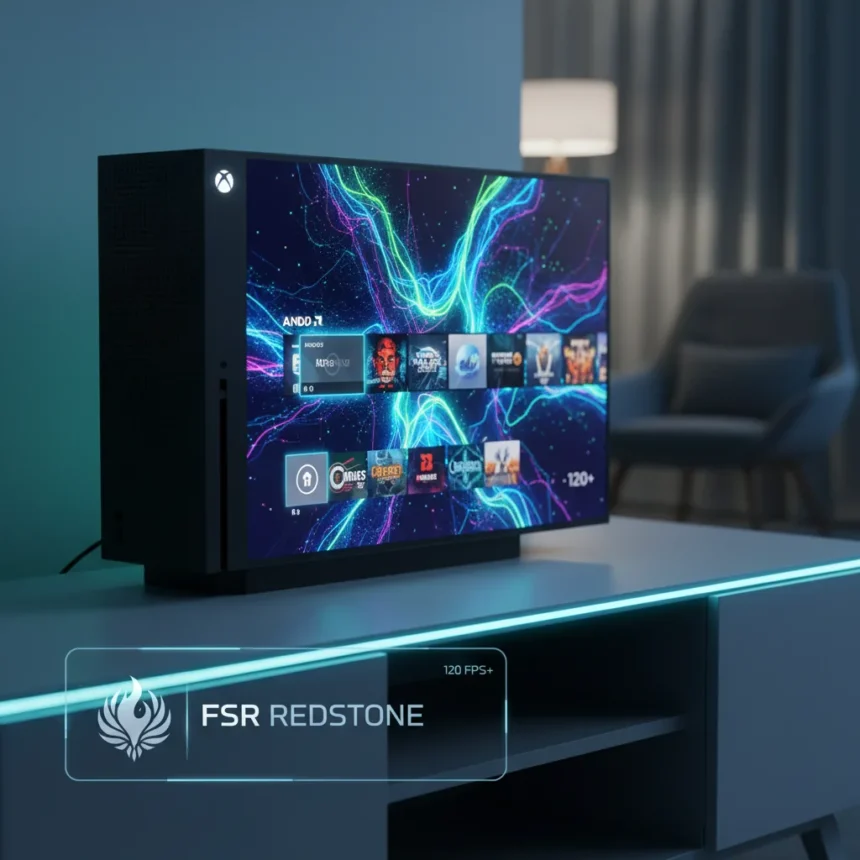
The Xbox Series X dashboard is getting a significant overhaul that extends the console’s competitive relevance well into 2026 and beyond, introducing neural rendering and AMD FSR Redstone integration to boost graphics fidelity and frame rates on existing games. Microsoft’s strategy here is clear: keep the current generation fresh while developers work on next-gen titles like Project Helix, which won’t reach alpha hardware until 2027.
Key Takeaways
- Xbox Series X dashboard overhaul uses neural rendering to predict and upscale graphics in real time
- AMD FSR Redstone partnership provides developer tools for AI-enhanced ray tracing and dynamic lighting
- Xbox mode rolls out to Windows PCs starting April 2026 in select markets
- Backward compatibility and 4K/120 FPS support remain Xbox’s advantage over PlayStation 5
- Project Helix next-gen console in development with custom AMD SoC and order-of-magnitude ray tracing leap
What Neural Rendering Means for Your Xbox Series X
Neural rendering is a hardware-supported feature that predicts and renders graphics in real time, allowing the Xbox Series X to boost resolution, frame rates, and add photorealistic details to older games without requiring developer rewrites. Think of it as intelligent upscaling that understands game scenes rather than just stretching pixels. The dashboard itself leverages this technology, but the real benefit comes when developers integrate it into their titles.
This approach differs fundamentally from how PlayStation 5 handles legacy games. While Sony’s console offers backward compatibility, it lacks the predictive rendering layer that neural technology provides. Xbox’s implementation means a 2020 game could look noticeably sharper and smoother on the Series X in 2026 than it did at launch, without the developer touching the original code.
AMD FSR Redstone: The Ray Tracing significant shift
AMD FSR Redstone represents a deeper partnership between Microsoft and AMD than standard FidelityFX Super Resolution, introducing AI RT cores for dynamic, lifelike lighting and ray tracing effects. Unlike DLSS, which is Nvidia’s proprietary technology, FSR Redstone is designed to work across AMD hardware and integrates directly into the Xbox ecosystem. Developers get tools to create richer, more immersive experiences without the performance penalty traditionally associated with ray tracing.


The integration of FSR Redstone into the dashboard signals Microsoft’s commitment to keeping the Series X competitive against PC gaming and next-gen consoles. Ray tracing has been a weak point for current-gen consoles—most games either disable it or run it at reduced frame rates. FSR Redstone aims to change that equation.
Xbox Mode on Windows: Blurring Console and PC Lines
Starting April 2026, Xbox mode will roll out to Windows 11 in select markets, bringing a controller-optimized Xbox UI to PCs. This feature bridges the gap between console and PC gaming, letting you switch from productivity work to gaming without leaving the Xbox interface. It’s a direct response to PC handheld competition like the ROG Ally, which already blurs the line between portable and desktop gaming.



The cross-platform integration connects Xbox consoles, PCs, and cloud gaming into a unified ecosystem. If you own an Xbox Series X and a gaming PC, Xbox mode creates a seamless experience where your library, achievements, and controller setup work identically on both. PlayStation 5 offers no equivalent—you’re either in console mode or PC mode, with separate launchers and interfaces.
Project Helix: The Next-Gen Shadow Looming Over Series X
While the Series X dashboard overhaul extends current-gen life, Microsoft has already revealed Project Helix, its next-generation console powered by a custom AMD SoC with FSR Next and an order-of-magnitude leap in ray tracing capability. Alpha hardware ships to developers in 2027, meaning the Series X has roughly two years of peak relevance before the conversation shifts entirely to next-gen.
This timeline matters. The dashboard overhaul isn’t a desperate attempt to save a dying console—it’s a calculated move to maximize the Series X’s value during its final years as the flagship hardware. Game Pass titles like Fable (launching Autumn 2026) and Forza Horizon 6 (May 19, 2026) will showcase what neural rendering and FSR Redstone can do on current hardware.
Does Xbox Series X Still Compete With PlayStation 5?
Yes, but the advantage narrows with each PlayStation exclusive. The Series X’s native 4K at up to 120 FPS, combined with VRR and ALLM support via HDMI 2.1, delivers cleaner motion and snappier input response than PlayStation 5 can match. Backward compatibility across thousands of older games gives Xbox a library depth advantage—you can play games from the original Xbox on Series X, while PlayStation 5 dropped support for most PS3 and older titles.


However, PlayStation 5 has momentum in exclusive titles. The neural rendering dashboard and FSR Redstone help Xbox keep current-gen competitive, but they don’t close the gap in first-party software quantity. The overhaul buys time for studios to finish next-gen projects, but it’s not a substitute for new, exclusive games.
What About Game Pass Integration?
Game Pass remains the Series X’s strongest differentiator. The dashboard overhaul works smoothly with Game Pass, ensuring day-one access to titles like Fable and other first-party releases. The neural rendering and FSR Redstone technologies will apply to Game Pass titles automatically, meaning subscribers get the visual benefits without paying extra or waiting for individual game updates.
Is the Xbox Series X Still Worth Buying in 2026?
If you’re a new buyer in 2026, the Series X is worth purchasing if you want 4K/120 FPS gaming, extensive backward compatibility, and access to Game Pass. The dashboard overhaul ensures the console will look and perform better over time, not worse. However, if you’re an existing Series X owner, the update is a quality-of-life improvement rather than a must-have system refresh. Your console plays the same games today that it will play after the rollout.
When Will Project Helix Release to Consumers?
Project Helix reaches alpha developer hardware in 2027, but consumer availability likely won’t happen until 2028 or 2029 based on typical console development cycles. Microsoft has not announced a release date or pricing for the next-generation console.
Should I Wait for Project Helix Before Buying an Xbox?
If you’re willing to wait 2-3 years for next-gen hardware, yes. If you want to game now, the Series X with its dashboard overhaul is the best option available. The neural rendering and FSR Redstone updates mean the Series X will remain visually competitive for several more years, even as Project Helix develops.
The Xbox Series X dashboard overhaul is a smart engineering move that extends the console’s lifespan without requiring new hardware. Neural rendering and FSR Redstone are real technologies with tangible benefits, not marketing fluff. For existing owners, it’s a free upgrade that improves image quality and frame rates. For potential buyers, it signals that Microsoft is committed to supporting the Series X through 2027 and beyond, making it a safer purchase than a console approaching end-of-life.
Where to Buy
Microsoft Xbox Series S | Microsoft Xbox Series X | Microsoft Xbox Series X Digital Edition | ASUS ROG Xbox Ally
Edited by the All Things Geek team.
Source: T3