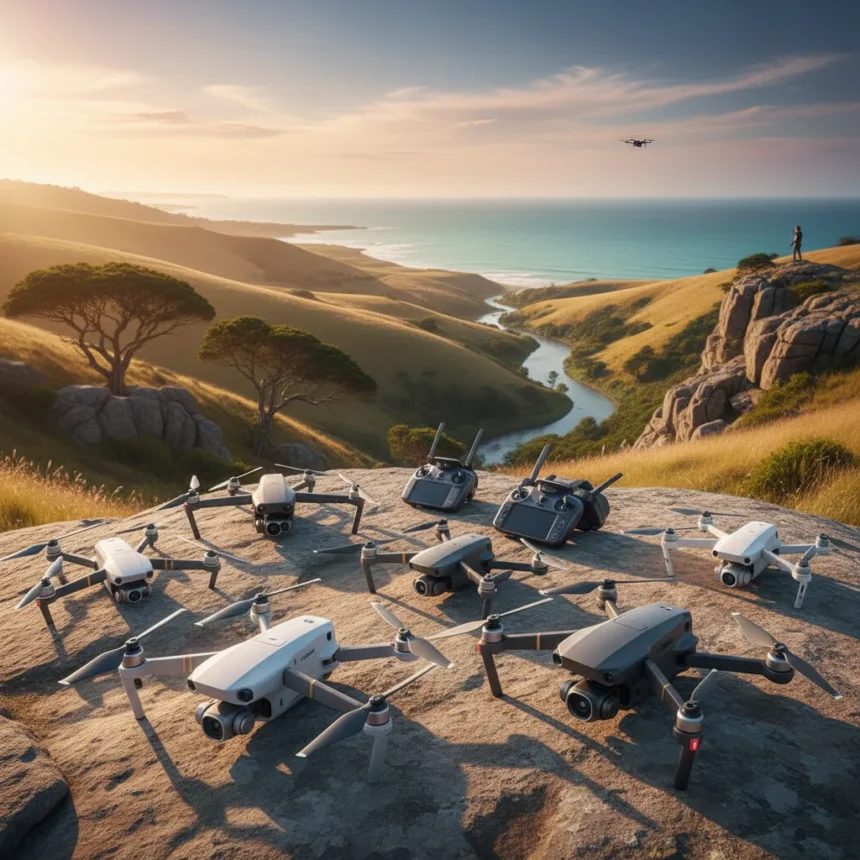
The best drones for summer offer the performance and durability needed to capture stunning sun-kissed landscapes when days are longest and light is brightest. As the days grow longer and brighter, now is the perfect time to grab a drone and take to the skies for landscape photography that makes the most of peak summer conditions.
Key Takeaways
- Summer demands drones with excellent image stabilization and sensor quality for bright-light landscape work.
- Budget options like the Skyrover S1 deliver 4K video and collision sensors under $300.
- Premium models like the DJI Air 3S offer incremental upgrades including improved transmission range and smoother footage.
- Beginner-friendly drones with auto-unfold and palm launch features lower the barrier to entry.
- Sensor size matters: larger 1/1.3-inch sensors handle varied lighting better than smaller alternatives.
The Case for Summer Drone Flying
Summer landscape photography demands different tools than other seasons. Extended daylight means you have more hours to scout locations, test compositions, and refine your shots. Bright sunlight, however, creates harsh shadows and exposure challenges that separate capable drones from mediocre ones. The best drones for summer combine reliable image stabilization, powerful sensors, and consistent flight performance in warm conditions.
Landscape photographers benefit most from drones that maintain sharp focus across varied terrain and handle reflective surfaces—water, sand, bright rock faces—without blown-out highlights or crushed shadows. This is where sensor quality and gimbal precision become critical factors in your equipment choice.
Budget-Friendly Contenders Worth Considering
Not every summer landscape project requires a premium investment. The Skyrover S1, priced at $270, delivers a 4K-capable 1/2-inch sensor with 12-megapixel photo capability and front/bottom collision sensors, making it a solid daytime performer for the price. For photographers willing to spend twice as much, the Skyrover X1 at $500 steps up to a larger 1/1.3-inch sensor, rotating head for dynamic angles, and 12MP RAW capture—advantages that shine in variable lighting conditions.


The DJI Mini 5 Pro represents another budget-conscious choice, with periodic discounts reaching $500 off during seasonal sales. As the most advanced mini-class drone available, it combines safety features with solid image and video quality in a portable package, making it ideal for photographers who value portability alongside capability.
Mid-Range All-Rounders for Most Summer Photographers
The DJI Air 3S positions itself as the best all-rounder for most people, offering meaningful upgrades over its predecessor. Its Ocusync 4 transmission system delivers better range and smoother footage than older models, while the included DJI RC2 controller features external antennas for more reliable signal in open landscapes. This combination of improved connectivity and video smoothness matters when you’re flying over water or expansive terrain where signal stability directly impacts flight safety.



Comparatively, the Potensic Atom 2 serves as a capable DJI Mini 4K alternative, featuring 48-megapixel images, 4K video at 30 frames per second, a three-axis gimbal, and a 1/2-inch CMOS sensor. For photographers seeking DJI’s ecosystem advantages without the premium price, this represents a serious contender that delivers landscape-grade image quality.
Premium Options for Demanding Landscape Work
The DJI Mavic 4 Pro stands as the premium choice for photographers who demand the absolute best in landscape capture. While specific technical details require deeper research beyond this summer guide, its positioning as a flagship model reflects years of refinement in sensor technology, gimbal engineering, and flight stability—all crucial for professional landscape work.
The broader DJI ecosystem remains relevant for 2026 and beyond, with models like the Air 3, Mavic 3 Pro, Mavic 3 Classic, Air 2S, and Mavic 2 Pro continuing to deliver reliable landscape performance. This ecosystem depth means photographers can find a model matching their specific budget and feature requirements without compromising on core landscape capabilities.
Beginner-Friendly Drones That Don’t Sacrifice Quality
Entry barriers matter. The DJI Flip earns recognition as the best overall beginner drone, featuring auto-on, auto-unfold, and palm launch capabilities that eliminate setup friction. For photographers new to aerial landscape work, these convenience features reduce cognitive load and let you focus on composition rather than technical operation.



The DJI Mini 4 Pro also targets beginners with extra sensors beyond the Flip, providing additional safety margins and obstacle detection that matter when you’re learning to fly over unfamiliar terrain. The HoverAir X1 Pro takes a different approach, optimizing for fast-paced and sports scenarios with a 104-degree field of view—wider than the typical 82-degree standard—making it useful for dynamic landscape sequences that require expansive framing.
What Makes a Drone Suitable for Summer Landscape Work?
Summer conditions present specific challenges. Extended exposure to heat affects battery performance and sensor behavior. Bright sunlight demands dynamic range handling that separates quality sensors from budget alternatives. Wind patterns shift with seasonal temperature changes, requiring stable flight characteristics. The best drones for summer combine larger sensors that handle bright light gracefully, reliable gimbal stabilization that smooths out wind-induced vibration, and flight systems engineered for warm-weather operation.
Sensor size emerges as a key differentiator. The 1/1.3-inch sensors found in premium models like the Skyrover X1 capture more light and preserve detail in shadows compared to smaller 1/2-inch alternatives, a meaningful advantage when summer light creates extreme contrast. This sensor difference translates directly to final image quality in landscape work where subtle tonal separation defines professional results.
Practical Considerations Before You Buy
Summer flying requires attention to practical details beyond raw specs. Heat management becomes critical—drones left in direct sunlight warm up quickly, affecting battery chemistry and sensor performance. Flight time decreases in hot conditions, so plan shorter missions or carry extra batteries. Bright sunlight creates reflections on camera lenses that degrade image quality, making lens quality and anti-reflective coatings worth considering.
Portability gains importance during summer when you might travel to multiple locations seeking optimal light. Compact models like the DJI Mini 5 Pro and DJI Flip fit easily into backpacks, while larger models like the Mavic 4 Pro demand dedicated carrying cases. This trade-off between capability and transportability shapes real-world usability across a summer shooting season.
FAQ
What is the best drone for summer landscape photography on a tight budget?
The Skyrover S1 at $270 delivers solid 4K video and collision sensors for daytime landscape work, making it the strongest budget option. If you can stretch to $500, the Skyrover X1 upgrades to a larger 1/1.3-inch sensor and RAW capture, offering better performance in variable lighting.
Do I need a premium drone like the Mavic 4 Pro for summer landscapes?
Not necessarily. The DJI Air 3S provides excellent all-around performance at a lower price point, with improved transmission and smooth video that handles most landscape scenarios well. The Mavic 4 Pro suits photographers who demand absolute peak image quality and are willing to pay premium prices.
How does summer heat affect drone performance?
Heat reduces battery life, affects sensor sensitivity, and can degrade flight stability. Shorter flight times and decreased image quality in extreme heat are common challenges. Plan shorter missions, carry spare batteries, and avoid leaving drones in direct sunlight between flights.
Summer landscape photography rewards careful equipment selection and thoughtful preparation. The best drones for summer balance image quality, flight reliability, and portability—matching your specific needs and budget rather than chasing the highest-priced option. Whether you choose a budget-friendly Skyrover, an all-around DJI Air 3S, or a premium Mavic 4 Pro, prioritize sensor quality and gimbal stabilization as your core investment, since these factors determine whether your summer landscape shots capture the light and detail that make aerial photography compelling.
Where to Buy
DJI Mini 5 Pro Fly More Combo which is a whopping $500 off at Amazon | Potensic Atom 2 bundle which is 21% off at Amazon | was $449 now $309 @ Amazon | was $439 now $349 @ Amazon | $259 @ Amazon
Edited by the All Things Geek team.
Source: Tom's Guide