





Coffee grinder quality is the most overlooked factor in home coffee setups, yet it determines success or failure more than any espresso machine ever will. Most home brewers obsess over their machine—dropping hundreds on shiny portafilters and pressure gauges—while their grinder quietly sabotages every shot. The result? Sour, over-extracted, or weak coffee that tastes nothing like what a barista pulls. This isn’t a minor detail. It’s the foundation of everything.
Key Takeaways
- Burr grinders produce consistent particle size; blade grinders create uneven chops that ruin extraction.
- Pre-ground coffee loses control over grind size and freshness, making consistent brewing impossible.
- Built-in grinders in super-automatic machines underperform standalone burr grinders.
- A pro-quality home setup with grinder, scale, and machine costs under $650 USD.
- Wrong grind size causes sour (too fine) or weak (too coarse) coffee across all brewing methods.
Why Coffee Grinder Quality Beats Machine Specs
Your coffee grinder is actually the most important part of your brewing journey. An ex-barista who tested this principle found that pairing a mediocre espresso machine with an excellent grinder produces better shots than pairing a premium machine with a cheap grinder. The machine controls pressure and temperature, sure. But the grinder controls particle size—and particle size controls extraction, which controls flavor. Mess up the grind, and no machine can save you.
Consider what happens with a blade grinder, the cheapest option most beginners buy. Blade grinders don’t grind; they chop randomly. Some particles end up powder-fine, others chunky. During brewing, the fine particles over-extract and turn bitter, while the chunks under-extract and taste sour. You get both defects in the same shot. A burr grinder—whether conical or flat—produces uniform particles. Every grain brews at the same rate. This consistency is non-negotiable for espresso, pour-over, drip, and French press alike.
Burr Grinders vs. Built-In Grinder Convenience
Many espresso machines, especially super-automatic models, include a built-in grinder for convenience. Don’t fall for it. Built-in grinders in machines like some Breville super-automatics perform worse than standalone burr grinders. The trade-off for automation is grind quality. If your machine grinds and tamps automatically, you lose the ability to adjust particle size for different beans, water hardness, or roast dates. You’re locked into one mediocre setting.
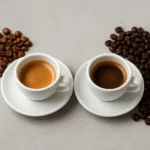

A standalone burr grinder like the Baratza Encore ESP offers affordable entry into consistent grinding. Step up to the Comandante C40 MK4, and you get precision that baristas trust for lattes, espresso, and every other method. The jump in grind consistency between a blade grinder and a quality burr grinder is night-and-day. The jump between a mediocre burr grinder and an excellent one is subtle but measurable in every cup.
Pre-Ground Coffee Destroys Control
Pre-ground coffee is unreliable. You don’t know the exact grind size, and oxidation begins the moment beans are ground. If you make coffee at home, buy whole beans and grind them fresh. This ensures you know exactly what size your coffee is being ground to. Grinding coffee correctly is the most important thing. When you control the grind, you control extraction. When extraction is precise, flavor follows.

The experiments are clear: too fine a grind produces sour, over-extracted coffee. Too coarse produces weak pressure and unbalanced flavor. Only fresh grinding with a quality burr grinder lets you dial in the sweet spot. Pre-ground coffee locks you out of that adjustment entirely.
Building a Pro Setup Without the Pro Price Tag
An ex-barista’s recommended home setup includes three things: a coffee scale, a good espresso machine, and a superior grinder. Total cost? Under $650 USD. This proves you don’t need to spend $1,000 to brew like a professional. You need the right priorities. Spend less on the machine, more on the grinder. Add a scale for precision. Skip the super-automatic convenience trap.
Espresso extraction mistakes—treating it like drip coffee, wrong grind size, poor tamping—damage machines and ruin taste, especially when grinding is poor. A quality grinder eliminates half those mistakes immediately. Particle consistency alone prevents the sour/weak extremes that plague home brewers.
What Grind Size Mistakes Actually Look Like
An ex-barista tested wrong grind sizes across three brewing methods and documented the results. Too fine on espresso? Sour, over-extracted shots that choke the machine. Too coarse? Weak pressure, thin body, unbalanced flavor. The same mistakes appear in pour-over and drip, just slower. A quality grinder with fine adjustment lets you correct these in seconds. A blade grinder can’t—the inconsistency is baked in.



Frequently Asked Questions
Is a burr grinder really necessary for home coffee?
Yes. Blade grinders produce inconsistent particles that guarantee uneven extraction. Burr grinders cost more upfront but eliminate the worst flavor defects and let you dial in shots properly.
Should I buy a super-automatic espresso machine with a built-in grinder?
Only if convenience is your priority over flavor. Built-in grinders underperform standalone burr grinders, and you lose the ability to adjust grind size. A semi-automatic machine paired with a standalone grinder gives barista control at lower cost.
Can pre-ground coffee ever work for espresso?
Not reliably. Pre-ground coffee loses freshness and you have no control over particle size. Fresh grinding is essential for consistent extraction and flavor.
The coffee industry loves selling expensive machines because they’re visible, shiny, and easy to market. Grinders are boring by comparison—metal burrs, no lights, no status symbol appeal. But boring is honest. A quality grinder will outlast three machines and brew better coffee than any premium espresso maker paired with a blade grinder. Stop chasing machine specs. Start grinding fresh. That’s where real coffee happens.
Where to Buy
BaratzaEncore ESP$199.95shop now | CASABREWSTornado$159.99shop now | 1ZpressoJ-Ultra$199shop now
Edited by the All Things Geek team.
Source: Tom's Guide




