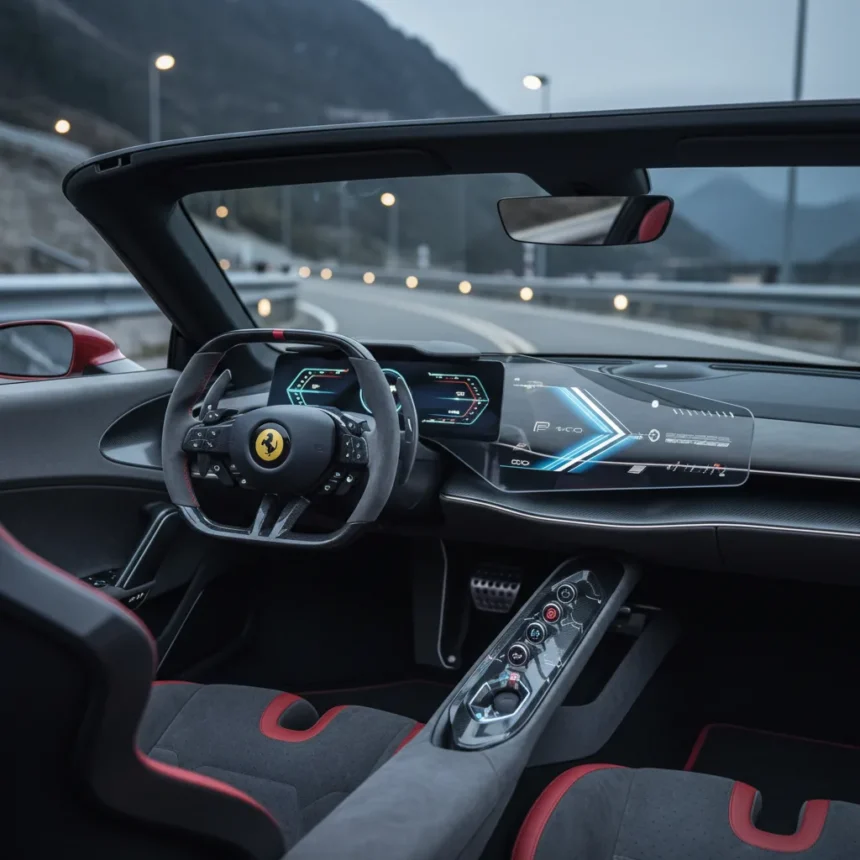
Ferrari’s EV cockpit design represents a watershed moment for electric performance cars, and Jony Ive’s involvement signals that luxury automakers are finally taking the human experience seriously in the transition away from combustion engines. The Gadget Show Podcast recently examined this shift alongside T3’s Hot 100 tech picks, highlighting how Ferrari is approaching electrification not as a compromise but as a design opportunity. For a brand built on visceral driving experiences, this pivot demands more than just swapping batteries for engines—it requires reimagining the entire interface between driver and machine.
Key Takeaways
- Jony Ive’s design influence on Ferrari’s EV cockpit marks a major shift in luxury automotive thinking
- The Testa Rossa J Pacco Gara race pack increases electric motor output from 12 kW to 14 kW and top speed beyond 50 mph
- T3 and The Gadget Show partnered for weekly tech and gaming coverage, covering Ferrari EV developments and emerging tech trends
- The episode also covered sodium-ion EV batteries and humanoid robot fight leagues alongside iPhone 17E rumours
- Ferrari’s electric models challenge the assumption that performance and zero-emission powertrains are fundamentally incompatible
Why Ferrari’s EV Cockpit Design Breaks the Mold
Most automakers treating electrification as engineering problem—how to fit batteries, how to manage thermal loads, how to maintain range. Ferrari, working with Ive, is treating it as a design problem: how should an electric performance car feel to drive? That distinction matters. The Testa Rossa J represents Ferrari’s answer, and the cockpit is where philosophy meets reality. When Ive brings his minimalist, human-centered approach to a car interior, the result challenges everything we expect from high-performance driving environments. Rather than drowning the driver in screens and haptic feedback, the design likely emphasizes clarity, tactile controls, and the relationship between input and response—precisely what electric cars often lose in translation from combustion engines.
The Pacco Gara race pack demonstrates this philosophy in action. Rather than incrementally tweaking power figures, Ferrari increased the electric motor output from 12 kW to 14 kW, pushing top speed beyond 50 mph. These are modest gains by supercar standards, but they reflect a deliberate approach: performance improvements that serve the driving experience rather than headline specifications. Ive’s design influence likely extends to how drivers interact with these performance gains—how the cockpit communicates power delivery, how controls respond, how the interior evolves as the car accelerates.
The Broader Context: EV Batteries and Robot Leagues
Ferrari’s EV cockpit design does not exist in isolation. The Gadget Show Podcast episode placed it within a broader conversation about electric vehicle technology, including sodium-ion EV batteries and the emerging phenomenon of humanoid robot fight leagues. Sodium-ion batteries represent a genuine alternative to lithium-ion, with different thermal characteristics and cost profiles—a technical shift that affects how cockpit designers must think about cooling, power distribution, and driver feedback. When you change the battery chemistry, you change the constraints on the entire vehicle architecture, including the interior environment.


The inclusion of humanoid robot fight leagues in the same episode might seem tangential, but it reflects a deeper truth: automotive design is no longer purely about cars. It is about how humans interact with intelligent machines across contexts. A cockpit designed by Ive is not just a driving interface—it is a statement about trust, control, and the role of technology in performance. That philosophy applies equally to a robot that must negotiate with a human operator and a car that must respond intuitively to a driver’s input.
Ferrari’s EV Strategy Against the Competition
Lamborghini and other performance brands are pursuing electrification with different philosophies. Where some automakers chase maximum power figures and charging speeds, Ferrari is investing in the experiential layer—the cockpit, the feedback, the relationship between driver intention and machine response. This is not a weakness; it is a competitive advantage for a brand whose customers care about how a car feels, not just what it does on a dyno.



The involvement of Jony Ive, a designer with zero automotive background, is itself a statement. Ferrari is not hiring a traditional car designer to tweak proportions and add LED strips. It is hiring someone known for reducing complexity, clarifying purpose, and designing for human behavior. That approach will feel alien to some performance car enthusiasts who expect maximum aggression and maximum visual complexity. For others—particularly younger buyers accustomed to Apple’s design language—it will feel like the first EV cockpit that actually respects their intelligence.
What This Means for the Future of Electric Performance
If Ferrari’s EV cockpit design succeeds, it establishes a template for how premium brands should approach electrification. Not as a technical problem to solve, but as a design opportunity to elevate the experience. The Testa Rossa J Pacco Gara’s modest power gains suggest Ferrari is not chasing raw numbers—it is chasing coherence, the sense that every component of the car, from motor to cockpit, works toward a unified vision. That philosophy will matter more as electric performance cars proliferate and customers become less impressed by specifications and more attuned to how cars actually feel to use.
How does the Testa Rossa J Pacco Gara compare to standard electric cars?
The Pacco Gara increases motor output from 12 kW to 14 kW and pushes top speed beyond 50 mph, making it a track-focused variant rather than a daily driver. Standard electric cars prioritize efficiency and range; the Pacco Gara prioritizes acceleration and handling, reflecting Ferrari’s performance-first ethos even in the EV era.
What is the Gadget Show Podcast covering besides Ferrari?
The podcast, hosted by Suzi and Jason and produced in partnership with T3, covers weekly tech and gaming news including iPhone 17E rumours, sodium-ion EV battery technology, and emerging trends like humanoid robot fight leagues.



Why does Jony Ive’s involvement in Ferrari’s EV cockpit matter?
Ive brings a design philosophy focused on clarity, simplicity, and human-centered interaction—principles that are rare in automotive cockpits but essential for making electric performance cars feel intuitive rather than overwhelming. His involvement signals that Ferrari is willing to challenge traditional performance car design conventions.
Ferrari’s EV cockpit design, shaped by Jony Ive’s influence, represents more than a technical upgrade—it is a philosophical statement about what electric performance should feel like. As automakers race to electrify, Ferrari is betting that the driver experience, not the battery capacity, will ultimately define whether electric performance cars succeed or fail.
Where to Buy
Sony LinkBuds Open | Lenovo Legion Go 2
Edited by the All Things Geek team.
Source: T3