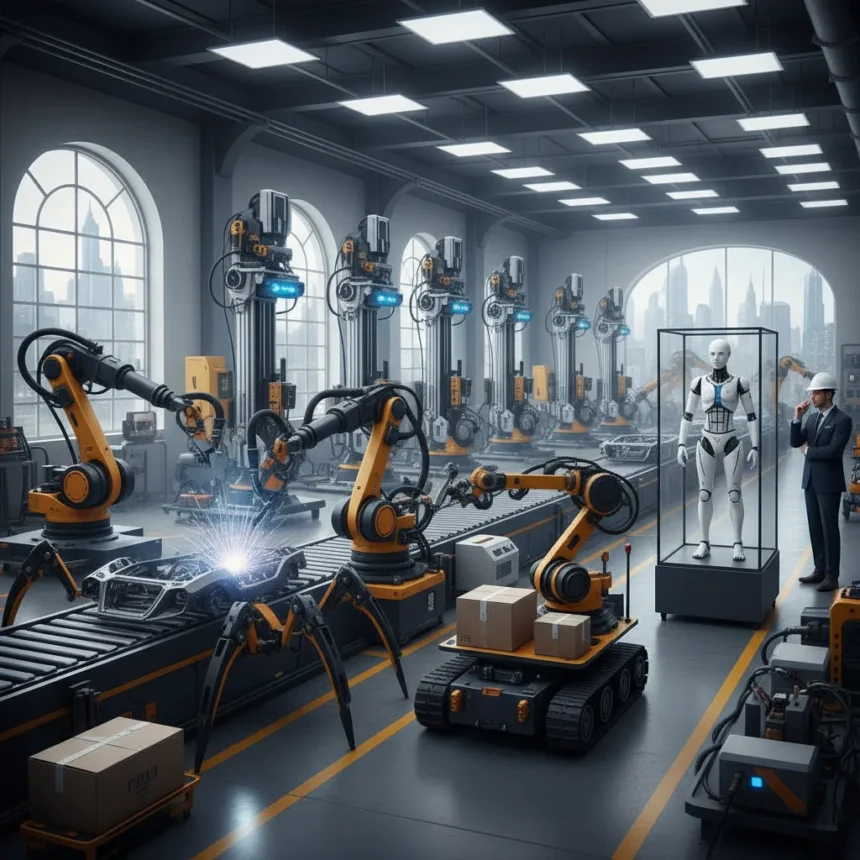
Purpose-built robots will be the real future of factory automation, not the humanoid machines that dominate tech headlines. The robotics industry is at an inflection point: investors and media are mesmerized by robots that walk on two legs and mimic human form, but the practical reality of manufacturing and logistics demands something different entirely.
Key Takeaways
- Humanoid robots attract investor attention but lack practical advantages for most factory tasks.
- Purpose-built robots are optimized for specific environments and constraints, delivering better efficiency.
- Wheels may be more cost-effective than legs for many industrial settings.
- Humanoids work best in spaces already designed for human movement, like retail and healthcare.
- The robotics future is diverse—specialized machines will outperform generalists in most real-world deployments.
Why purpose-built robots outperform humanoids in manufacturing
Purpose-built robots are engineered for single tasks or constrained environments, making them far more efficient than generalist humanoid designs. A robot optimized to move pallets, assemble components, or manage logistics doesn’t need legs, hands, or a human-shaped torso. It needs the right gripper, the right speed, and the right footprint for its specific job. Humanoids, by contrast, waste energy and materials on features that most factory floors don’t require.
The cost argument is particularly stark. A wheeled robot purpose-built for warehouse logistics can move goods faster and cheaper than a humanoid attempting the same task. Wheels scale better on flat factory floors. They’re more stable. They require less sophisticated balance algorithms. Yet humanoid advocates rarely acknowledge this straightforward engineering reality: the human form is optimized for human environments, not industrial ones.
Where humanoids actually belong
Humanoids do have a genuine niche—just not the one their evangelists claim. These robots make sense in spaces already designed around human movement: retail stores, hospitals, logistics hubs where workers navigate aisles, and warehouses where the infrastructure assumes a human-sized agent. If a facility’s layout, doors, tools, and workflows were built for people, a humanoid can theoretically slot into that existing design without expensive retooling.


But this is a narrow advantage. Most manufacturing environments are not designed for humans—they’re designed for machines. Calling humanoids the future of factory automation because they work in human-centric spaces is like saying cars will replace forklifts because they have steering wheels. The logic collapses under practical scrutiny.
The hype cycle versus engineering reality
Humanoid robots are experiencing a classic technology hype cycle. They’re visually striking. They’re easy to explain to investors and journalists. A robot that looks like a person triggers immediate science-fiction associations, which drives headlines and funding. Meanwhile, purpose-built robots—unglamorous, task-specific, and optimized for actual work—toil in factories without generating venture capital excitement or media coverage.



This disconnect matters because it distorts investment and R&D priorities. Capital flows toward humanoids partly because they’re better at capturing attention, not because they’re better at solving real problems. The robotics industry risks building the wrong machines for the wrong reasons, chasing a narrative instead of engineering solutions.
The diverse robotics future
The robotics market won’t have a single winner. Instead, expect a portfolio of specialized machines. Wheeled robots for flat surfaces. Climbing robots for vertical tasks. Articulated arms for precision assembly. Humanoids for retail and healthcare. Legged robots for uneven terrain. Each form factor solves a different problem better than generalist alternatives.
The mistake is treating humanoid adoption as a proxy for robotics adoption overall. Just because humanoids grow in deployment doesn’t mean they’re winning the broader market—it means they’re finding their specific niches while purpose-built robots dominate everywhere else. The future isn’t humanoid robots or purpose-built robots. It’s both, in their proper places.
Will humanoid robots ever dominate manufacturing?
Humanoid robots will remain a small fraction of industrial automation. Manufacturing environments optimize for machine efficiency, not human compatibility. A humanoid walking on two legs through a factory is solving a problem that doesn’t exist. Purpose-built robots, designed specifically for the constraints and demands of industrial settings, will continue to outperform humanoids in cost, speed, and reliability.



Why do humanoid robots get more media attention than purpose-built alternatives?
Humanoid robots are visually compelling and easy for audiences to understand—they look like people, so the story writes itself. Purpose-built robots are specialized, unglamorous, and require technical explanation. Journalists and investors naturally gravitate toward the more narrative-friendly option, even if it’s not the more practical one.
What’s the real future of factory automation?
The real future is a diverse ecosystem of specialized robots optimized for specific tasks. Wheels for logistics. Arms for assembly. Humanoids for human-centric environments. Purpose-built robots will dominate manufacturing because they were designed for it, while humanoids find their place in retail, healthcare, and other spaces where human-like form factors actually add value. Stop waiting for humanoids to reshape factories. The revolution is already happening—it’s just not as photogenic.
Edited by the All Things Geek team.
Source: TechRadar