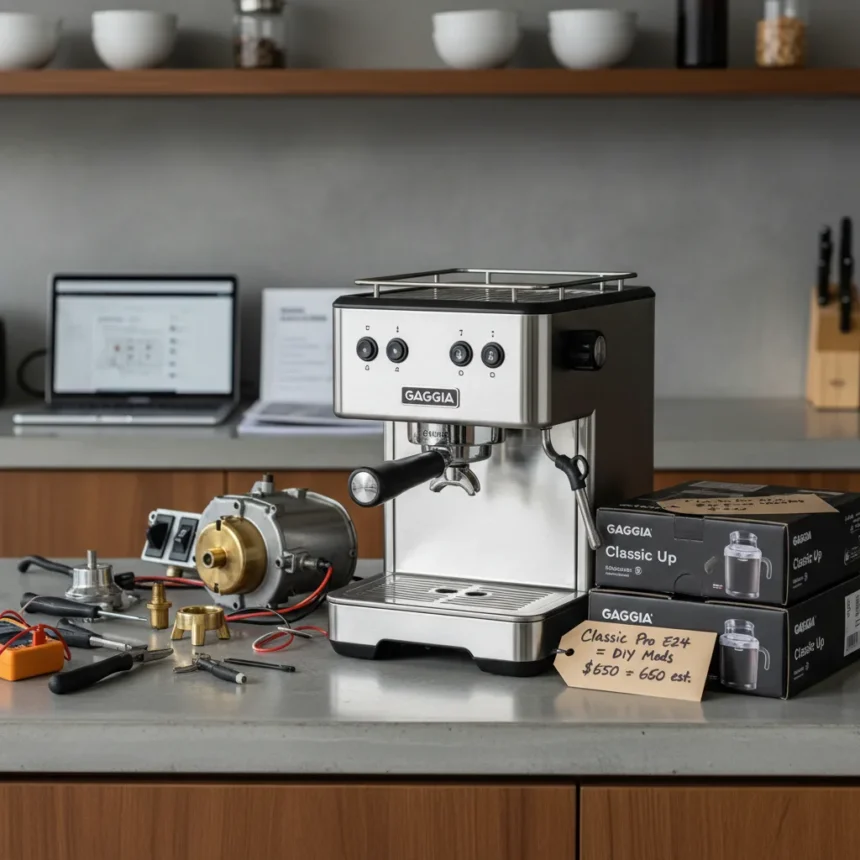
The Gaggia Classic Up represents a factory-integrated answer to a decade of aftermarket tinkering. Originally launched in 1991 as a stripped-down manual espresso machine, Gaggia’s newest iteration, announced in February 2026, bundles the modifications that home baristas have been bolting onto the Classic Pro series for years: a PID controller with dual thermoprobes, a 2-inch screen, an articulating steam wand, pre-infusion with three modes, and a lead-free brass boiler. For the first time, you get warranty-backed stability instead of voiding your warranty with third-party upgrades. The question is whether paying more for factory integration makes financial sense.
Key Takeaways
- Gaggia Classic Up integrates PID, screen, articulating wand, and brass boiler as factory features, eliminating DIY modification need.
- New model includes timed shots, pre-infusion modes, and a manometer with black dial for precise brew control.
- Dimensions are 20 cm wide, 24 cm deep, 36 cm tall; weighs 9.3 kg; made in Italy with 1250-watt power.
- Previous Gaggia Classic Pro E24 lacks screen, articulating wand, and integrated PID but costs significantly less.
- Reviewer Tom’s Coffee Corner grades the machine A for features but C for value relative to cost.
What’s New in the Gaggia Classic Up
The Gaggia Classic Up modernizes the iconic 1991 design without abandoning its manual roots. The lead-free brass boiler replaces materials used in earlier iterations, improving thermal stability and flavor consistency. The dual-thermoprobe PID controller maintains precise brewing and steam temperatures—something previous Classic Pro models required aftermarket mods to achieve reliably. An articulating steam wand with greater range of motion is a major ergonomic upgrade over the fixed wand in prior models.
The 2-inch screen with four capacitive buttons provides shot timing and pre-infusion mode selection. Pre-infusion itself offers three distinct modes, allowing users to customize how water initially contacts the coffee puck before full pressure application. Newly designed rocker switches are backlit for visibility, and the manometer with black dial gives visual feedback on group pressure during extraction. The 58mm portafilter handle is newly designed and paired with a metal-based tamper, a step up from plastic handles in budget models.
Gaggia Classic Up vs. Previous Models and Competitors
The most direct comparison is the Gaggia Classic Pro E24, released in 2024. The E24 includes a brass boiler and solid build quality but lacks the PID controller, screen, articulating wand, and manometer integrated into the new Classic Up. The E24 has been praised as a budget king for espresso, capable of excellent results with aftermarket modifications like a PID retrofit kit or a 9-bar spring kit from vendors like Shades of Coffee. For users willing to tinker, the E24 remains a cost-effective entry point, though it requires technical confidence and voids the original warranty.


Older Gaggia Classic Pro models from 2019 and 2023 featured chrome-plated brass groups and stainless steel portafilters in the Evo variant, but they too lacked factory PID integration and required aftermarket OPV adjustment kits—typically inexpensive (around £10) but demanding user modification. The Gaggia Accademia sits at the opposite end of the spectrum: a £1,999 super-automatic with dual boilers, automatic milk carafe, and Espresso Plus System, aimed at convenience-focused buyers rather than manual espresso enthusiasts. The Classic Up occupies the middle ground, targeting home baristas who want factory-backed features without the super-automatic price tag.
The Value Question: Features Don’t Always Equal Worth
Here is where the Gaggia Classic Up stumbles. Tom’s Coffee Corner, a respected espresso reviewer, graded the machine an A for features but a C for value. The reason is straightforward: the feature set represents what the espresso community has been requesting for years, but bundling those features into a factory product costs more than the sum of buying a cheaper Classic Pro E24 and adding mods individually. A user purchasing the E24 and spending £10 on an OPV spring kit and £200–300 on a PID retrofit still lands below the Classic Up’s price, while retaining control over which upgrades matter most.



The warranty argument cuts both ways. Factory integration means you do not void coverage by modifying the machine, which appeals to users who fear breaking something during a retrofit. But for DIY-confident espresso enthusiasts, the cost premium for that peace of mind may not justify the expense. The articulating steam wand and pre-infusion modes are genuine usability wins, yet they do not fundamentally change espresso quality in ways that justify a significant price jump over a modded E24.
Who Should Buy the Gaggia Classic Up?
The Gaggia Classic Up is built for buyers who want modern espresso features without accepting the risk or hassle of aftermarket modifications. If you value warranty coverage, prefer factory-backed reliability, and want a beautiful machine out of the box, the Classic Up delivers. It is made in Italy, measures 20 cm wide by 24 cm deep by 36 cm tall, and weighs 9.3 kg, making it compact enough for most kitchen counters. The 1250-watt power consumption is reasonable for a home espresso machine.
However, if you are budget-conscious and comfortable with basic modifications, the Gaggia Classic Pro E24 remains the smarter buy. It is cheaper, proven in the wild, and capable of excellent espresso with minor tweaks. The £10 OPV spring and a PID retrofit kit—while requiring installation—still leave you with money in your pocket compared to the Classic Up.
Is the Gaggia Classic Up worth the upgrade from the Classic Pro E24?
Only if you prioritize warranty coverage, factory integration, and convenience over cost. The E24 with modest mods delivers 90 percent of the Classic Up’s performance for significantly less money. Unless you specifically want the articulating wand and pre-infusion modes without touching a screwdriver, the E24 remains the better value proposition.



Can you modify the Gaggia Classic Up further, or does factory integration lock you out?
The brief does not specify whether the Classic Up allows further user modifications beyond its factory features. Given that previous Gaggia Classic models have supported community mods, it is likely possible, but warranty implications should be verified with Gaggia before attempting any aftermarket upgrades.
How does the brass boiler in the Classic Up compare to earlier models?
The lead-free brass boiler in the Classic Up is a material upgrade from some earlier iterations, providing better thermal stability and heat retention for more consistent brewing temperatures. This is one of the few improvements that genuinely benefits every user, regardless of skill level.
The Gaggia Classic Up is a well-engineered machine that answers a decade-old wish from the espresso community. It bundles the mods that users have been installing themselves into one factory-backed package. The problem is that factory integration costs money, and for budget-conscious home baristas, the Gaggia Classic Pro E24 with strategic aftermarket upgrades remains the smarter financial choice. The Classic Up wins on convenience and warranty peace of mind—but value? That verdict depends entirely on whether you trust your own hands or prefer to leave tinkering to the factory.
Where to Buy
346 Amazon customer reviews | £549
Edited by the All Things Geek team.
Source: T3