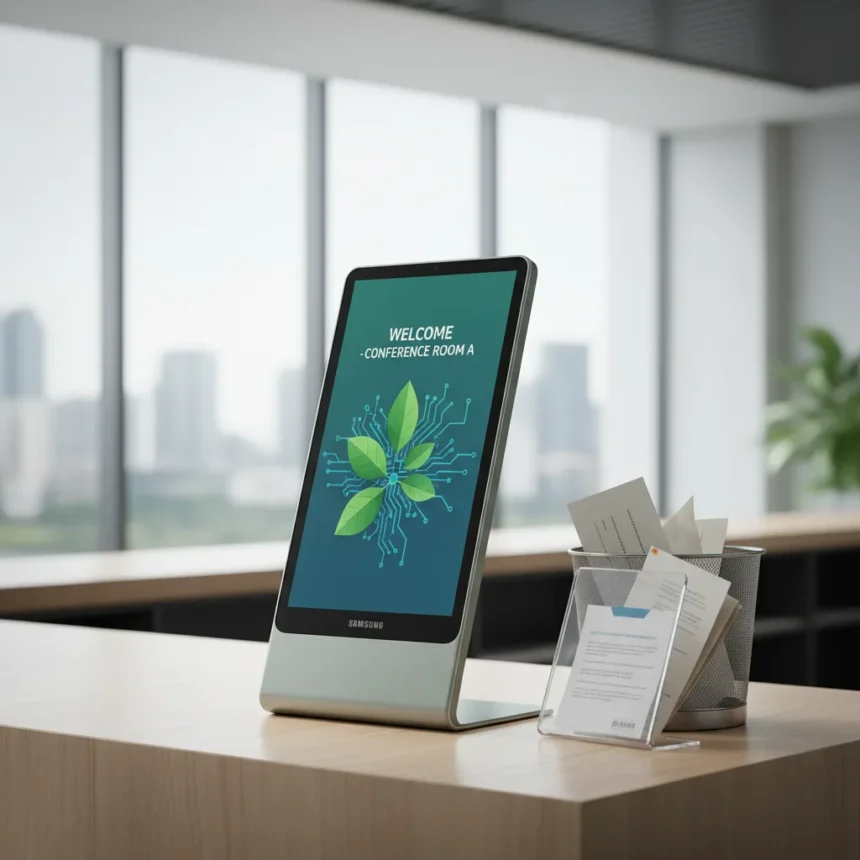
Samsung’s new 13-inch color e-paper display is positioning itself as the digital replacement for printed signs cluttering corporate offices, retail shelves, and hotel lobbies. The EM13DX model, announced globally on January 28, 2026, and launching in the US on March 26, 2026, uses advanced digital ink technology to eliminate the need for static paper signage while consuming virtually no power when displaying static images.
Key Takeaways
- Samsung’s 13-inch color e-paper display uses zero watts for static images, eliminating constant power drain
- Ultra-thin 17.9 mm design with embedded rechargeable battery enables cable-free workplace deployment
- World’s first display housing made from phytoplankton-derived bio-resin, verified by UL standards
- 1,200 x 1,600 resolution delivers paper-like visibility with smooth color gradations
- Remote updates via WiFi and Bluetooth through Samsung E-Paper App and VXT management software
Why Color E-Paper Display Technology Matters for Modern Workplaces
The color e-paper display represents a fundamental shift in how organizations handle internal communications. Unlike LCD or LED signage that drains power constantly, this technology maintains its image indefinitely without electricity once loaded. For facilities managing dozens of menu boards, wayfinding signs, pricing displays, or shift schedules, the power savings alone justify the switch. But the real advantage is flexibility—update a sign remotely without reprinting, no technician visit required, no waste.
Samsung’s color e-paper display measures 305.2 x 237.6 x 17.9 mm and weighs just 0.9 kg with battery, making it comparable to an A4 sheet of paper in both size and portability. The 16.9 mm bezel sits in a gray-white non-glossy frame, designed to blend into workplace environments rather than announce itself as a screen. VESA 100 x 100 mm mounting supports flexible placement on shelves, counters, tables, and doors without permanent installation.
The display’s 1,200 x 1,600 resolution at 4:3 aspect ratio delivers crisp text and imagery with paper-like visibility—a critical requirement for workplace signage that must remain readable in varied lighting conditions. Samsung’s advanced color imaging algorithm produces smooth gradations and enhanced colors that traditional e-ink cannot match, bridging the gap between printed paper quality and digital flexibility.


Eco-Credentials and Sustainability Claims
Samsung’s color e-paper display is the first in its class to use bio-resin housing derived from phytoplankton, a claim verified by UL standards. The device also incorporates 45% recycled plastic and ships in 100% paper packaging, addressing the environmental cost of manufacturing and distribution. For organizations tracking carbon footprints and waste reduction, replacing thousands of printed signs with a single reusable display is a measurable sustainability win.
The ultra-low power consumption amplifies this advantage. Operating at zero watts for static images, the device only draws power during updates or when changing content. An embedded rechargeable battery eliminates the need for permanent power cables, reducing both infrastructure complexity and energy waste. In retail environments where dozens of price tags, menu boards, and promotional signage rotate constantly, the cumulative power savings across a facility is substantial.



Connectivity and Management Features
The color e-paper display connects via USB 2 (including USB Type-C), WiFi, and Bluetooth, enabling both local and remote content updates. Samsung provides two management tools: the Samsung E-Paper App for direct device control and Samsung VXT for enterprise-scale remote management across multiple displays. This two-tier approach suits both small operations managing a handful of signs and large organizations deploying hundreds across multiple locations.
The device operates 24/7 and functions reliably across a temperature range of 0-40°C, covering most indoor workplace environments. Battery life specifications are not detailed in Samsung’s public materials, so real-world endurance remains unverified—a potential question for organizations considering large-scale rollouts.
Positioning Against Printed Signage
The color e-paper display directly competes with printed posters, laminated menus, and point-of-purchase displays that dominate retail and hospitality settings. Unlike traditional signage, it eliminates reprinting costs, labor for manual updates, and the environmental waste of discarded paper. A restaurant chain managing daily menu changes across 50 locations sees immediate cost recovery; a retail chain updating prices across thousands of locations reduces labor overhead dramatically.
However, Samsung has not released pricing information, citing the commercial nature of the product and the need for volume-based negotiations. Without pricing data, organizations cannot calculate return-on-investment or compare total cost of ownership against existing signage systems. This gap is likely intentional—Samsung is targeting enterprise buyers with dedicated procurement teams rather than individual retailers.



Launch Timeline and Regional Availability
Samsung announced the 13-inch color e-paper display globally on January 28, 2026, with US commercial availability beginning March 26, 2026. The device is currently listed on Samsung business sites for Hong Kong, Singapore, and Malaysia, though US commercial availability on Samsung’s official US site remains unconfirmed. Organizations interested in early adoption should contact Samsung’s commercial sales team directly rather than expecting immediate retail or online availability.
What This Means for Your Organization
The color e-paper display fills a genuine gap in workplace technology. It is not trying to be a TV or an interactive touchscreen—it is a replacement for static paper signage with the flexibility of digital updates. For hospitality, retail, corporate offices, and healthcare facilities, that is a powerful value proposition. The eco-friendly housing and ultra-low power consumption address growing corporate sustainability mandates, and remote management capabilities reduce operational overhead.
The lack of independent performance testing—battery life duration, real-world color accuracy, update speed—means early adopters will be taking some risk. Samsung’s specifications are solid, but only field deployment will reveal whether the color e-paper display performs as reliably in busy retail or hospitality environments as traditional printed signage.
Is Samsung’s color e-paper display suitable for outdoor use?
Samsung does not specify outdoor operating conditions for the color e-paper display. The stated temperature range of 0-40°C covers most indoor environments, but direct sunlight exposure, moisture, and extreme weather are not addressed in available specifications. Outdoor deployment would require verification with Samsung’s commercial sales team.
How long does the battery last on the color e-paper display?
Samsung has not published specific battery life figures for the 13-inch color e-paper display. Since the device consumes zero watts for static images, battery drain depends entirely on how frequently content is updated. Real-world endurance will only become clear after commercial deployment and customer feedback.
Can the color e-paper display be customized for specific workplace layouts?
The VESA 100 x 100 mm mounting standard allows flexible placement on shelves, counters, tables, and doors without permanent installation. The 305.2 x 237.6 mm display dimensions are fixed, but the modular mounting approach supports varied workplace configurations. Organizations with custom spatial requirements should contact Samsung directly to discuss integration options.
Samsung’s 13-inch color e-paper display represents a genuine evolution in workplace signage—moving from static printed paper to flexible, remotely updatable digital displays without sacrificing power efficiency or environmental responsibility. For organizations tired of reprinting signs and tracking manual updates, the technology solves a real problem. Pricing and battery life remain unknowns, but the March 2026 US launch will quickly reveal whether this is a niche product or a genuine category disruptor.
Edited by the All Things Geek team.
Source: TechRadar