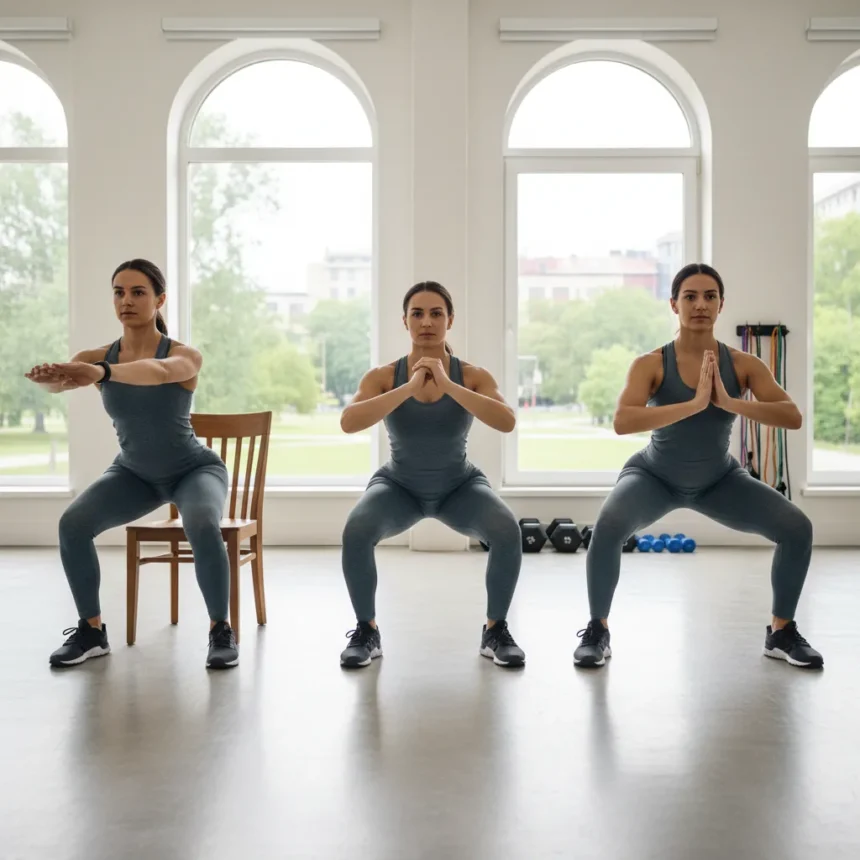
Essential squats for beginners form the foundation of any lower-body training program, requiring minimal equipment and delivering maximum results for those just starting their fitness journey. A personal trainer has outlined three fundamental squat variations that build strength and improve mobility without demanding advanced technique or heavy loading.
Key Takeaways
- Three beginner-friendly squat variations target lower-body strength and mobility simultaneously
- Proper form prioritizes controlled movement over heavy weight
- These exercises require minimal equipment and can be performed at home
- Progressive modifications allow beginners to advance as strength improves
- Mobility gains complement strength development for balanced fitness
Why Essential Squats for Beginners Matter
Lower-body training often intimidates beginners who assume they need barbells, racks, or heavy dumbbells to see results. Essential squats for beginners demolish that myth. Bodyweight and light-load variations build genuine strength while teaching movement patterns that transfer to daily life—climbing stairs, standing from chairs, lifting objects safely. The three-squat progression recommended by this personal trainer prioritizes technique mastery before adding resistance, reducing injury risk and establishing sustainable habits.
Mobility matters equally to strength. Squats that demand full range of motion improve hip and ankle flexibility, counteracting the tightness modern desk-bound living creates. This dual benefit—strength plus mobility—makes these exercises unusually efficient for beginners with limited time or access to facilities.
The Three Essential Squats for Beginners Explained
The personal trainer recommends three distinct squat variations, each addressing different movement qualities. The first emphasizes control and body awareness. The second introduces lateral movement to engage stabilizer muscles often neglected in straight-line exercises. The third challenges balance and unilateral strength development. Performing these three variations in sequence creates a complete lower-body stimulus without requiring external load.

Proper form execution prevents compensation patterns that undermine progress. Key cues include maintaining a neutral spine, distributing weight evenly across the foot, and moving with intention rather than speed. Beginners should perform these movements slowly, pausing at the bottom position to feel the working muscles and ensure proper depth.
Progressive Modifications and Advancement
Beginners should not expect to master all three variations immediately. Start with bodyweight versions, focusing on 3 sets of 8-10 repetitions with controlled tempo—2 seconds down, 1-second pause, 2 seconds up. Once form becomes automatic and movement feels stable, add light resistance using dumbbells, a kettlebell, or even a water bottle. Increase repetitions before adding weight; this builds endurance and reinforces technique.



Progression pathways vary by individual. Some beginners advance quickly through bodyweight variations and move to light loading within 2-3 weeks. Others benefit from 4-6 weeks of bodyweight practice before adding external resistance. Listen to your body and prioritize movement quality over advancing speed.
Frequently Asked Questions
How many times per week should beginners perform these squats?
Beginners can safely perform these squat variations 2-3 times per week, allowing at least one rest day between sessions. This frequency builds strength and work capacity without overtraining. As conditioning improves, frequency can increase to 4 days weekly if desired.
What if I experience knee or hip pain during these exercises?
Stop immediately and consult a qualified fitness professional or physical therapist before continuing. Pain signals a form breakdown or movement limitation requiring assessment. Do not push through discomfort; proper diagnosis prevents injury progression and ensures safe progression.
Can these squats replace other leg exercises entirely?
These three variations provide excellent foundational strength and mobility work, but complementary movements—like single-leg work, hamstring-focused exercises, or calf training—create more balanced development. Use these squats as your primary lower-body foundation and add supplemental exercises based on individual goals and limitations.



Essential squats for beginners work because they respect the reality of starting strength training: technique and consistency matter infinitely more than load. Master these three variations, progress gradually, and you will build genuine lower-body strength and mobility that lasts. The best program is the one you actually perform, and these accessible exercises make consistency achievable for anyone willing to start.
Edited by the All Things Geek team.
Source: Tom's Guide