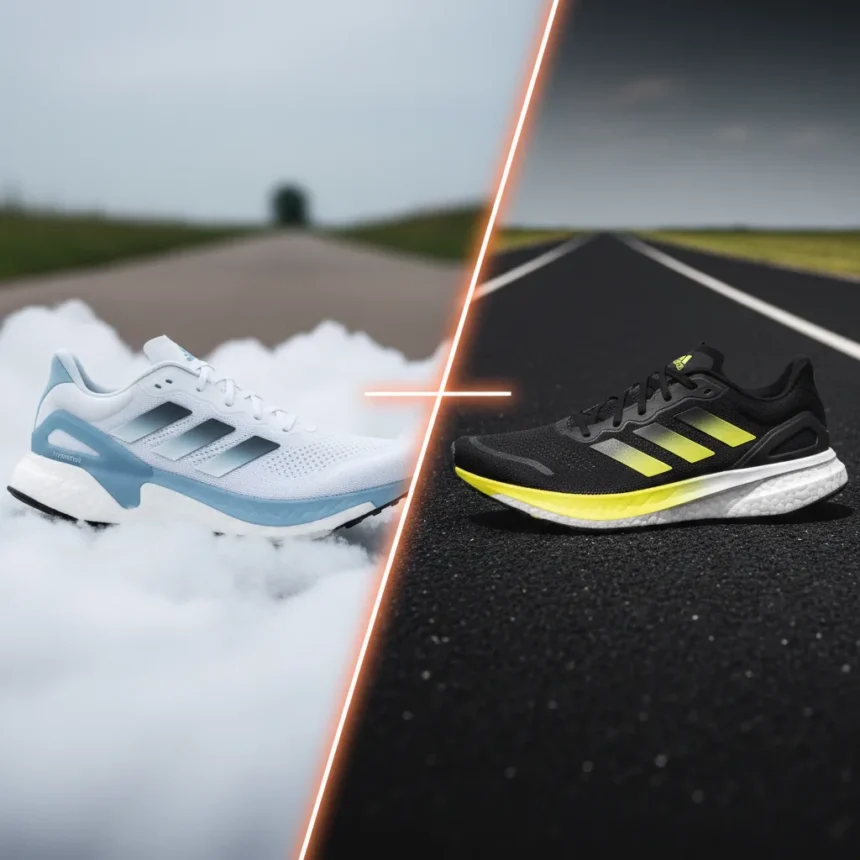
The Adidas Hyperboost Edge vs Adizero Evo SL choice boils down to a fundamental question: do you want maximum cushioning or lightweight versatility? Adidas launched the Hyperboost Edge in March 2026 as a new super-trainer with a springy midsole, while the Adizero Evo SL remains the company’s lightweight daily trainer that earned recognition as a favorite running shoe of 2025. Both shoes target daily training runs, but they diverge sharply in execution and feel.
Key Takeaways
- Hyperboost Edge is a max-stack trainer with 45mm heel cushioning, while Evo SL is a lightweight alternative with versatile performance.
- Hyperboost Edge costs $200 USD and features new Hyperboost Pro foam; Evo SL offers better value for general training.
- Hyperboost Edge excels on easy and long runs but feels awkward at faster paces due to its bulk.
- Evo SL combines comfort and speed in a lightweight package but sacrifices some stability.
- Choose Hyperboost Edge for cushioned, bouncy training; choose Evo SL for versatile, speedy daily runs.
Adidas Hyperboost Edge vs Adizero Evo SL: Core Differences
The Adidas Hyperboost Edge vs Adizero Evo SL comparison reveals two entirely different philosophies. The Hyperboost Edge is a highly cushioned daily trainer built around Adidas’s new Hyperboost Pro foam midsole, a springy material rather than a recycled formula. It measures 45mm at the heel and 39mm at the forefoot, making it a true max-stack option for runners seeking plush protection. The shoe weighs just under 9 ounces in a US size 8.5, and its PRIMEWEAVE upper uses a soft woven material with cushioned heel pads designed for comfort and lockdown.
The Adizero Evo SL takes the opposite route. Described as an excellent daily trainer with a rare combination of comfort and speed, this lightweight shoe works well across a wide range of runs and offers good value for the performance level it delivers. Where the Hyperboost Edge prioritizes maximum cushioning, the Evo SL balances responsiveness with comfort in a more minimal package. The trade-off: the Evo SL is not the most stable shoe in Adidas’s lineup, while the Hyperboost Edge provides a full outsole for traction and stability.
Hyperboost Edge: Maximum Cushioning, Problematic Upper
The Hyperboost Edge is particularly enjoyable at easy and steady paces and works well as a long-run shoe if the upper does not bother you. Runners seeking a bouncy, protective ride will appreciate the new Hyperboost Pro foam, which lab testing places slightly ahead of the ASICS Megablast in energy return. The LIGHTTRAXION outsole delivers grip without adding bulk, and the durable design holds up well to repeated training.

But here’s the catch: the Hyperboost Edge has an uncomfortable, rigid, hot upper that may be a deal-breaker for some runners. The shoe can feel awkward at faster paces because of its size, and it would not be a first choice for all-out workouts or racing. At $200 USD (£170 in the U.K.), the Hyperboost Edge sits at the premium end of the daily trainer market. It is not as speedy as some rivals, making it less suitable for tempo work or speed-focused sessions.
Adizero Evo SL: Lightweight Versatility Wins
The Adizero Evo SL delivers versatility without the bulk. Its lightweight design and responsive ride make it the better all-round value daily trainer compared to the Hyperboost Edge. Runners who want a shoe that handles easy runs, tempo work, and occasional faster efforts will find the Evo SL more adaptable. The shoe earned its status as a favorite running shoe of 2025 because it offers a rare combination of comfort and speed in a design that does not feel heavy on the feet.



The trade-off is stability. The Evo SL is not the most stable option for runners who need extra medial support or who prefer a wider platform. If you land heavily on the inside of your foot or need a shoe with maximum side-to-side support, the Hyperboost Edge’s full outsole and max-stack platform provide more security. The Evo SL also sits cheaper than the Hyperboost Edge, aligning with other traditional Adidas daily trainers in the $140-$150 price range.
Who Should Buy Which Shoe?
Choose the Hyperboost Edge if you prioritize cushioning above all else and plan to run mostly at conversational paces. This shoe shines on easy runs and long-distance training where maximum impact protection matters more than responsiveness. The new Hyperboost Pro foam delivers a satisfying bounce, and the durable construction will last through high mileage. Just be prepared for the upper to feel stiff and potentially hot during longer efforts.
Choose the Adizero Evo SL if you want a shoe that does everything reasonably well without excelling at just one thing. It is the better choice for runners who mix easy runs with occasional tempo work, who value lightweight feel, and who do not need maximum side-to-side stability. The Evo SL is also the more economical choice, offering strong performance at a lower price point than the Hyperboost Edge.
How does the Hyperboost Edge compare to other max-stack trainers?
The Hyperboost Edge offers slightly more stability and comfort for easy paces than the ASICS Megablast, though the Megablast is faster, bouncier, lighter, and more expensive. Both are super-trainers designed for cushioned daily training, but the Hyperboost Edge’s new foam formulation gives it a distinct character within the category.



Is the Adizero Evo SL good for racing?
The Adizero Evo SL is a daily trainer, not a racing shoe. Its lightweight design and responsive ride make it suitable for tempo runs and faster training efforts, but it is not built for race-day performance like a dedicated racing flat or carbon-plated shoe.
Which shoe is better for long runs?
The Hyperboost Edge is the better choice for long runs if you want maximum cushioning and protection. Its max-stack platform and new Hyperboost Pro foam provide plush support over extended distances, assuming the upper does not cause discomfort. The Evo SL can handle long runs too, but its lighter, more responsive design suits varied-pace training better than sustained easy running.
The Adidas Hyperboost Edge vs Adizero Evo SL decision is not about which shoe is objectively better—it is about matching your running style to the shoe’s strengths. If you run easy and long, want maximum bounce, and can tolerate a stiff upper, the Hyperboost Edge delivers. If you want a versatile, lightweight daily trainer that costs less and handles mixed-pace training, the Evo SL is the smarter choice. Most runners will find the Evo SL’s all-around capability more practical, but the Hyperboost Edge rewards those who specifically crave cushioned, conversational-pace running.
Edited by the All Things Geek team.
Source: Tom's Guide