





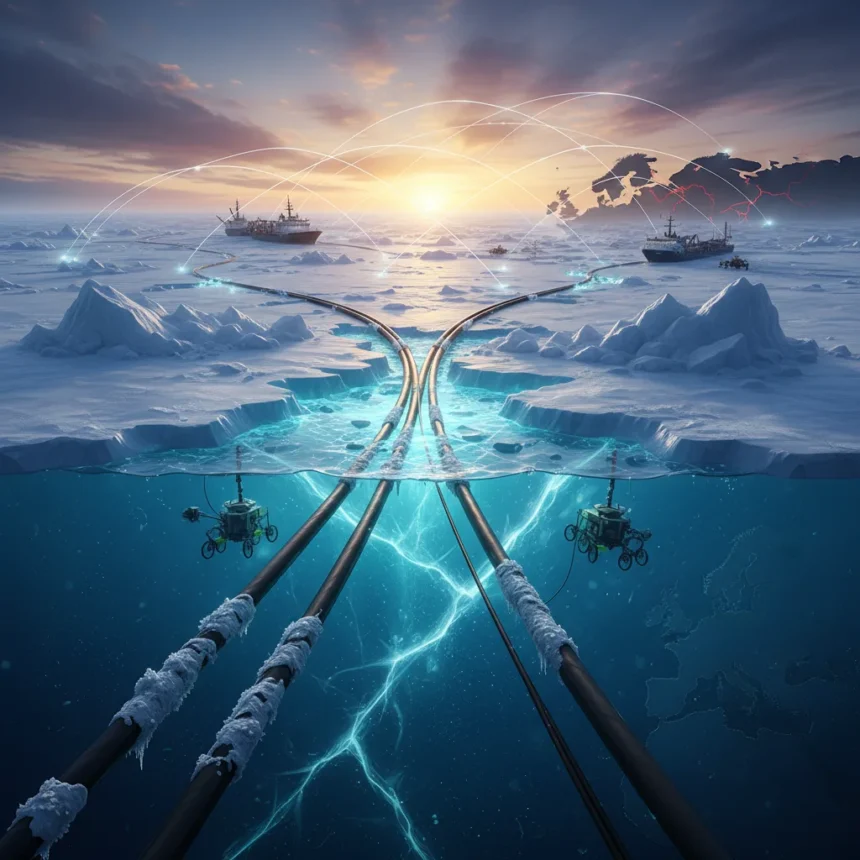
Arctic undersea cables are becoming Europe’s answer to a growing infrastructure crisis in the Baltic Sea, where repeated sabotage and mysterious cable cuts have threatened continental connectivity since 2022. Rather than continue relying on vulnerable routes through contested waters, Europe is pivoting toward polar alternatives that bypass geopolitically unstable regions entirely.
Key Takeaways
- Ten subsea cables in the Baltic Sea have been cut since 2022, with seven disruptions occurring between November 2024 and January 2025.
- The November 2024 simultaneous damage to BCS East-West Interlink and C-Lion1 cables prompted NATO accusations of hybrid warfare and sabotage.
- Arctic undersea cables offer a geopolitically neutral route connecting Europe to Asia while avoiding conflict-prone regions.
- The EU-Japan Arctic cable collaboration and Cinia’s Far North Fiber Express represent new partnerships moving away from Russian-Nordic cooperation.
- AI infrastructure demand and the green energy transition will require more diversified undersea cable routes globally.
Why Arctic undersea cables matter right now
The urgency is straightforward: Europe’s existing undersea infrastructure is failing. Since 2022, approximately ten subsea cables connecting the Baltic Sea region have been severed. That number accelerated dramatically in late 2024. Between November 2024 and January 2025 alone, seven cuts occurred. On 17–18 November 2024, two cables—the BCS East-West Interlink and C-Lion1—were damaged near-simultaneously, prompting European officials and NATO members to accuse Russia of hybrid warfare. Both cables were restored by 28 November 2024, but the pattern revealed a systemic vulnerability that Arctic undersea cables could solve.
The BCS East-West Interlink, a 218-kilometer cable built in 1997 and owned by Arelion, connects Lithuania to Sweden’s Gotland island. Its repeated disruptions alongside other Baltic cables suggest either coordinated sabotage or a deliberate campaign of infrastructure degradation. Western intelligence officials scrutinized the Chinese cargo ship Yi Peng 3 for its presence near the damaged cables, believing its anchor may have caused the damage either accidentally or under Russian influence. Whether intentional or not, the Baltic route has become a liability.
Arctic undersea cables as a geopolitical pivot
Europe’s interest in Arctic undersea cables is not new, but recent disruptions have accelerated deployment timelines. In March 2016, Cinia Ltd announced the Arctic Connect project, designed to link Southern Finland through Kirkenes, Norway to Murmansk, Russia. That project never materialized as geopolitical cooperation between Russia and Nordic nations dissolved. What emerged instead are two competing visions: a Russian-led Polar Express and a revised Far North Fiber Express led by Cinia, which routes westward away from Russian territory.

The EU-Japan collaboration on an Arctic cable project exemplifies this shift. Rather than integrating Russian infrastructure, Europe is now building partnerships with democratic nations to create redundant, geopolitically aligned routes. These cables bypass the Baltic entirely, routing connectivity through Arctic waters where fewer chokepoints exist and fewer state actors can easily interfere. The strategy mirrors Meta’s global approach—the company is developing an around-the-world subsea cable project explicitly designed for infrastructure resilience.
The infrastructure resilience imperative
Arctic undersea cables address a problem that extends beyond geopolitics. The AI boom is driving explosive demand for data connectivity. Simultaneously, Europe’s green energy transition requires undersea power cables to transport electricity between countries, islands, and offshore wind farms to the mainland. These dual pressures mean Europe cannot rely on a single routing strategy or a single geographic corridor.



The Baltic Sea incidents have exposed how concentrated infrastructure creates systemic risk. When two cables fail within hours, continental connectivity suffers. Arctic undersea cables provide geographic diversity—they follow a different path, cross different waters, and connect through different landing points. This redundancy is not theoretical. In January 2022, the Arctic Svalbard archipelago experienced a subsea cable disruption, but the underlying causes remain unclear, suggesting that Arctic routes themselves are not immune to disruption. However, multiple independent routes mean a single failure cannot cripple the entire system.
Who benefits and what comes next
Arctic undersea cables benefit Europe’s digital economy broadly—faster, more reliable connectivity to Asia reduces latency and improves resilience for financial services, cloud computing, and AI workloads. They also benefit smaller nations. Cinia’s Far North Fiber Express and similar projects create alternative pathways for countries that might otherwise depend entirely on Baltic routing. The EU-Japan partnership signals that Western democracies are willing to invest in infrastructure that aligns with shared security interests rather than pure cost optimization.
The European Commission is reportedly considering new legislation to mitigate security risks related to subsea cables, suggesting that regulatory frameworks will evolve alongside physical infrastructure. The CTF Baltic task force, which monitors shadow vessels approaching undersea cables and pipelines in the Baltic Sea, indicates that Europe recognizes the hybrid-warfare dimension of cable protection. Arctic undersea cables are not a complete solution—they are one piece of a broader strategy that includes monitoring, regulation, and international cooperation.
Is Arctic routing really safer?
Arctic undersea cables reduce vulnerability to specific regional actors and chokepoints, but they introduce new challenges. Arctic waters are harsh. Ice, extreme weather, and geographic isolation complicate maintenance and repair. Routes are longer, which increases latency slightly. However, these trade-offs are acceptable if they eliminate the concentration risk of the Baltic route. A cable in the Arctic that takes longer to repair is still preferable to a cable in the Baltic that gets cut every few months.



Will Arctic undersea cables actually get built?
The Arctic Connect project’s failure shows that ambitious Arctic cable plans can stall. Geopolitical shifts, funding constraints, and regulatory uncertainty all pose risks. However, the EU-Japan collaboration and Cinia’s Far North Fiber Express suggest that new projects have stronger political backing than Arctic Connect did. Unlike the earlier project, these initiatives explicitly exclude Russian participation, removing a major point of geopolitical friction. Funding from EU institutions and Japanese partners provides capital that pure private ventures might lack. Timelines remain unclear, but the momentum is real.
What happens to existing Baltic cables?
Europe will not abandon the Baltic route—it carries too much traffic and too much existing infrastructure. Instead, Arctic undersea cables will provide redundancy and reduce the consequences of future disruptions. If a Baltic cable fails, traffic can reroute through Arctic alternatives. This layered approach is how resilient infrastructure works. The goal is not to replace the Baltic entirely but to ensure that no single route can be weaponized or sabotaged without catastrophic consequences.
Why can’t Europe just build more Baltic cables?
Building more cables in the same region does not solve the underlying problem—it merely multiplies the targets. If ten cables in the Baltic can all be cut within months, adding an eleventh cable in the same waters does not reduce vulnerability. It increases the attacker’s options. Arctic routing breaks the geographic concentration that makes the Baltic attractive to malicious actors. Diversity of location is as important as diversity of quantity.
Are Arctic undersea cables a long-term solution?
They are part of a longer-term solution. As AI infrastructure and renewable energy transition accelerate, Europe will need multiple independent undersea routes—Arctic, Mediterranean, Atlantic, and potentially others. Arctic undersea cables fill a specific gap: they connect Europe to Asia while avoiding the Baltic’s geopolitical exposure. They are not a panacea, but they represent the kind of strategic thinking that critical infrastructure requires in an era of hybrid warfare and great-power competition. Europe is learning that resilience means redundancy, and redundancy means routes that bypass contested regions entirely.
Edited by the All Things Geek team.
Source: TechRadar




