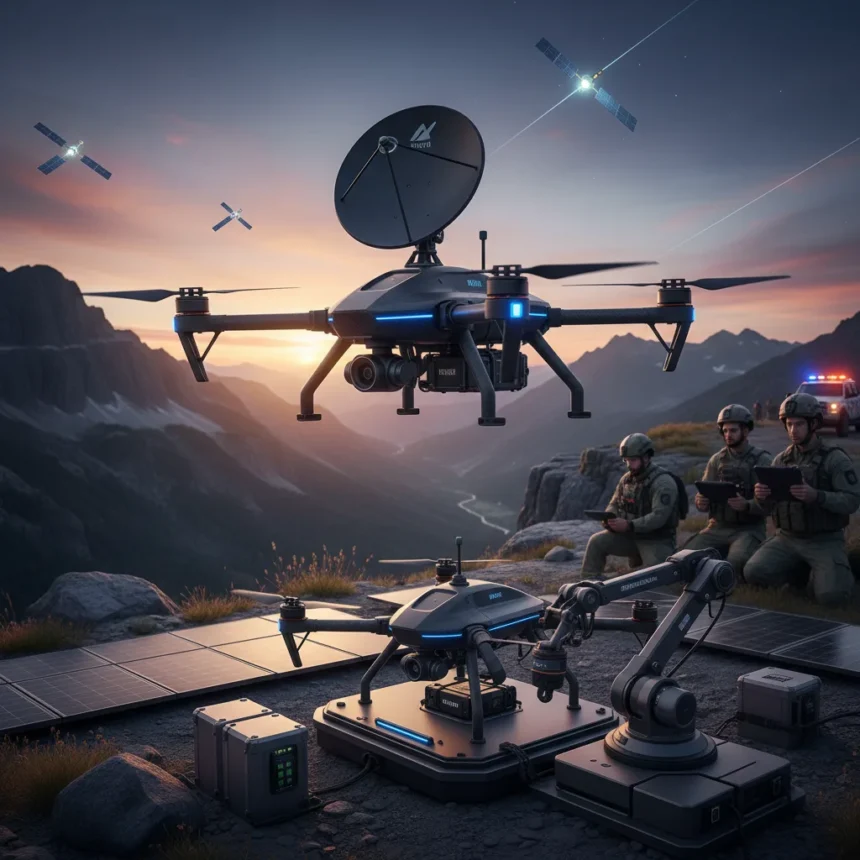
The BRINC Guardian is a first responder drone Starlink connected, designed to reach scenes 8 miles away and stay operational for over an hour—a capability that fundamentally shifts how police departments and emergency services respond to 911 calls. Announced March 24, 2026, by Seattle-based BRINC, the Guardian weighs 44 lbs and flies at up to 60 mph, equipped with dual 4K cameras, dual thermal sensors, a 1,000-lumen spotlight, and a laser rangefinder. What sets it apart is its triple-redundant connectivity: local mesh radios, dual SIM 5G/LTE, and an integrated Starlink satellite panel that enables operation anywhere in the world, even in rural areas or disaster zones without terrestrial signals.
Key Takeaways
- BRINC Guardian covers 7x more area and stays on-scene 4x longer than traditional first responder systems
- Starlink integration enables 8-mile operational range versus 3-mile limit of current non-DJI platforms
- 62-minute flight time at 60 mph allows rapid scene assessment and sustained monitoring
- Guardian Station robotic dock swaps batteries automatically in ~1 minute for 24/7 continuous operations
- Dual 4K cameras with 640x zoom and dual 1280px thermal cameras provide detail from significant altitude
Why Starlink Changes the Game for First Responder Drones
Satellite connectivity in a first responder drone Starlink system eliminates the connectivity bottleneck that has limited public safety drones to 3-mile ranges. Traditional systems rely on line-of-sight radio or cellular networks that fail in rural areas, forests, and disaster zones where infrastructure is damaged or absent. BRINC’s integrated Starlink panel solves this by providing worldwide coverage independent of terrestrial infrastructure. The company notes that Starlink has never before been built into a commercially produced quadcopter, giving the Guardian what amounts to unlimited range anywhere on Earth. For a police department responding to a vehicle pursuit across county lines or a search-and-rescue operation in remote terrain, this shift from 3 miles to 8 miles represents a 7x increase in coverage area.
The competitive landscape matters here. DJI’s M400, the closest comparable platform, offers 59 minutes of flight time and 56 mph max speed—nearly identical specs to the Guardian on paper. But the M400 lacks Starlink connectivity and battery-swap automation, meaning operators must manually swap batteries between flights and lose signal beyond line-of-sight range. The Guardian’s architectural advantage is not raw speed or endurance—it is persistent, reliable connectivity and autonomous operations that keep the drone in the air continuously without human intervention between flights.
Autonomous Battery Swaps and 24/7 Operations
The Guardian Station, a robotic docking system paired with the drone, handles battery swaps automatically in approximately one minute. A depleted battery is removed and a fully charged one inserted without human hands touching the system. The same station can load automatic payloads—defibrillators, Narcan, flotation devices—depending on the emergency type. This automation enables true 24/7 operations: a police dispatch center can launch the Guardian on a 911 call via computer-aided dispatch integration, and the drone will autonomously launch, assess the scene, return, dock, swap batteries, reload payloads, and stand ready for the next call. Traditional systems require a trained operator to physically handle the drone between flights, a bottleneck that limits response frequency and ties up personnel.

Flight endurance of 62 minutes is manufacturer-specified and assumes optimal conditions without payload weight; real-world endurance carrying medical supplies or other payloads may differ. Still, the combination of 62-minute flights and automatic battery swaps means a single Guardian can maintain continuous airborne presence across multiple 911 incidents without downtime. For a police department managing a large geographic area, this represents a dramatic efficiency gain over traditional helicopter response, which requires pilots, fuel, and fixed hangars.
Camera and Sensor Capabilities for Scene Assessment
The Guardian carries dual 4K cameras with 640x total zoom (40x optical, 12x digital) and dual 1280px thermal cameras with 64x total zoom (4x optical, 16x digital). The dual 4K setup allows simultaneous wide-angle and zoomed-in video feeds, useful for tracking suspects or scanning large scenes. From significant altitude, the optical zoom is sharp enough to read license plate details, a capability that transforms how officers can assess vehicle pursuits without putting helicopters in the air. The thermal cameras detect heat signatures in darkness or heavy smoke, critical for search-and-rescue operations or structure fires.



Integrated modules add operational flexibility. The SkyBeam spotlight delivers 1,000 lumens with a 2.3-degree field of view and adaptive brightness, useful for nighttime operations. The laser rangefinder measures distance with sub-2-foot accuracy up to 4,900 feet, enabling precise positioning for rescue operations or threat assessment. The 130 dBA siren and speaker—three times louder than a police car—can broadcast warnings or instructions to people on the ground from the air. These modules are not aftermarket add-ons; they are integrated into the airframe, reducing weight and complexity compared to external payloads.
Market Timing and BRINC’s Expansion
BRINC tripled its revenue in 2025 and increased production capacity 5x, signaling confidence in demand for the Guardian. The March 2026 announcement comes as police departments nationwide face budget constraints and helicopter shortages. A drone-based response system costs a fraction of helicopter operations and eliminates pilot fatigue and scheduling conflicts. The Guardian’s Starlink connectivity addresses a pain point specific to rural law enforcement: agencies in remote areas have historically been unable to deploy drones effectively because cellular coverage is spotty. Now, a sheriff’s office in Montana or rural Texas can launch a Guardian and maintain a live video feed from 8 miles away regardless of local cell tower density.
The 44-lb weight and IP55 weather resistance (dust and water protection) mean the Guardian can operate in rain, dust storms, and rough terrain where lighter drones would fail. This durability matters for public safety, where equipment must function reliably in unpredictable conditions.
Can the Guardian really operate 62 minutes in real-world conditions?
The 62-minute flight time is BRINC’s specification and assumes optimal conditions with no payload or headwind. Carrying medical supplies, thermal cameras, or operating in wind will reduce endurance. Real-world testing by independent third parties has not yet been published, so field performance remains unconfirmed. However, even at 45 minutes of actual flight time—a conservative estimate—the Guardian still exceeds most current first responder drones.



How does Starlink connectivity work on a moving drone?
The integrated Starlink panel maintains connection to low-earth orbit satellites as the drone moves, providing latency and bandwidth suitable for live video streaming and command signals. In areas without 5G or LTE coverage, Starlink becomes the primary link. The triple-redundant design (mesh, cellular, and satellite) means the drone can switch between networks smoothly as it flies, ensuring no loss of signal during transitions.
Is the Guardian available for purchase now?
The Guardian was announced March 24, 2026, but BRINC has not disclosed pricing, pre-order dates, or delivery timelines. Police departments interested in the system should contact BRINC directly. Given the company’s production capacity increase, units may become available to early adopters in late 2026 or early 2027, but no official launch window has been stated.
The BRINC Guardian represents a genuine inflection point for emergency response technology. By solving the connectivity and endurance problems that have limited drone adoption in public safety, it enables police and fire departments to replace expensive helicopter operations with a system that is faster to deploy, cheaper to operate, and available 24/7. Whether the 62-minute flight time holds in field conditions remains to be seen, but the architecture—Starlink connectivity, autonomous battery swaps, and integrated sensors—addresses real operational constraints that have plagued first responder drones for years.
Edited by the All Things Geek team.
Source: Tom's Hardware