





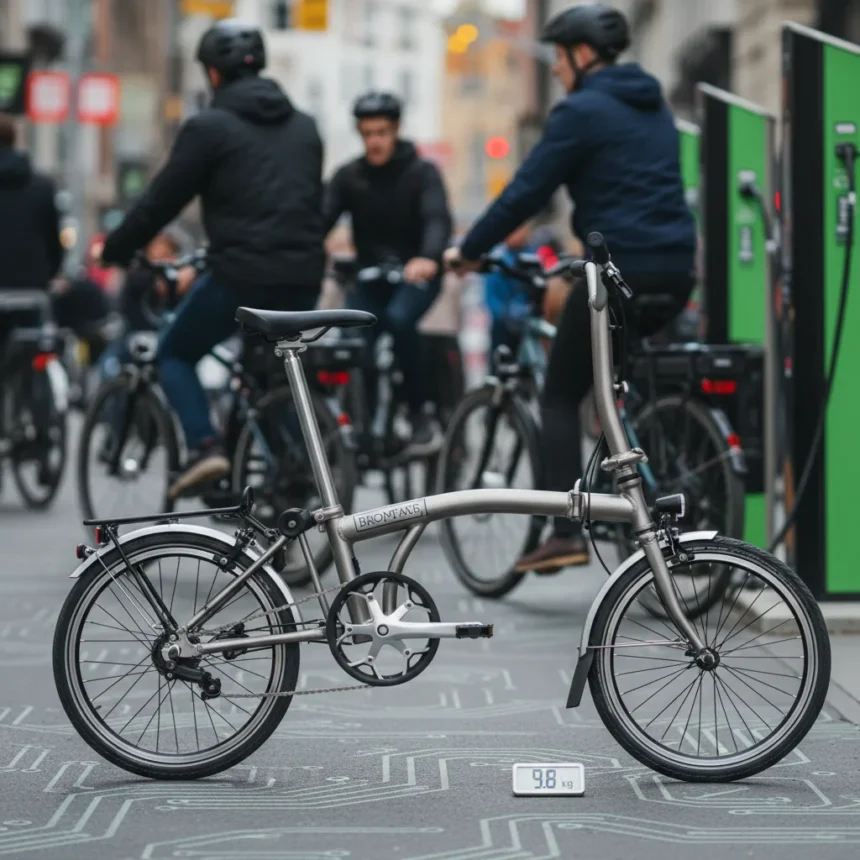
The Brompton P Line folding bike is a titanium-framed commuter designed by British heritage brand Brompton, launched May 26, 2025, weighing 9.4kg for the single-speed Explore model and 9.75kg for the 6-speed Urban variant. It is Brompton’s lightest and fastest production folding bike to date, arriving as the global folding bike market grows 18 percent annually amid rising e-bike adoption.
Key Takeaways
- Brompton P Line weighs 9.4kg (Explore) and 9.75kg (Urban), making it the lightest production folder from the 50-year-old brand.
- Titanium front triangle, fork, and rear frame combined with carbon fiber fork reduce weight while maintaining stiffness.
- New 12-speed drivetrain upgrade (£650) uses K-Eye chain and electronic indexing for 520% gear range.
- Hydraulic disc brakes (160mm rotors) replace rim brakes, improving modulation on city rides.
- Priced from £3,350 (Explore) to £3,850 (Urban); available now via Brompton.com and authorized dealers.
Why Brompton Went Titanium for the P Line
Brompton’s decision to use titanium extensively marks a significant departure from its steel-framed heritage. The P Line uses titanium for the front triangle, fork, and rear frame, with 6061 aluminum filling the remaining main tube sections. This material choice cuts weight dramatically compared to the classic C Line (11.8kg steel frame), delivering a bike that is 20 percent lighter and 15 percent stiffer. The unnamed Brompton lead engineer noted that titanium flexes in exactly the right way to make the ride feel alive, suggesting the material choice is not merely about shedding grams but altering how the bike responds to urban terrain.
The carbon fiber fork further reduces unsprung mass, while titanium seat post clamps and proprietary titanium hinges (previously steel) eliminate traditional weight penalties in folding mechanisms. These refinements address a long-standing criticism of folding bikes: that they feel sluggish and heavy compared to rigid single-speeds. The P Line is not the lightest folder on the market—the Birdy Sport weighs 10.1kg—but it is the lightest Brompton production bike ever made and significantly lighter than the electric G Line (13.3kg), which sacrifices speed for motor assistance.
Gearing and the 12-Speed Upgrade Option
The Brompton P Line folding bike arrives with four standard gearing configurations: single-speed (44/13), 2-speed, 4-speed, and 6-speed. For riders tackling urban inclines, Brompton introduced a new 12-speed drivetrain upgrade kit (£650) that installs on all P Line models. The upgrade uses a K-Eye 10-speed chain optimized for Brompton’s 44-tooth chainring and electronic indexing shifters mounted on the handlebar. The system delivers a 520 percent gear range, allowing riders to calibrate low gearing (0.85 ratio) for hills or high gearing (4.0 ratio) for flat sprints via the Brompton app.

This flexibility matters for commuters who encounter mixed terrain. The standard 6-speed covers most urban riding, but the 12-speed option lets riders fine-tune their drivetrain without sacrificing the compact fold. Installation requires swapping the rear derailleur hanger, fitting the K-Eye chain, attaching the new derailleur, installing shifters, and calibrating through the app.
Wheels, Brakes, and Handling
The Brompton P Line folding bike rides on 349mm rims paired with 35mm Schwalbe One TLE tires, upgradable to 40mm for rougher terrain. This wheel size is standard for Brompton folders, keeping the packed dimensions tight (585 x 565 x 270mm) while offering adequate rolling efficiency for city speeds. The bike unfolds in under 20 seconds, maintaining Brompton’s practical design philosophy.



New hydraulic disc brakes (160mm rotors with flat-mount calipers) replace the rim brakes found on older Brompton models, offering superior modulation and stopping power in wet conditions. This upgrade matters for urban commuters navigating traffic and rain-soaked streets. The new Parallel Plus saddle provides 60 percent more comfort than previous models, though this figure comes from unspecified Brompton lab testing rather than independent verification. The 520mm handlebar uses Brompton’s P Type geometry for an upright posture, prioritizing visibility over aggressive aerodynamics.
How the P Line Compares to Rivals
Brompton’s P Line folding bike faces competition from several categories. The Tern Vektron (12.3kg, hub-motor electric) is heavier but offers motor assistance, making it faster uphill for riders willing to sacrifice pedaling purity. The Birdy Sport (10.1kg, $2,800) is lighter but does not fold as compactly and costs less—a trade-off for riders prioritizing weight over portability. The Dahon Curl SP (9.8kg, $1,200) is cheaper and nearly as light, but lacks the premium materials and refined geometry of the P Line.
Against Brompton’s own lineup, the P Line sits between the classic C Line and the electric G Line. It is 28 percent lighter than the G Line but sacrifices motor assistance, appealing to riders who want speed through fitness rather than battery. Compared to the C Line, the P Line is stiffer, faster, and more responsive, justifying its higher price for commuters who value performance. The P Line outperforms most rivals in foldability and packed size, but it is not the most versatile off-road option—full-suspension folders like the Mobiky handle rough terrain better, though they sacrifice compactness.
Pricing and Availability
The Brompton P Line folding bike launches at £3,350 for the Explore (single-speed) and £3,850 for the Urban (6-speed). In USD, pricing is $4,200 and $4,800 respectively, with the 12-speed upgrade kit adding $800. The bike is available now via Brompton.com and authorized dealers worldwide, with immediate stock in the UK and EU, and US shipping beginning June 2025. Brompton offers 0 percent APR financing over 12 months in the UK, easing the entry cost for commuters.



This pricing positions the P Line as a premium product. It is significantly more expensive than the Dahon Curl SP but cheaper than the Tern Vektron. For city riders who commute daily and value compact storage alongside genuine speed, the P Line’s cost reflects its material choices and engineering refinement. Whether it justifies the premium over lighter, cheaper alternatives depends on whether you prioritize Brompton’s foldability, heritage, and ride quality.
Should you buy the Brompton P Line folding bike?
The Brompton P Line folding bike suits commuters who use public transit, store their bike in small apartments, and want a genuine performance machine rather than a compromise. If you live in a dense city with stairs, tight closets, or train commutes, the P Line’s compact fold and sub-10kg weight matter. If you have unlimited bike storage and prioritize maximum speed, a rigid single-speed or lightweight road bike will outpace it. The P Line is for riders who refuse to sacrifice performance for portability.
What is the folding process for the P Line?
The Brompton P Line folding bike uses the same five-step mechanism as classic Brompton folders: release the main frame hinge and fold the rear wheel under the frame, fold the pedals inward, collapse the handlebar downward, tuck the front wheel behind the frame using a secondary latch, and secure everything with the frame clip. The entire process takes under 20 seconds and requires no tools.
Can you upgrade an existing Brompton to 12-speed?
Yes, the 12-speed drivetrain upgrade kit (£650) installs on all P Line models and likely on compatible older Brompton frames, though the brief confirms compatibility only with P Line variants. Installation involves swapping the rear derailleur hanger, fitting the K-Eye chain, attaching the new derailleur with electronic indexing, and calibrating via the Brompton app. Most bike shops familiar with Brompton can perform this work.
The Brompton P Line folding bike arrives at a moment when urban cyclists are questioning whether e-bikes are the only answer to heavy commuting. By delivering genuine speed and lightness without a motor, Brompton is betting that riders still value the simplicity and satisfaction of human-powered commuting. Whether that bet pays off depends on whether commuters in 2025 still care about bikes that feel fast.
Edited by the All Things Geek team.
Source: T3




