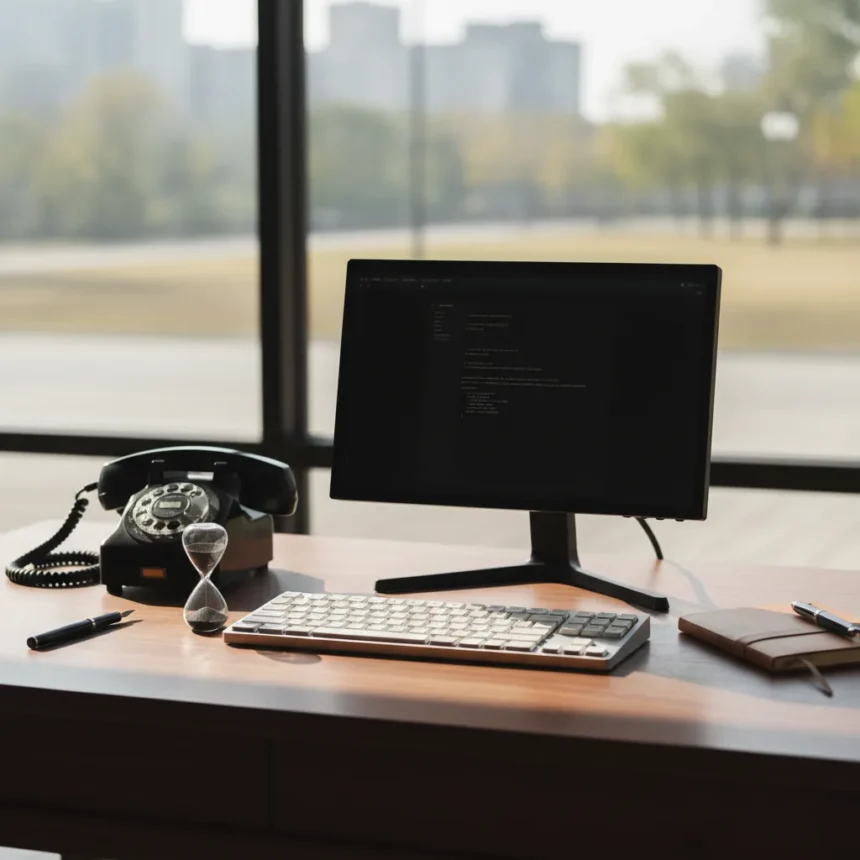
Distraction-free work gear represents a deliberate rejection of always-on connectivity in favor of tools designed to eliminate digital noise. Rather than fighting constant notifications and context-switching, workers are choosing equipment that makes distraction physically impossible—keyboards without internet, displays without notifications, devices engineered for single-task focus. This counterintuitive approach flips the productivity narrative: the hardest gear to use is often the gear that produces the best work.
Key Takeaways
- Intentionally limited tools force deeper focus by removing choice and distraction.
- Distraction-free work gear includes mechanical keyboards, e-ink displays, and offline-first devices.
- Single-purpose hardware costs more upfront but saves time and mental energy long-term.
- The friction of limited functionality paradoxically increases output quality.
- Digital minimalism in gear design mirrors the broader shift away from always-on culture.
Why Making Work Harder Saves Focus
The logic seems backward: why deliberately choose harder tools? Because ease of distraction is the enemy of depth. When switching between tasks requires just one click, the brain fragments. When checking email takes a keystroke, focus evaporates. Distraction-free work gear eliminates that friction in the opposite direction—it makes distraction harder than focus. A mechanical keyboard without wireless capability cannot receive Slack messages. An e-ink display cannot show notifications. A device without internet cannot tempt you into browsing.
This is not about rejection of technology—it is about rejecting technology that works against you. The best distraction-free work gear is engineered with constraints. Those constraints are features, not bugs. They force intentionality. When you cannot easily switch tasks, you commit deeper to the one in front of you. When your screen cannot flash alerts, your attention stays where you put it. The friction becomes productive friction.
Types of Distraction-Free Work Gear That Actually Deliver
Distraction-free work gear spans multiple categories, each solving a different focus problem. Mechanical keyboards designed for writing eliminate wireless connectivity entirely—some models include no digital features beyond the keyboard itself, communicating only via USB cable. E-ink displays remove the hypnotic pull of backlit screens by mimicking paper, stripping away color and animation that trigger distraction. Offline-first devices like certain dedicated writing machines run proprietary operating systems that simply do not include email clients, browsers, or app stores.

The most effective distraction-free work gear combines multiple constraints. A setup might include a mechanical typewriter-style keyboard paired with an e-ink secondary display, connected to a computer that runs a distraction-blocking operating system. Each layer removes one avenue of distraction. The result is not a limitation—it is clarity. Writers report that the inability to check email mid-sentence actually accelerates their work because the cognitive cost of resuming focus drops to zero.
How Distraction-Free Work Gear Compares to Standard Equipment
Standard work gear—laptops, smartphones, wireless peripherals—optimizes for convenience and connectivity. Every device is designed to receive notifications, sync across platforms, and keep you perpetually available. This is the default assumption of modern work: always on, always reachable, always ready to switch context. Distraction-free work gear inverts this. It optimizes for depth over availability, single-task performance over multitasking readiness.



The tradeoff is real. Distraction-free work gear is less convenient. You cannot check your calendar from your keyboard. You cannot video conference on an e-ink display. You cannot receive urgent messages on a device without internet. But that tradeoff is precisely the point. The inconvenience is the feature. It forces you to batch tasks deliberately instead of context-switching reactively. A writer using distraction-free work gear might check email once per hour instead of 50 times, losing nothing of importance and gaining hours of uninterrupted focus.
The Hidden Cost of Always-On Connectivity
The reason distraction-free work gear is gaining traction is that the cost of constant connectivity is finally becoming visible. Every notification fragment attention. Every context switch imposes a cognitive penalty—research on task-switching shows that returning to a previous task takes significantly longer than the switch itself because your brain must reload context. Over a workday, these penalties compound into lost hours. Distraction-free work gear eliminates the notification problem by making notifications impossible.
This is not asceticism or Luddism. It is pragmatism. If your job requires deep focus—writing, coding, design, analysis—then distraction-free work gear is not a luxury, it is a tool that directly improves output. The person using a mechanical keyboard with no wireless capability will complete more writing in the same time than someone using a laptop with Slack open. The constraint is not a sacrifice; it is an investment in productivity.
FAQ
What is the best distraction-free work gear for writers?
Mechanical keyboards designed for writing, paired with e-ink secondary displays or a dedicated writing device, eliminate notifications and digital temptation. Many writers pair these with a computer running a distraction-blocking operating system that removes email and browser access during work sessions. The specific setup depends on your workflow, but the principle is consistent: remove choice.



Does distraction-free work gear actually improve productivity?
Yes, but only for work requiring deep focus. If your job is reactive—customer support, rapid-response management—constant connectivity matters. If your job requires sustained attention, distraction-free work gear measurably improves output by reducing context-switching and cognitive load. The tradeoff is reduced real-time responsiveness, which is acceptable for many roles.
Is distraction-free work gear worth the cost?
Distraction-free work gear costs more upfront than standard equipment, but the time saved through improved focus often justifies the expense within weeks. If deep work is central to your job and your salary reflects that, the ROI is clear. For roles where constant connectivity is required, the cost may not make sense.
The shift toward distraction-free work gear reflects a broader recognition: the most productive workers are not the most connected ones. They are the most focused ones. In an economy that rewards depth, the hardest tools to use are often the smartest choice. Intentional friction beats frictionless distraction every time.
Where to Buy
reMarkable Tablet 2 at Amazon for $449 | Amazon Kindle Scribe (2024) at Amazon for $249.99 | Majority MP3 Player (128GB Black) at Amazon for $34.99 | Amazon.com | Amazon.co.uk
Edited by the All Things Geek team.
Source: TechRadar