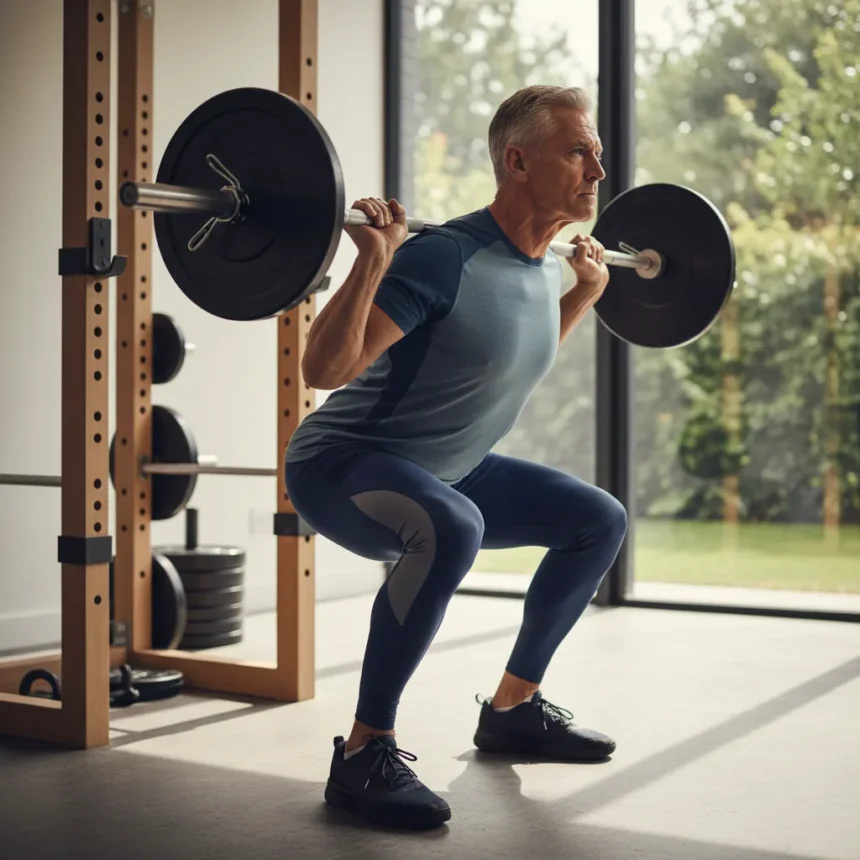
Elite leg strength after 60 is defined by specific, measurable benchmarks that predict real-world function—not gym vanity metrics. The ability to stand from a chair without hands, climb stairs without gripping railings, and maintain balance on uneven ground depends entirely on lower-body power and endurance. For seniors, a 75-second squat hold or 20+ sit-to-stands in 30 seconds signals exceptional strength, mobility, balance, and neuromuscular function.
Key Takeaways
- A 75+ second squat hold indicates elite lower-body endurance and stability after age 60.
- 20+ sit-to-stands in 30 seconds demonstrates exceptional functional leg strength in seniors.
- Bodyweight squats and loaded barbell work (125–200% body weight) represent elite benchmarks for older lifters.
- Squat holds test isometric strength; dynamic tests like sit-to-stands measure power and real-world function.
- Age-specific norms for women aged 60–80 range from 9–17 chair stands in 30 seconds depending on age.
The Squat Hold Test: Your Elite Strength Baseline
The squat hold—an isometric exercise where muscles maintain tension without movement—has become the standard test for elite leg strength after 60. Here’s how it breaks down: holding a squat position for under 20 seconds indicates you’re still building a foundation. Twenty to 45 seconds shows a solid base that supports everyday movement. Forty-five to 75 seconds demonstrates strong, steady tension control. Seventy-five seconds or longer? That’s elite territory. The longer you can hold, the greater your muscular endurance, stability, and ability to recover from falls—all critical for independence as you age.
Why does this matter more than raw strength numbers? Because a 75-second squat hold translates directly to real life. You can stand from a low chair without pushing off with your arms. You can descend stairs one step at a time instead of two. You can stand on one leg while putting on pants without toppling over. These aren’t gym achievements—they’re the difference between living independently and needing help with basic tasks.
Sit-to-Stands: The Functional Strength Test That Matters
The 30-second chair stand test measures how many times you can rise from a seated position without using your arms. For women aged 60–64, the normal range is 12–17 reps; by age 75–79, that drops to 10–15. Hitting 20+ sit-to-stands signals elite functional strength. Men’s benchmarks for this test remain unstated in current research, making direct gender comparison difficult, but the principle holds: more reps mean stronger legs and better real-world mobility.

This test is superior to isolated squat reps because it mimics what your body actually does—rise from sitting, maintain balance, repeat. It taxes your quads, glutes, and stabilizer muscles simultaneously. It also reveals power, not just endurance. A senior who can rip off 20 sit-to-stands in 30 seconds has explosive leg strength, not just the ability to hold a position. That explosive power is what prevents falls and keeps you functional when you trip or stumble.
Building Elite Leg Strength: Progressive Exercises
If your current squat hold maxes out at 30 seconds or your sit-to-stands fall below your age bracket, targeted work will close the gap. Start with eccentric leg lowering: lie on your back, lift one leg until your thighs align, then slowly lower to touch the bed and immediately lift back up. This single-leg work fires your quads and builds quad-specific endurance. Do 2–3 sets of 10–15 reps, focusing on the slow descent—that eccentric phase is where strength gains happen.



Band-resisted squats to a chair add resistance without heavy weights. Place a resistance band around your knees, keep them apart, stick your bottom out, and lower to the chair in 3–4 seconds. The slow descent builds eccentric strength; the band adds resistance without joint stress. Perform 8–15 reps for 3 sets. Tempo squats—holding a dumbbell or book bag at chest height and lowering slowly—work your quads and glutes together while building the control needed for the squat hold test. These progressions work because they target the exact muscle actions your body needs for functional independence.
Barbell Strength Standards: The Loaded Benchmark
For gym-goers serious about measuring elite strength, barbell back squat standards provide a concrete target. Women performing a squat at 100% of their body weight represent extremely strong performance; men at 125% of body weight signal elite strength. Advanced lifters after years of dedicated training can reach 150–200% of body weight, though this requires systematic programming and injury-free training cycles. These numbers dwarf what most seniors pursue—and rightfully so. A 75-year-old does not need to barbell squat at double bodyweight. They need a 75-second squat hold and 15+ sit-to-stands. That’s elite for their demographic.
The distinction matters because online strength standards often blur age categories. A 30-year-old man squatting 200% bodyweight is elite for his age and training status. A 65-year-old man squatting at bodyweight is elite for his age and functional capacity. Conflating the two creates unrealistic expectations and injury risk. Train for your decade of life, not against it.
Why Isometric Holds Reveal What Dynamic Tests Miss
Squat holds and sit-to-stands test different qualities. The hold measures time-under-tension and muscular endurance—your ability to maintain force without fatigue. Sit-to-stands measure power and rate of force development—how quickly you can generate strength. Both predict functional independence, but they reveal different weaknesses. If you can hold a squat for 60 seconds but only manage 12 sit-to-stands, your endurance is solid but your explosive power lags. Conversely, if you rattle off 20 sit-to-stands but collapse into a squat hold after 30 seconds, you have power but lack sustained control. A comprehensive strength program addresses both.



Frequently Asked Questions
How long should I hold a squat if I’m 65 years old?
Aiming for 45–75 seconds demonstrates strong leg strength; 75+ seconds is elite. Start where you are—even 20 seconds is a baseline—and add 5–10 seconds weekly as your quads and glutes adapt. Consistency matters more than starting high.
Can I improve my sit-to-stand reps if I’m over 60?
Yes. Band-resisted squats, eccentric leg lowering, and tempo squats all boost sit-to-stand performance. Most seniors gain 3–5 additional reps within 4–6 weeks of focused training. Progress depends on consistency and proper form—never sacrifice technique for speed.
Is a bodyweight squat elite strength after 60?
A full bodyweight squat—controlled descent and ascent without assistance—signals exceptional strength for most seniors. Many people over 60 cannot perform even one unassisted squat, so completing multiple reps represents elite functional capacity. This is distinct from loaded barbell squats, which require years of training.
Elite leg strength after 60 is not about ego or gym records—it’s about preserving the independence and mobility that define quality of life. A 75-second squat hold and 20+ sit-to-stands are not arbitrary numbers. They represent the threshold where your legs reliably support standing, stair climbing, and balance recovery. Test yourself honestly, identify your gaps, and train consistently. The payoff is not a bigger number on a lift—it’s the ability to live without assistance.
Edited by the All Things Geek team.
Source: Tom's Guide