





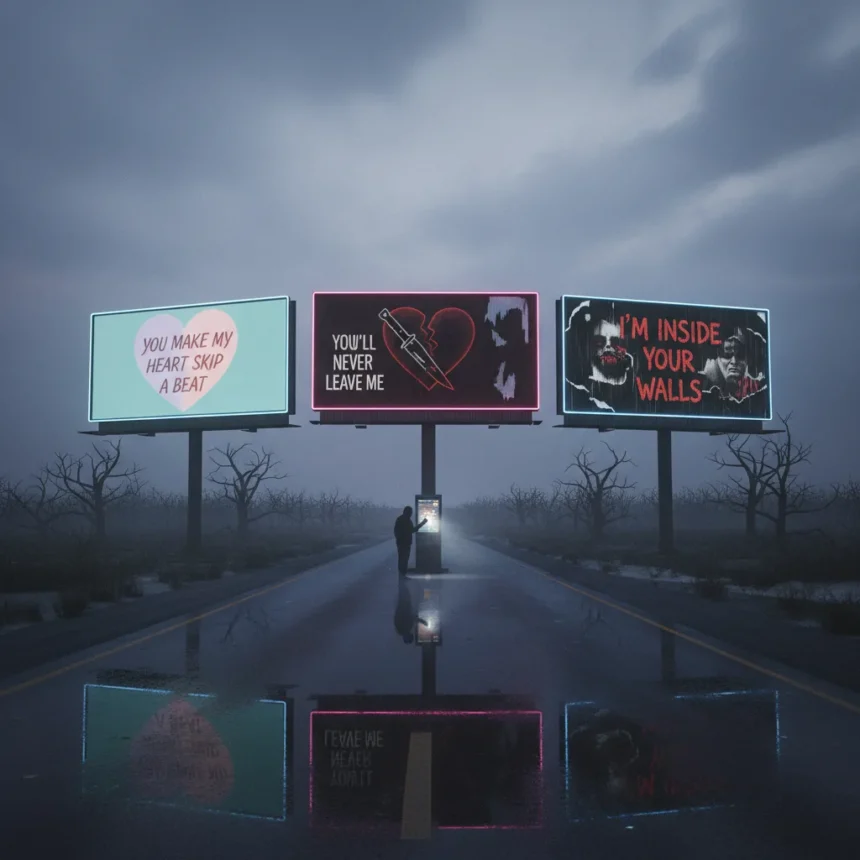
A horror movie billboard campaign that begins as a romantic plea and escalates into psychological terror is reshaping how studios promote films in public space. The campaign for Obsession, arriving in theaters May 15, started with innocent-looking billboards in New York City and Los Angeles asking passersby to text a number with the message: “I love you so so much! Text me?” What viewers didn’t know was that they were entering an interactive horror narrative designed to feel increasingly unsettling.
Key Takeaways
- The horror movie billboard campaign began with romantic messages and progressively escalated to obsessive, threatening language.
- Interactive billboards in NYC and LA invited people to text a mystery number, turning passive advertising into active participation.
- Graffiti-style edits added messages like “are you ignoring me” and “you know I would do anything for you right?” as the campaign evolved.
- The mystery texter was revealed to be Nicki, the creepy antagonist in the horror film Obsession.
- The campaign demonstrates how horror storytelling can blur the line between entertainment promotion and real-world psychological experience.
How the Horror Movie Billboard Campaign Evolved
The horror movie billboard campaign didn’t announce itself as a movie promotion. Instead, it mimicked the escalation pattern of an obsessive relationship, mirroring the psychological arc of the film itself. The initial billboards featured a simple, wholesome declaration: “I love you so so much! Text me?” This phase felt like a genuine romantic gesture—confusing enough to make people curious but not alarming enough to ignore.
As days passed, the billboards transformed. Graffiti-style additions appeared, shifting the tone from romantic to disturbing. New messages included “are you ignoring me” and “you know I would do anything for you right?” The progression was deliberate. Each iteration pushed the emotional narrative further into obsession, mirroring the escalation tactics of an abusive relationship. By the time the campaign revealed its true purpose, viewers had experienced a miniature horror narrative in real time.
Why This Horror Movie Billboard Campaign Works
Traditional film marketing relies on trailers, posters, and social media—passive consumption channels. The horror movie billboard campaign inverted that formula by making the audience active participants. When someone texted the number, they became part of the story. They weren’t just learning about Obsession; they were experiencing it. This participatory element transforms advertising from broadcast messaging into interactive theater. The campaign forced people to make a choice: engage with the mystery or walk away. That choice itself becomes part of the horror experience.

The campaign also weaponizes ambiguity. In the early phases, viewers couldn’t distinguish between a genuine person reaching out and a marketing stunt. That uncertainty—the not-knowing—is the core of psychological horror. By the time the reveal came that the mystery texter was Nicki, the film’s antagonist, the campaign had already planted genuine unease in the minds of everyone who participated. The horror movie billboard campaign succeeded because it didn’t feel like advertising. It felt like something happening to you.
The Horror Movie Billboard Campaign and Film Branding
Horror films face a unique marketing challenge: how do you convey dread without spoiling the experience? Jump-scare trailers often diminish the actual film. Dialogue-heavy teasers can feel cheap. The horror movie billboard campaign solved this by translating emotional tone into real-world interaction rather than relying on visual spectacle. Viewers didn’t need to see monsters or gore to feel genuine discomfort. The escalating messages from a mysterious admirer created a psychological texture that traditional advertising cannot replicate.



This approach also sidesteps the problem of ad fatigue. People ignore billboards. They skip YouTube ads. But when a billboard appears to be changing in real time, when it seems to be responding to the world around it, people stop and pay attention. The horror movie billboard campaign made itself impossible to ignore by making the audience feel personally targeted. Whether that targeting was real or simulated didn’t matter—the feeling was authentic.
Is This the Future of Horror Film Marketing?
The horror movie billboard campaign raises questions about the ethics and effectiveness of immersive advertising. It works because it unsettles people. But can this strategy scale without becoming gimmicky or manipulative? If every horror film launches an escalating text-message campaign, the novelty evaporates and the psychological impact dulls. The campaign’s power lies partly in its surprise—viewers didn’t expect a billboard to participate in their psychology.
What makes the horror movie billboard campaign notable is its restraint. It didn’t rely on gore, jump-scares, or explicit imagery. Instead, it leveraged the oldest tool in horror’s toolkit: the unknown. A text from a stranger. A message that shifts from sweet to sinister. The suggestion of danger rather than its explicit display. For studios willing to take creative risks, this campaign demonstrates that the most effective horror marketing happens in the space between what’s shown and what’s imagined.
Does the horror movie billboard campaign actually convert viewers to ticket sales?
The brief does not specify ticket sales data or conversion metrics for the campaign. The campaign’s effectiveness appears to be measured by its cultural impact—the conversation it generates and the psychological engagement it creates—rather than disclosed box office attribution. Whether participation in the text-message mystery translates directly to theater attendance remains unverified.



What happens when you text the number in the horror movie billboard campaign?
The research brief does not detail what message recipients receive when they text the mystery number or how the interactive experience unfolds after initial contact. The campaign’s mechanics beyond the billboard escalation and the reveal of Nicki as the antagonist are not documented in available sources.
How does the horror movie billboard campaign compare to traditional film advertising?
Traditional film marketing—trailers, posters, social media clips—presents finished content to passive audiences. The horror movie billboard campaign inverts this by creating an unfolding narrative in public space that requires audience participation to fully experience. Rather than showing viewers what the film contains, it makes them feel what the film explores, turning the advertisement itself into a piece of interactive storytelling.
The horror movie billboard campaign succeeds because it understands that marketing doesn’t have to announce itself. The best advertising becomes indistinguishable from genuine experience. By starting as something that felt personal and intimate—a love note on a billboard—and escalating into something unsettling and obsessive, the campaign embedded the film’s psychological core into the real world. Obsession arrives in theaters May 15, but for those who saw the billboards evolve, the experience began weeks earlier. That’s the power of advertising that doesn’t feel like advertising at all.
Edited by the All Things Geek team.
Source: Creativebloq




