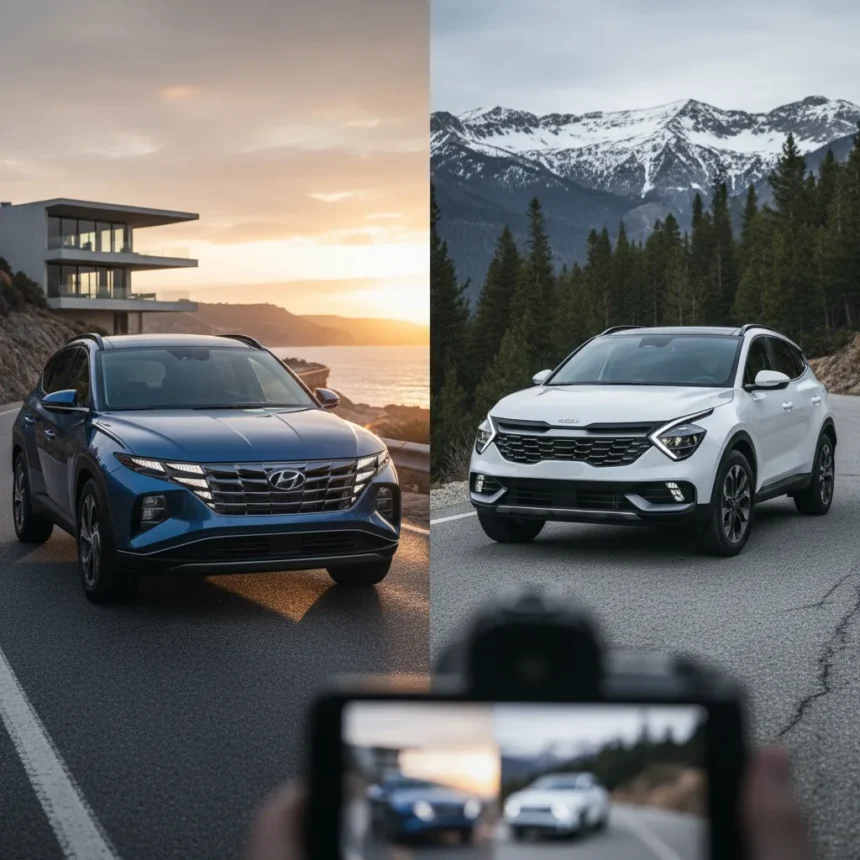
The Hyundai Tucson Hybrid vs Kia Sportage Hybrid decision comes down to one question: are you willing to pay for extra space and premium features, or would you rather maximize fuel economy and save thousands? After a week behind the wheel of each, the answer is clearer than the spec sheets suggest.
Key Takeaways
- The Kia Sportage Hybrid achieves 42 mpg combined, while the Tucson Hybrid averages 32.4 mpg in real-world driving.
- The Tucson Hybrid costs $41,195 for the tested trim; the Sportage Hybrid SX-Prestige costs $40,590—a $605 difference.
- The Tucson Hybrid is larger with more premium features like panoramic roof and adaptive cruise control.
- The Sportage Hybrid excels in convenience features and delivers superior fuel economy.
- For most buyers, the Sportage Hybrid offers better value unless you genuinely need the extra cargo space.
The Core Comparison: Size, Features, and Efficiency
Both the 2026 Hyundai Tucson Hybrid and 2026 Kia Sportage Hybrid share the same platform, yet they target distinctly different buyers. The Tucson Hybrid is the larger, more premium option, while the Sportage Hybrid prioritizes fuel economy and affordability. The tested Tucson Hybrid trim carries a price tag of $41,195, making it only $605 more than the Sportage Hybrid SX-Prestige tested at $40,590. That narrow gap masks a fundamental difference in how each SUV justifies its existence.
The Hyundai Tucson Hybrid delivers a 1.6L turbocharged GDI 4-cylinder hybrid engine producing 231 hp, with an EPA-estimated 35 mpg for the trim tested. In real-world driving over 210.9 miles, the author averaged 32.4 mpg—respectable but not exceptional for a hybrid. The Tucson compensates with a suite of premium features: adaptive cruise control that can keep the vehicle centered in its lane, blind spot camera monitors, a sprawling panoramic roof, and a head-up display. These conveniences create a more upscale cabin experience.
The Kia Sportage Hybrid, by contrast, is engineered for efficiency. It delivers an EPA-estimated 42 mpg combined, a significant advantage over the Tucson. On a short grocery run of just 3 miles, the Sportage Hybrid achieved 76.8 mpg, demonstrating its hybrid system’s effectiveness in city driving. The Sportage base LX trim starts at $30,490, making it the more accessible entry point. The tested SX-Prestige trim includes its own array of useful conveniences: blind spot camera monitors, a dedicated steering wheel button for Lane Following Assist, and a head-up display.

Where the Tucson Hybrid Makes Its Case
The Hyundai Tucson Hybrid’s extra size and premium features create a more concrete value proposition when the price difference is modest. If you regularly transport four or five passengers, haul cargo, or value the psychological comfort of a larger vehicle, the Tucson’s additional interior space justifies its position in the market. The adaptive cruise control that centers the vehicle in its lane is genuinely useful on long highway stretches, and the panoramic roof elevates the daily commute experience—small touches that accumulate into a more premium feel.
The Tucson also appeals to buyers who view their SUV as a statement of intent: a larger, more feature-rich vehicle that signals a step up from the compact class. For families with growing needs or those planning to keep the vehicle for a decade, that extra space and durability may prove invaluable over time. The question is whether that marginal benefit justifies the price when the Sportage Hybrid sits right beside it.



Why the Sportage Hybrid Wins for Most Buyers
Unless you absolutely need the extra space, the Kia Sportage Hybrid is the smarter choice. It delivers 42 mpg combined fuel economy—a 10 mpg advantage over the Tucson—which translates to real savings at the pump over the vehicle’s lifetime. The Sportage’s convenience features, including blind spot camera monitors and Lane Following Assist, are described as genuinely useful tools that elevate the daily commute. These are not gimmicks; they address real-world driving challenges.
The Sportage Hybrid’s greatest strength lies in its balance of efficiency, affordability, and practicality. At $30,490 for the base LX trim, it undercuts the Tucson Hybrid’s entry price significantly, and even the premium SX-Prestige tested costs only $605 more than the Tucson’s tested trim. For buyers prioritizing value, the Sportage Hybrid delivers a compelling package without compromise. You sacrifice some interior space and a few premium touches, but you gain thousands in savings and substantially better fuel economy.
Real-World Testing: What the Numbers Reveal
The Hyundai Tucson Hybrid vs Kia Sportage Hybrid choice becomes stark when you examine real-world fuel economy. The Tucson’s 32.4 mpg actual average falls short of its 35 mpg EPA estimate, suggesting that the hybrid system’s benefits diminish in certain driving conditions. The Sportage Hybrid’s 42 mpg combined rating, coupled with its 76.8 mpg short-trip performance, demonstrates a more efficient hybrid architecture better suited to modern driving patterns. If you commute in stop-and-go traffic, the Sportage’s efficiency advantage becomes even more pronounced.
Pricing proximity creates an interesting dynamic. The tested vehicles differ by only $605, yet that equivalence masks their different philosophies. The Tucson asks you to pay for premium features and space; the Sportage asks you to accept a smaller footprint in exchange for efficiency and value. For most buyers—especially those in urban or suburban environments where fuel economy matters—the Sportage Hybrid’s proposition is stronger.



Is the Hyundai Tucson Hybrid worth the extra cost?
Only if you genuinely need the extra cargo space, more premium features, or prefer a larger vehicle. The Tucson Hybrid’s $41,195 tested price point is competitive, but the Sportage Hybrid SX-Prestige delivers nearly equivalent features at $40,590 with superior fuel economy. The Tucson’s panoramic roof and adaptive cruise control are nice, but they don’t offset the Sportage’s 10 mpg advantage in combined fuel economy.
Which trim level should you choose?
For the Kia Sportage Hybrid, the SX-Prestige trim balances features and value effectively, including blind spot cameras and Lane Following Assist. If budget is tight, the base LX at $30,490 offers solid fundamentals. For the Hyundai Tucson Hybrid, the tested trim at $41,195 includes the premium features that justify its size, though buyers should verify whether those features justify the price against the Sportage Hybrid’s offering.
The Hyundai Tucson Hybrid vs Kia Sportage Hybrid showdown reveals that platform-sharing doesn’t guarantee identical value propositions. The Sportage Hybrid wins for efficiency-focused buyers who don’t need maximum interior space, while the Tucson Hybrid appeals to those prioritizing premium features and larger dimensions. For the vast majority of compact SUV shoppers, the Sportage Hybrid’s combination of fuel economy, affordability, and convenience features delivers the stronger case. The Tucson is a fine vehicle—it’s just that the Sportage Hybrid is the smarter financial choice unless you have a specific need for extra space.
Edited by the All Things Geek team.
Source: Tom's Guide