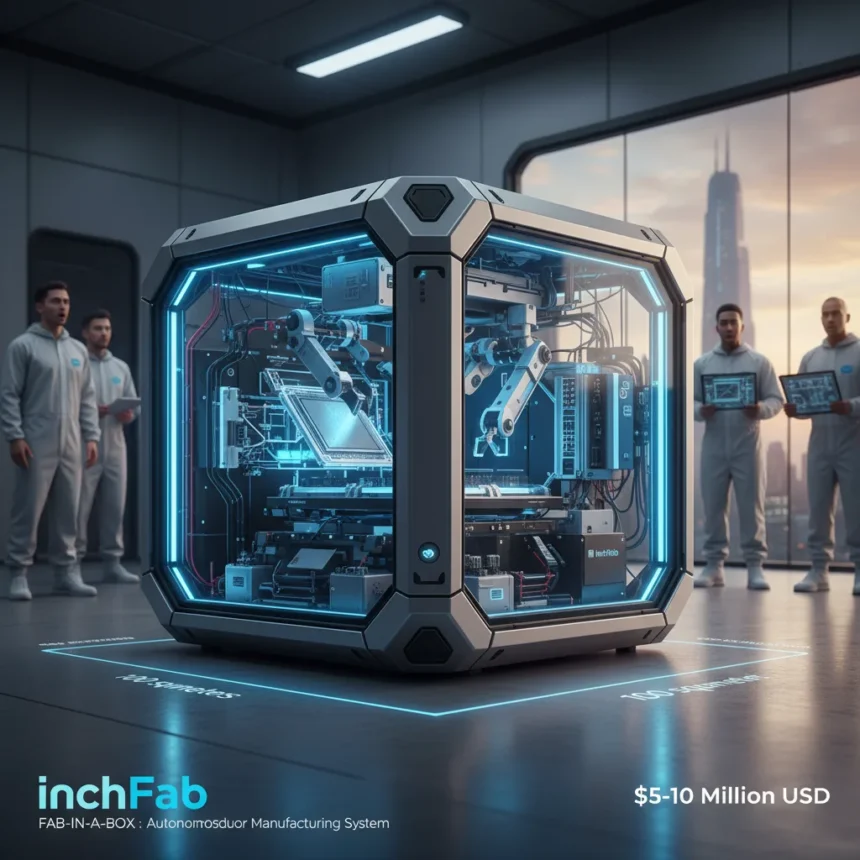
InchFab is building a semiconductor fab-in-a-box system designed to make chip manufacturing accessible to smaller companies and individual innovators who cannot justify access to a multi-billion-dollar foundry. The company’s pitch is simple: application-specific fabs built around the principle “One Application One Fab One Chip.” Instead of treating semiconductor fabrication as an industrial monopoly, InchFab wants to shrink it into something modular, affordable, and deployable by organizations that have historically been locked out of custom chip production.
Key Takeaways
- InchFab’s fab line costs $5–10 million and occupies roughly 100 square meters of floor space
- The company estimates approximately 80% of current products cannot economically justify a traditional multi-billion-dollar fab
- InchFab originated from MIT PhD research aimed at democratizing semiconductor fabrication
- The business model shifted from foundry services to manufacturing lines that customers can operate independently
- The platform is modular, allowing fabrication processes to adapt as customer needs change
Why Compact Semiconductor Manufacturing Matters Now
The semiconductor fab-in-a-box concept arrives at a moment when industries increasingly demand flexibility and cost-effectiveness over scale. Traditional semiconductor manufacturing requires billions of dollars in capital investment and serves high-volume, standardized products. But according to Mitchell Hsing, InchFab’s co-founder, roughly 80% of today’s products do not justify those economics. A medical device manufacturer needing a custom sensor chip, a robotics company requiring specialized control circuitry, or an automotive supplier building application-specific processors—none of these organizations need a fab capable of producing billions of units annually. They need something smaller, cheaper, and faster to market.
InchFab’s approach mirrors what IBM did for personal computers: take a technology once reserved for massive corporations and make it accessible to smaller players. The historical parallel is apt. IBM did not invent the PC, but it standardized and commodified the form factor, enabling a wave of compatible hardware and software innovation. InchFab is attempting something similar for semiconductor fabrication—not inventing the technology, but packaging it into a modular, repeatable unit that lowers the barrier to entry.
How the Semiconductor Fab-in-a-Box Works
InchFab’s system is compact by design. The entire fab line occupies approximately 100 square meters—roughly the size of a large residential apartment—and costs between $5 million and $10 million. For context, a state-of-the-art semiconductor fab built by Intel or TSMC can span over 100,000 square meters and cost upwards of $10 billion. InchFab’s footprint is roughly 1,000 times smaller and its capital requirement is roughly 1,000 times lower.

The company originated from PhD research at MIT, where Hsing and his co-founder focused on democratizing fabrication at the micro scale. Rather than trying to compete with giant foundries on volume or latest process nodes, InchFab targets a different market: companies that need custom chips but lack the capital or production volume to justify traditional foundry access. The platform is modular, meaning fabrication processes can be adapted as customer requirements change. This flexibility is critical because application-specific manufacturing is inherently variable—each customer’s needs differ, and a rigid system cannot serve that diversity.
The Business Model Shift: From Foundry Services to Manufacturing Lines
InchFab’s business strategy has evolved. The company initially pursued a foundry services model—customers would send designs, and InchFab would manufacture chips in-house. That model quickly proved limiting. Instead, InchFab shifted to selling manufacturing lines themselves, allowing customers to operate their own fabs independently. This is a crucial distinction. A customer buying a fab-in-a-box gains control over their production schedule, intellectual property, and supply chain. They are no longer dependent on a third-party foundry’s capacity or pricing.



This shift reflects a deeper insight: many organizations would rather own and operate their own fabrication capability than outsource it. The capital barrier has been the only thing stopping them. By reducing that barrier from billions to tens of millions, InchFab opens a new market segment that traditional foundries ignore because it is too small to be profitable for them.
Semiconductor Fab-in-a-Box Versus Traditional Foundry Economics
The contrast between InchFab’s model and traditional semiconductor foundries is stark. A conventional fab is a centralized, high-volume operation. It achieves economies of scale by running the same processes repeatedly across thousands of customer designs. That model works beautifully for products like smartphone processors, memory chips, and other high-volume commodities. But it is terrible for niche, application-specific chips where production volume is measured in thousands or tens of thousands, not millions.
Traditional foundries have no incentive to serve these smaller customers. The fixed costs of running a fab are so enormous that a small production run does not justify the overhead. InchFab’s decentralized model flips this logic. Instead of one massive fab serving many customers, many smaller fabs each serve one or a few customers. The unit economics work because the fab itself is cheaper to build and operate.
What Could This Enable?
If InchFab’s vision succeeds, the implications are significant. Smaller companies could design and fabricate custom chips without needing billions in capital or years of lead time. Universities could build fabs for research. Startups could iterate on silicon designs as easily as they iterate on software. Industries from medical devices to agriculture to aerospace could access custom semiconductors that are currently economically unfeasible.



The broader concept is decentralized fabrication—moving chip manufacturing from a few giant fabs concentrated in Taiwan, South Korea, and the United States to a more distributed model where fabrication happens closer to where chips are designed and used. This has geopolitical, economic, and innovation implications that extend far beyond InchFab itself.
Is InchFab’s fab-in-a-box actually affordable compared to traditional fabs?
Yes. InchFab’s system costs $5–10 million and occupies 100 square meters, compared to traditional fabs that cost $10 billion or more and span over 100,000 square meters. This makes it accessible to mid-sized companies and well-funded startups that could never afford a conventional fab.
What products could benefit from a semiconductor fab-in-a-box?
Application-specific chips that do not justify high-volume production are the primary target. Medical sensors, automotive control systems, robotics processors, and specialized industrial electronics are all candidates. Any product requiring custom silicon but produced in relatively small quantities could benefit from InchFab’s model.
How does InchFab’s approach differ from traditional semiconductor foundries?
Traditional foundries operate centralized, high-volume fabs serving many customers. InchFab’s model is decentralized—customers buy or operate their own fab-in-a-box for application-specific production. This eliminates dependence on foundry capacity and allows for greater flexibility and control over intellectual property.
InchFab represents a genuine attempt to reshape semiconductor manufacturing economics. Whether it succeeds will depend on execution, customer adoption, and whether the real-world challenges of operating a fab can be solved at the smaller scale. But the concept is sound: if 80% of products cannot justify a $10 billion fab, there is a massive untapped market for something cheaper and smaller. InchFab is betting that market is worth building for.
Edited by the All Things Geek team.
Source: TechRadar