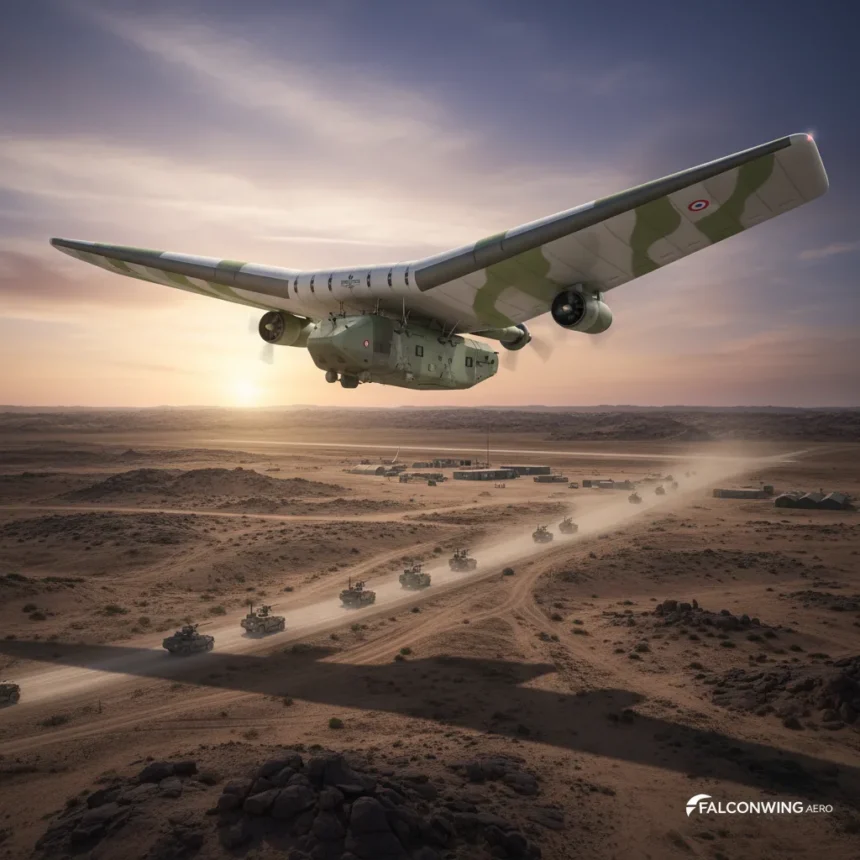
An inflatable wing cargo drone represents a fundamental rethinking of how military logistics systems are built and deployed. Unlike traditional rigid-frame cargo drones that rely on complex structural engineering, this French startup’s approach uses an inflatable wing to generate aerodynamic lift—not buoyancy—making the system lighter, more portable, and easier to maintain in field conditions.
Key Takeaways
- The inflatable wing cargo drone generates lift through aerodynamics, not buoyancy or gas inflation.
- The design replaces traditional rigid airframes with a collapsible, portable structure.
- The system is intended for autonomous resupply missions on the battlefield.
- Simplified maintenance operations are a core advantage over conventional cargo drones.
- The concept could fundamentally alter how military logistics are conducted in combat zones.
How the Inflatable Wing Cargo Drone Works
The core innovation behind the inflatable wing cargo drone lies in its aerodynamic principle. The inflatable wing generates lift through the same physics that propels traditional aircraft—pressure differences across a wing surface—rather than relying on buoyancy or helium inflation. This distinction matters because it means the drone operates as a true flying vehicle, not a lighter-than-air platform. The inflatable structure allows the entire airframe to compress and pack down for transport, addressing one of the biggest logistical headaches in modern warfare: getting resupply equipment into austere or forward-deployed locations where traditional rigid drones cannot fit.
By eliminating the rigid fuselage, the inflatable wing cargo drone reduces manufacturing complexity and structural failure points. Traditional cargo drones require precision-engineered frames, welded joints, and complex assembly procedures. An inflatable design simplifies this dramatically. When the drone arrives at a forward operating base, ground crews can deploy it with minimal tools and training, then pack it away just as quickly. This portability makes the system far more practical for rapid resupply operations where speed and simplicity are survival factors.
Why Battlefield Logistics Need This Design
Autonomous resupply missions are among the most dangerous and time-consuming operations in modern warfare. Traditional cargo drones require secure landing zones, recovery teams, and often need to return to established bases. An inflatable wing cargo drone changes this calculus by being deployable from nearly anywhere and requiring minimal ground infrastructure. The drone can be packed into a vehicle, carried by a small team, or stored in confined spaces—capabilities that rigid-frame systems simply cannot match.

The simplified maintenance advantage cannot be overstated. In combat environments, repair facilities are often nonexistent or severely limited. A rigid drone with a damaged fuselage section might be permanently grounded. An inflatable wing system can often be patched in the field using basic materials and techniques, keeping the drone operational far longer than its rigid counterpart. This resilience under austere conditions is precisely what military logistics planners are seeking as they rethink how to support distributed, fast-moving forces.
Inflatable Wing Cargo Drone vs. Traditional Rigid Systems
The contrast between an inflatable wing cargo drone and conventional rigid-frame cargo drones reveals why this design matters. Traditional systems excel at carrying heavy payloads over long distances from established bases—they are optimized for volume and predictability. But they are also expensive, require dedicated maintenance infrastructure, and cannot be quickly repositioned. The inflatable wing design trades some payload capacity and range for portability, ease of repair, and rapid deployment. For battlefield resupply, where speed and flexibility often matter more than maximum cargo volume, this trade-off strongly favors the inflatable approach.



Rigid drones also demand precision manufacturing and careful handling. A structural crack in the fuselage or a bent frame member can compromise the entire vehicle’s integrity. An inflatable wing system is inherently more forgiving—minor punctures can be sealed, and the flexible structure absorbs impacts that would damage a rigid frame. This durability in harsh field conditions is a genuine operational advantage that extends aircraft lifespan and reduces logistics burden on already-stretched military supply chains.
Could This Change How Wars Are Fought?
The article’s framing suggests the inflatable wing cargo drone could fundamentally alter military logistics doctrine. If autonomous resupply becomes truly decentralized—if small teams can deploy drones from anywhere without fixed infrastructure—then the entire structure of forward operating bases and supply lines shifts. Units can move faster, operate more independently, and respond to opportunities without waiting for traditional logistics pipelines. This matters because in modern conflict, speed and distributed operations often determine outcomes.
However, the technology’s real impact depends on scaling and reliability. A concept that works in testing may face challenges in actual combat: harsh weather, electromagnetic interference, or enemy countermeasures could limit effectiveness. The inflatable wing cargo drone is a promising innovation, but like all military technology, its true value will only be proven through sustained operational use. For now, it represents a meaningful step toward more flexible, resilient battlefield logistics.
What Makes This Design Practical for Soldiers?
Soldiers in the field care about three things: speed, reliability, and simplicity. The inflatable wing cargo drone addresses all three. A rigid drone might require a trained technician to diagnose and repair. An inflatable wing system can be serviced by anyone with basic field training. This democratization of maintenance is revolutionary for military logistics, where skilled personnel are scarce and every hour of downtime costs lives.



The portability factor cannot be understated either. A rigid cargo drone occupies significant space in a vehicle or cargo container. An inflatable wing system can be rolled up and carried by two soldiers, then deployed in minutes. For rapid response scenarios—a unit pinned down and needing ammunition or medical supplies—this speed advantage could be decisive. The system transforms resupply from a scheduled, centralized operation into an on-demand, distributed capability.
Is the inflatable wing cargo drone ready for deployment?
The available information indicates the system has been tested and is being discussed as a novel concept, but there is no confirmation of large-scale operational deployment or production timelines. The technology appears to be in active development by the French startup, with military interest clear, but full-scale adoption likely remains months or years away.
How does an inflatable wing generate lift without helium or gas?
The inflatable wing generates aerodynamic lift the same way traditional aircraft wings do: through the shape and angle of the wing surface relative to airflow. The inflation simply maintains the wing’s structural shape. The lift comes from pressure differences across the wing, not from buoyancy—a critical distinction that makes this a true flying vehicle rather than a balloon-based system.
Could soldiers repair an inflatable wing cargo drone in the field?
Yes. The inflatable design is inherently simpler to repair than rigid structures. Minor punctures can be sealed with patches, and the flexible material is more forgiving of impact damage. This field-repair capability is one of the system’s primary advantages over traditional rigid-frame cargo drones, which often require specialist technicians and replacement parts.
The inflatable wing cargo drone represents a pragmatic rethinking of military logistics technology. It sacrifices some performance metrics for portability, simplicity, and resilience—exactly the trade-offs that forward-deployed units need. Whether it ultimately transforms warfare depends on whether it scales reliably and whether militaries commit to restructuring their logistics around distributed, autonomous resupply. For now, it is a genuinely novel approach to a problem that has vexed military planners for decades.
Edited by the All Things Geek team.
Source: TechRadar