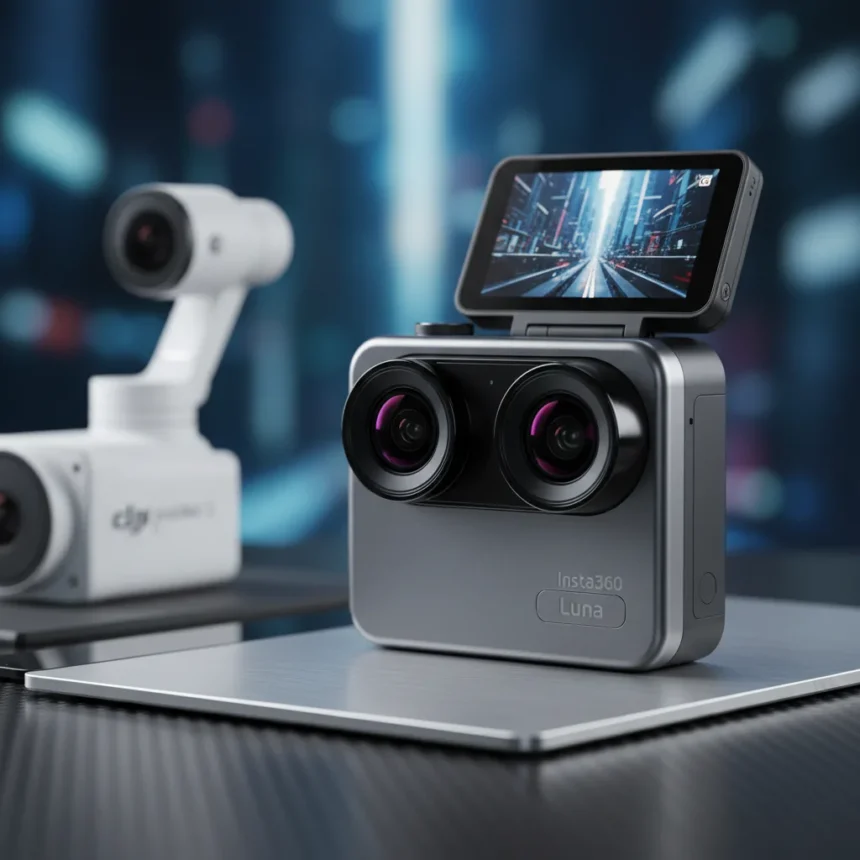
The Insta360 Luna vlogging camera marks the company’s boldest push into DJI’s pocket-gimbal territory, and it is not playing the budget game. Insta360 has built its reputation on 360-degree cameras, but Luna abandons that niche entirely to compete directly with the DJI Osmo Pocket 4 and Pocket 4P with a premium-focused strategy. The co-founder was explicit: “We’re not going to compete on price”.
Key Takeaways
- Insta360 Luna comes in two versions: single-lens Pro and dual-lens Ultra, targeting DJI Pocket 4 and 4P respectively
- Both models feature a Type 1 sensor with f/1.8 Leica-engineered lens and 10-bit color support
- Luna Ultra includes 1x main camera and 3x telephoto with up to 6x lossless zoom and 12x digital zoom
- Removable screen with built-in microphone enables solo creators to frame and present themselves remotely
- 3-axis gimbal stabilization matches DJI’s architecture but Luna’s dual-lens design is the key differentiator
Why Insta360 Is Betting on Premium Over Price
Insta360’s refusal to undercut DJI on price reveals a strategic shift. Instead of flooding the market with a cheaper alternative, the company is building a feature-first competitor that targets creators who value hardware quality and workflow flexibility over cost savings. The Insta360 Luna vlogging camera’s positioning suggests the market has matured beyond race-to-the-bottom pricing in the creator-camera category.
This approach mirrors how smartphone makers like Apple and Samsung compete—not by being cheaper, but by offering exclusive capabilities that justify premium positioning. For Insta360, that means the removable screen with integrated microphone becomes more than a convenience; it is a genuine productivity tool for solo vloggers who need to frame themselves while maintaining gimbal stability. DJI’s Pocket cameras lack this removable display with built-in audio, forcing creators to use external rigs or accept limited self-presentation options.
The Insta360 Luna vlogging camera’s Dual-Lens Advantage Over DJI
The Luna Ultra’s dual-camera setup is the strongest argument for choosing Insta360 over DJI. Where the DJI Pocket 4P offers a single fixed focal length, the Luna Ultra pairs a 1x main wide-angle camera with a 3x telephoto lens, delivering five distinct zoom steps through a combination of 6x lossless zoom and 12x digital zoom. This flexibility matters for vloggers who need to shoot multiple framing styles without swapping hardware or sacrificing image quality.

The main camera uses a 1-inch sensor design paired with an f/1.8 Leica-engineered lens, while both models support 10-bit color recording. These specs are not minor upgrades—10-bit color grading flexibility is typically reserved for cinema cameras, and the Leica lens partnership signals optical quality that DJI has not emphasized in its Pocket lineup. The 3-axis gimbal stabilization matches DJI’s proven architecture, but the sensor and optics pairing suggests Insta360 is targeting image quality parity or superiority rather than feature parity.
What the Removable Screen Means for Solo Creators
The removable display with built-in microphone is Insta360’s most creator-centric feature. For vloggers shooting alone, this solves a real problem: framing yourself while maintaining gimbal stability and monitoring audio levels. The screen detaches, allowing creators to position it for self-facing shots while the gimbal remains stable, and the integrated microphone means cleaner audio capture without dangling external mics.



DJI’s Pocket cameras rely on smartphone mounting or external monitor solutions, adding bulk and complexity. By integrating the screen and microphone, Insta360 Luna vlogging camera reduces friction in the solo-creator workflow. Subject tracking rounds out the feature set, automating framing adjustments so creators can focus on performance rather than camera control.
Insta360 Luna vlogging camera Availability and Pricing Questions
Neither official pricing nor launch timing has been confirmed, leaving significant uncertainty about market positioning. Without price information, it is impossible to assess whether Insta360’s premium feature set justifies a premium price tag or if the company is targeting price parity with DJI while offering superior hardware. The dual-lens Ultra likely commands a higher price than the single-lens Pro, mirroring DJI’s Pocket 4 and 4P positioning, but exact figures remain unannounced.
This silence is strategic—Insta360 can generate buzz around features and specifications without committing to a price that might undercut its own positioning or alienate early adopters. Once pricing is revealed, the real competition with DJI begins.
Can Insta360 Really Challenge DJI’s Pocket Dominance?
DJI has owned the pocket-gimbal category through brand recognition, ecosystem maturity, and proven reliability. The Pocket 4 and 4P have a massive installed base of creators, and switching costs are real—existing accessories, learned workflows, and ecosystem familiarity create friction. Insta360 Luna vlogging camera enters this market as a challenger with superior hardware on paper but zero installed base.



The dual-lens Ultra is genuinely differentiated. DJI’s single fixed focal length is a deliberate design choice that simplifies the gimbal and keeps weight down, but it also limits framing flexibility. Insta360’s willingness to add a telephoto module and the complexity that comes with it suggests confidence in execution and a bet that creators value zoom flexibility enough to adopt new hardware.
What remains unknown is whether the feature advantages translate to real-world preference. Build quality, software responsiveness, battery life, and overall reliability will determine adoption. On specs alone, Insta360 Luna vlogging camera has a credible case. Whether that case converts creators away from DJI depends on factors not yet revealed.
Is the Insta360 Luna Ultra worth switching from DJI Pocket 4P?
If the dual-lens zoom flexibility and removable screen with microphone align with your workflow, yes—provided pricing is competitive. For creators who need multiple focal lengths or frequently shoot solo self-facing content, Luna Ultra offers genuine advantages DJI does not. However, DJI’s ecosystem maturity and proven reliability remain compelling reasons to stay, especially if price significantly exceeds the Pocket 4P.
What makes the removable screen on Insta360 Luna vlogging camera important?
The built-in microphone and detachable design enable solo creators to frame themselves while maintaining gimbal stability and capturing clean audio. DJI’s Pocket cameras require external solutions for similar functionality, adding complexity and weight to the rig.
How does the Luna Ultra’s zoom compare to DJI Pocket 4P?
The Luna Ultra offers 6x lossless zoom plus 12x digital zoom through its dual-camera setup. DJI Pocket 4P uses a single fixed focal length with digital zoom only, giving Luna significantly more framing flexibility for varied shot composition.
Insta360’s Luna vlogging camera represents a genuine challenge to DJI’s pocket-gimbal dominance, but only if execution matches ambition. The hardware specifications suggest serious engineering, and the premium positioning signals confidence. Whether creators adopt Luna depends on pricing transparency, real-world reliability, and whether the feature advantages overcome DJI’s ecosystem advantage. The market is ready for a credible alternative—Insta360 may have finally built one.
Edited by the All Things Geek team.
Source: TechRadar