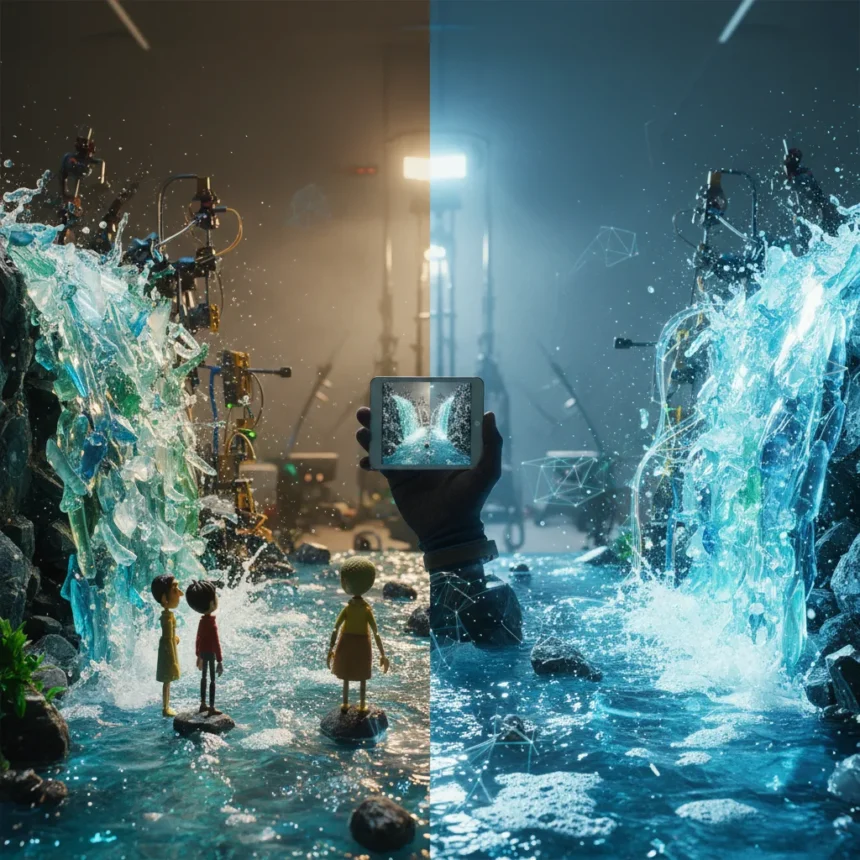
Water in stop-motion animation has always been a technical nightmare. Laika studios, the Portland-based animation house behind Coraline, Kubo and the Two Strings, and Missing Link, has spent nearly two decades solving this problem through a hybrid approach combining practical effects with digital simulations. The studio recently revealed its methods through the “Craft in Motion” series, exposing techniques that range from 3D-printed water strands fitted with magnets to full-scale fluid dynamics simulations.
Key Takeaways
- Laika uses 3D-printed replacement animation for controlled water effects like shower streams and toilet water in Coraline.
- “Rig water”—a mixture animators control frame-by-frame—creates dribbling effects and puddles that stay in place.
- Kubo and the Two Strings integrated CGI water simulations with stop-motion puppets using accurate object tracking.
- Practical setups include a sheet of glass and tennis racket for wave motion, plus two discs creating caustic highlights.
- Missing Link employed rigid body and fluid dynamics simulations for large-scale water effects like collapsing ice bridges.
The Coraline Shower: Printing Water Frame by Frame
In Coraline (2009), the infamous shower scene featuring rusty, rancid water required a solution that did not exist before. Laika animators used rapid prototyping (RP) 3D printers to manufacture individual strands of water for each frame of animation. These tiny printed segments were fitted with magnets, allowing animators to position and swap them precisely as the camera rolled. The technique was labor-intensive but gave complete control over the water’s appearance and movement. Water shooting from the toilet used the same replacement animation method—each frame required a freshly printed water segment positioned in the set.
For dribbling effects down bathroom walls, the team developed what they call “rig water,” a specially mixed liquid that animators could manipulate to form puddles without flowing away. Once a puddle was formed, it stayed exactly where the animator placed it, eliminating the unpredictability of real water. This hybrid approach—printed solids for splashing streams, mixed liquid for static pooling—became foundational to Laika’s water toolkit. “Water in stop motion is usually very difficult to achieve. So we’ve come up with a novel way of solving that issue. We really wanted to keep everything practically,” the animators explained.
Practical Rigs That Fake Motion and Light
Beyond individual water elements, Laika developed larger practical setups to simulate water movement and reflections. One rig uses a simple sheet of glass with a huge tennis racket moved left-to-right behind it to create the illusion of wave motion across the set. Another setup employs two rotating discs positioned to cast dancing highlights—caustics—onto walls and surfaces, mimicking the natural light patterns water creates. These practical tricks cost nothing compared to rendering time and integrate smoothly with the hand-crafted aesthetic of stop-motion puppets.

These setups appear across multiple Laika films: Coraline, ParaNorman, The Boxtrolls, Kubo and the Two Strings, and Missing Link. The consistency of approach suggests that once Laika solved the fundamental problem, the studio iterated on the same core techniques rather than reinventing water effects for each project. The practical methods prioritize animator control and visual consistency with the deliberately crafted look of stop-motion.
Kubo’s Leap: Blending CGI Water With Puppet Physics
As Laika’s films grew in scope and ambition, purely practical water became impractical. Kubo and the Two Strings (directed by Travis Knight) marked a shift toward digital water effects integrated with stop-motion puppets. Rather than replacing practical methods, Kubo used CGI water simulations to handle expansive ocean scenes and complex interactions that would be nearly impossible to achieve frame-by-frame with printed parts.



The key to making digital water feel at home in a stop-motion film was scale and physics accuracy. Brian Horsley, a visual effects supervisor on the project, explained the approach: “The stop motion at LAIKA is so smooth that really all we needed was an accurate object track for the puppets and to simulate water around the characters as one would normally”. This means animators tracked the precise position and movement of each puppet, then simulated water responding to those movements as if the puppets were human-sized. The collaboration between practical animation and digital effects required constant communication to ensure water looked like it belonged in the same frame as hand-crafted puppets.
Missing Link and Large-Scale Water Simulations
By Missing Link, Laika had refined its digital approach enough to handle massive water sequences. The film employed rigid body and fluid dynamics simulations for water effects and a collapsing ice bridge sequence. These simulations went beyond simple water interaction—they modeled how ice and water behave together under physical stress, creating effects that would be impossible to achieve practically without destroying expensive sets.
The evolution from Coraline’s printed water strands to Missing Link’s fluid dynamics represents not a rejection of practical methods but an expansion of the toolkit. Laika still uses 3D printing and rig water where practical effects serve the story better. The studio chooses digital simulation when the scope of a scene—an ocean, a flood, a collapsing structure—demands it. “That’s a really, really important thing that we learned early on when the scope of these films started to just grow… How do we do that in a way that we can create visuals that feel that they belong in the stop motion hand-crafted environment? The answer to that was largely through collaboration,” an Laika animator noted.
Why Laika’s Approach Matters Beyond Stop-Motion
Water in stop-motion animation reveals a broader principle: the best visual effect is the one that solves the immediate creative problem with the fewest compromises. A 3D-printed water strand does not look like real water under a microscope, but it looks exactly right in a stop-motion film because it exists in the same physical space as the puppets. A fluid simulation might be more physically accurate, but it only works if the animator tracks the puppet correctly and the compositor integrates it smoothly. Laika’s hybrid approach acknowledges that different shots demand different solutions.



The studio’s “Craft in Motion” series, which showcased these techniques, reflects a philosophy of transparency about how animation actually works. Rather than hiding the seams between practical and digital, Laika celebrates the ingenuity required to make water behave on a miniature set. This is not a limitation of stop-motion—it is the discipline’s unique strength.
How does Laika create shower water in stop-motion?
Laika uses rapid prototyping 3D printers to manufacture individual water strands for each frame of animation in shower scenes. These printed segments are fitted with magnets for precise positioning and are swapped frame-by-frame as the camera rolls, giving animators complete control over the water’s appearance.
What is rig water and how does it work?
Rig water is a specially mixed liquid that animators control to form puddles and dribbling effects without the unpredictability of real water. Once placed, it stays exactly where the animator positions it, eliminating flow and allowing frame-by-frame manipulation.
Why does Laika use both practical and digital water effects?
Practical effects like 3D printing and rig water give animators precise control for close-up shots and small-scale interactions. Digital simulations handle large-scale sequences—oceans, floods, collapsing bridges—that would be impractical to achieve by hand while maintaining the hand-crafted aesthetic of stop-motion.
Laika’s water techniques reveal that stop-motion animation is not a limitation to overcome but a discipline with its own logic and elegance. By combining 3D printing, mixed liquids, practical rigs, and digital simulation, Laika has made water a character in its own right—no longer an obstacle, but a storytelling tool that feels as carefully crafted as every puppet and set piece on screen.
Edited by the All Things Geek team.
Source: Creativebloq