





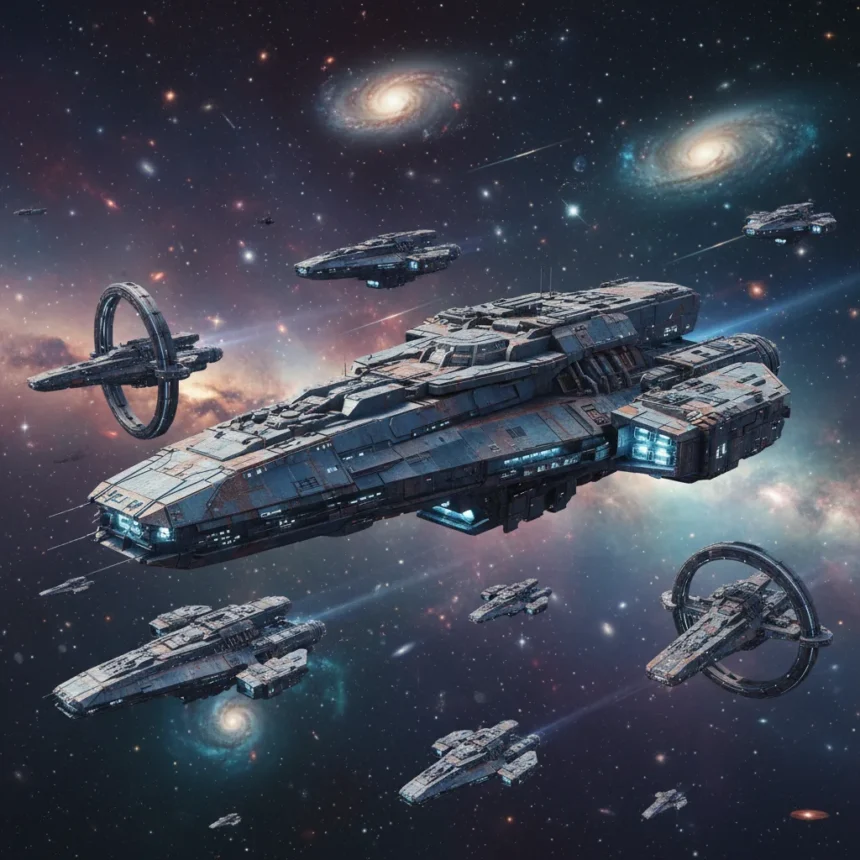
Spacecraft design standout requires more than rendering metallic hulls and adding glowing panels. Mark Zhang, a freelance concept artist based in Hangzhou, China, has built a reputation by understanding how mechanical intricacy plays against the vastness of space itself.
Key Takeaways
- Mark Zhang specializes in science fiction and futuristic spacecraft concept art.
- His portfolios on ArtStation and personal site showcase entertainment industry work.
- Spacecraft designs gain visual impact through contrasting detailed mechanics with cosmic emptiness.
- Contact for collaborations available at [email protected].
- All artworks carry copyright protection under Mark Zhang’s name.
Who is Mark Zhang and what makes his spacecraft designs different
Mark Zhang is a freelance concept artist and digital illustrator specializing in science fiction and futuristic concept art, with a particular focus on spacecraft and spaceship design. Based in Hangzhou, China, he maintains professional portfolios on ArtStation and a personal website at markzhang.art, where potential collaborators and enthusiasts can explore his work. His background spans multiple entertainment industry projects, giving him practical insight into how concept art translates to production environments.
What distinguishes Zhang’s approach from generic space art is his understanding of scale and contrast. A spacecraft design stands out not because every surface is detailed, but because those details exist in deliberate relationship to the emptiness surrounding them. When a viewer encounters one of Zhang’s pieces, they see a vessel that feels tangible—rivets, panel lines, structural reinforcement—set against the infinite black of space. This contrast creates visual tension that holds the eye.
The contrast principle in spacecraft design standout
The core insight behind spacecraft design standout is architectural: intricate mechanical elements gain power when positioned against vast, simple backgrounds. Zhang leverages this principle by treating the cosmos not as decoration but as a compositional tool. A detailed spacecraft loses impact if surrounded by equally busy nebulae, asteroid fields, or space stations. Conversely, a vessel with thoughtful mechanical complexity becomes almost monumental when isolated against deep space.

This approach mirrors how industrial designers approach product visualization. A camera’s internal mechanism becomes more impressive when shown against a clean white background than when surrounded by competing visual noise. In spacecraft design, the cosmos serves the same function—it isolates the subject and forces the viewer to confront the engineering.
How mechanical detail elevates spacecraft design standout
Spacecraft design standout depends heavily on what Zhang calls intentional detailing. Not every surface needs texture, but the surfaces that receive attention should reflect plausible engineering logic. Engine housings, thermal radiators, docking mechanisms, and structural supports should suggest function. A thruster array positioned asymmetrically reads as purposeful; identical repeated elements read as lazy.



The difference between memorable spacecraft and forgettable ones often comes down to this specificity. A generic spaceship has smooth sides and glowing windows. A standout design has solar panel articulations, visible cargo bay doors, heat-scarred hull sections, and asymmetrical propulsion systems that suggest the vessel evolved to solve real problems. Zhang’s work demonstrates that viewers—even casual ones—unconsciously recognize the difference between arbitrary detail and purposeful engineering.
Building a spacecraft design standout portfolio
For artists pursuing this direction, Zhang’s public portfolios offer accessible reference points. His ArtStation profile and personal website showcase completed projects and working approaches. Collaboration inquiries can be directed to [email protected] for those interested in commissioning similar work.
The path to making spacecraft design standout involves studying real spacecraft engineering—not for photorealism, but for logic. How do actual satellites manage heat? Where do solar panels actually mount? What do thruster clusters look like? This research informs every design choice, even in purely fictional vessels. The result feels inevitable rather than arbitrary.
Does spacecraft design standout require photorealism
No. Zhang’s work proves that spacecraft design standout succeeds through clarity and purposeful contrast, not necessarily photographic accuracy. Stylized rendering, painterly brushwork, and even graphic simplification work when the underlying design logic is sound. What matters is that the vessel reads as engineered, not imagined.



Can spacecraft design standout work in crowded scenes
Yes, but with discipline. A spacecraft design standout in a crowded composition requires either scale dominance (making it significantly larger than surrounding elements), tonal dominance (making it significantly lighter or darker), or compositional dominance (placing it at a visual focal point). The principle remains: contrast creates impact. In a busy scene, that contrast becomes harder to achieve, which is why many concept artists isolate their spacecraft against clean backgrounds.
How do you develop a personal style in spacecraft design
Style emerges from consistent decision-making about what details matter. Some artists favor angular, aggressive designs. Others prefer organic, flowing forms. Zhang’s approach—emphasizing mechanical authenticity and cosmic isolation—is a recognizable stylistic choice. Developing your own style requires making similar commitments: deciding what your spacecraft designs communicate, what aesthetic language you speak, and how you’ll use contrast to make them stand out.
The lesson from Mark Zhang’s spacecraft design standout work is that concept art succeeds when it serves a purpose beyond decoration. Whether designing for film, games, or personal projects, the most memorable spacecraft emerge from artists who understand engineering logic, compositional contrast, and the power of simplicity. A vessel designed with intention, set against infinite space, will always outshine a busy jumble of random details. That principle transcends medium and remains the foundation of standout spacecraft design.
Where to Buy
26% OFFHUIONInspiroy H640p Drawing Tablet$27.99$37.99shop now | 20% OFFXPPenArtist 12$159.99$199.99shop now | 19% OFFXPPenArtist 13.3 Pro V2$209.99$259.99shop now | 5% OFFWacomIntuos Small Drawing Tablet$47.45$49.95shop now
Edited by the All Things Geek team.
Source: Creativebloq




