





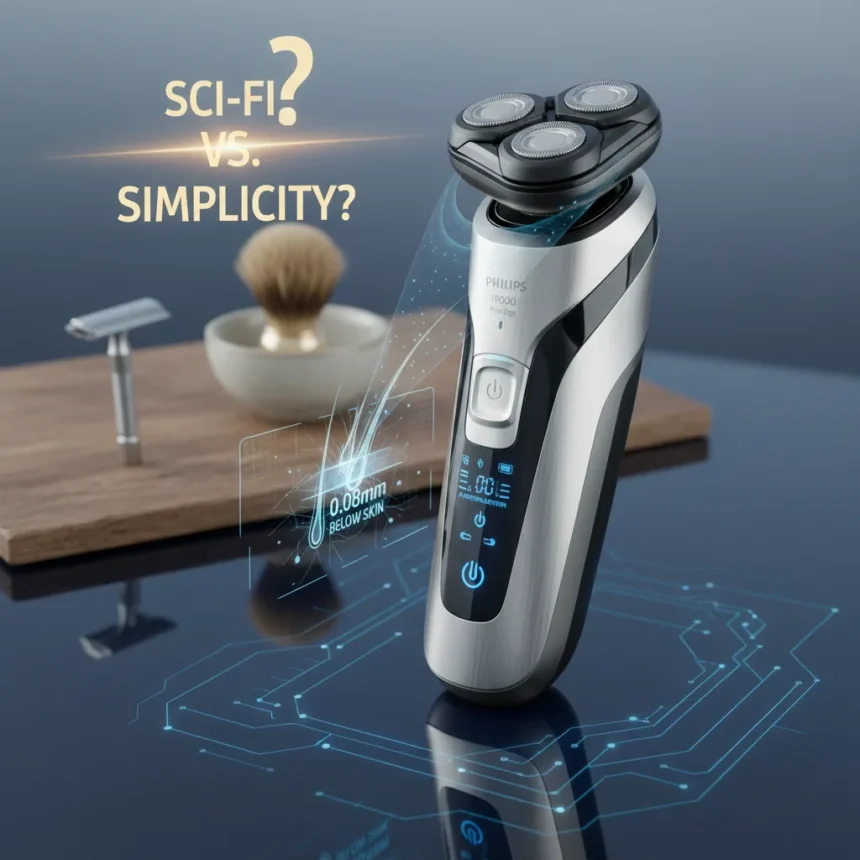
The Philips Norelco i9000 Prestige Ultra is Philips’ flagship rotary electric shaver, launched as the brand’s most intelligent shaver yet, featuring AI-driven personalization and the ability to cut hair up to 0.08mm below the skin’s surface. At $329.99 USD, this isn’t a casual purchase—it’s a statement that you’re willing to pay for precision engineering and real-time adaptive technology in your morning routine.
Key Takeaways
- Cuts hair 0.08mm below skin surface for enhanced smoothness compared to standard rotary shavers
- LED pressure indicator system provides real-time feedback with three color states: blue (too soft), orange (too hard), green (correct)
- Supports both wet and dry shaving with triple-head rotary design and ergonomic grip
- AI personalization features adapt to your shaving technique in real time
- 30 shaves per full charge; costs $329.99 USD starting price
The Philips Norelco i9000 Prestige Ultra’s Cutting Edge Technology
The standout feature here is the sub-skin-surface cutting capability. The Philips Norelco i9000 Prestige Ultra lifts hair directly from the root and cuts up to 0.08mm below the skin’s surface, delivering what Philips markets as the cleanest, smoothest shave of your life. This is genuinely unusual in the rotary shaver category. The reviewer who tested the unit in action confirmed there was only hair being shaven, no skin damage—though this is a single observation, not clinical validation.
The triple-head rotary system features agile heads that navigate facial contours without requiring you to contort your face into unnatural angles. For anyone who’s struggled with standard razors catching whiskers along the jawline or neck, this matters more than marketing copy suggests.
Real-Time Feedback That Actually Works
The LED pressure indicator system is the quiet innovation here. Three color states guide your technique in real time: blue means you’re pressing too softly, orange means too hard, and green confirms you’ve found the sweet spot. Most shavers leave you guessing. This one talks back. Over dozens of shaves, this feedback loop trains your hand to apply consistent pressure, reducing irritation and improving results. It’s not flashy. It’s practical.

The AI-driven real-time personalization adapts to your unique shaving pattern, and TechRadar’s reviewer noted this approach has already proven successful in earlier Philips generations. The extra tech flair is neat, though whether you need AI to shave is a separate philosophical question.
How the Philips Norelco i9000 Prestige Ultra Compares
The base Philips i9000 model sits around $259.99–$300 USD with promotional pricing, offering the same triple-head design and LED pressure indicators but without the advanced AI personalization. For most users, the base model delivers solid performance at a lower entry point. You’re paying roughly $30–$70 more for the Prestige Ultra’s adaptive intelligence.



At the premium end, the Philips Shaver S9000 Prestige (SP9883/35) lists at £699 or AU$999, though UK retailers often discount it to around £300. It offers SkinIQ technology for an even more delicate shave, an ultraflex floating head moving in eight directions, wireless charging, and a self-cleaning station. The S9000 targets a different market—those willing to invest in a complete grooming ecosystem. The i9000 Prestige Ultra is more focused: premium rotary shaving without the station infrastructure.
Battery Life and Wet/Dry Versatility
You get approximately 30 shaves per full charge, which translates to roughly two weeks of daily use for most people. That’s competitive for a flagship rotary shaver. The unit supports both wet and dry shaving, so you can use it under the shower with gel or cream, or dry for quick touch-ups. This flexibility matters if you travel frequently or prefer different shaving environments.
Is the Philips Norelco i9000 Prestige Ultra Worth the Premium?
The Philips Norelco i9000 Prestige Ultra occupies an awkward middle ground. It’s more expensive than the base i9000 but less feature-rich than the S9000 Prestige. If you value AI personalization and the pressure feedback system, the extra investment makes sense. If you just want a reliable rotary shaver, the base model or a competitor in the $250–$300 range will serve you fine. The sub-skin cutting depth is genuinely innovative, but whether you’ll notice a meaningful difference in daily use depends on your skin sensitivity and shaving habits.
FAQ
Does the Philips Norelco i9000 Prestige Ultra work for sensitive skin?
The pressure indicator system and AI personalization are designed to reduce irritation by guiding proper technique. However, cutting 0.08mm below the skin’s surface is aggressive by definition. If you have very sensitive skin or razor bumps, test it carefully or start with the base i9000 model.



How long does a full charge last?
The Philips Norelco i9000 Prestige Ultra delivers approximately 30 shaves per full charge, which is roughly two weeks of daily shaving.
Can you use the Philips Norelco i9000 Prestige Ultra in the shower?
Yes. The unit supports both wet and dry shaving, so you can use it with shaving gel or cream under the shower, or dry for quick touch-ups.
The Philips Norelco i9000 Prestige Ultra is a well-engineered flagship shaver that delivers real innovation—the sub-skin cutting depth, the pressure feedback system, and the AI personalization all work as advertised. Whether you need all three is the real question. For tech-forward shavers who want precision and adaptability, it’s a solid choice. For those seeking simplicity, the base i9000 or competing rotary shavers offer better value.
Where to Buy
$389.96 at Amazon | $389.96 at Amazon
Edited by the All Things Geek team.
Source: TechRadar




