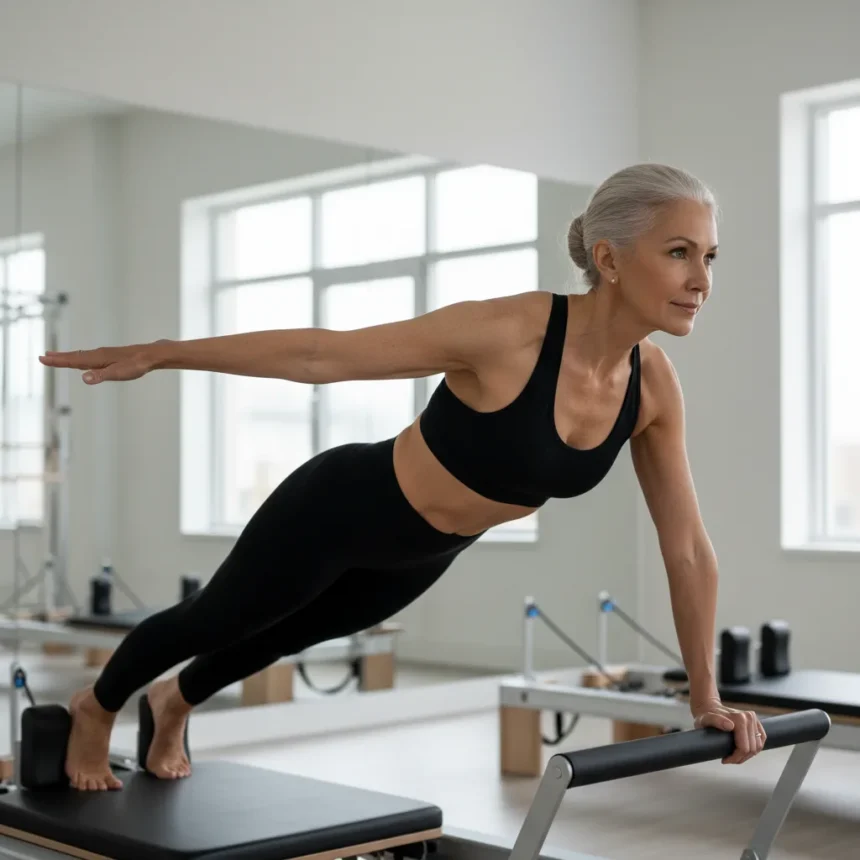
A 72-year-old Pilates instructor has built strength exercises for seniors into her daily routine, claiming she is in better physical condition now than she was at 40. Her approach abandons traditional crunches and sit-ups in favor of controlled Pilates movements that build deep core stability without joint strain.
Key Takeaways
- Pilates-based strength exercises for seniors prioritize core stability over superficial abdominal definition.
- Controlled movements reduce injury risk compared to high-impact traditional strength training.
- Daily practice of targeted exercises can improve posture, mobility, and functional fitness in older adults.
- No equipment or extreme intensity needed to build measurable strength gains after 70.
- Hip flexor mobility and spinal alignment are critical targets for aging athletes.
Why Strength Exercises for Seniors Matter More Than You Think
Strength exercises for seniors address a critical gap in fitness culture. Most workout programs target younger bodies with higher injury tolerance and faster recovery. A 72-year-old body requires precision, controlled tempo, and deep engagement of stabilizer muscles rather than explosive power. This instructor’s philosophy centers on longevity and functional strength—the ability to move, lift, and maintain balance in daily life—rather than aesthetic muscle gain. The difference is profound. A 40-year-old might chase visible abs through high-repetition crunches. A 72-year-old who has invested decades in Pilates pursues something more valuable: a body that does not break.
The absence of crunches and sit-ups from her routine is deliberate. These exercises compress the spine repeatedly, creating cumulative stress on intervertebral discs. Pilates-based strength exercises for seniors replace this compression with isometric holds and controlled articulation, distributing load across multiple muscle groups instead of isolating the rectus abdominis. The result is core strength that translates to real-world function—standing longer without fatigue, lifting grandchildren without back pain, maintaining upright posture without conscious effort.
The Core Exercises That Define Her Routine
Her strength exercises for seniors focus on five primary movements, each targeting different layers of the core and stabilizer muscles. These are not random exercises—they are foundational Pilates patterns refined over decades of teaching and personal practice. The exercises progress in difficulty but remain accessible to beginners who follow proper form cues.

The first movement emphasizes neutral spine positioning and pelvic stability. Lying on your back with knees bent and feet flat, the exercise begins with breath awareness. Inhale to prepare, then exhale while engaging the deep abdominal muscles—the transverse abdominis—without tilting the pelvis or flattening the lower back into the mat. This single action activates the body’s natural corset, the deep core layer that prevents injury during daily movement. Holding this engagement for 5-10 breaths, repeated for 8-10 cycles, builds endurance without impact. The simplicity is deceptive. Most people cannot maintain this engagement for more than two breaths without compensating elsewhere—gripping the neck, holding breath, or hiking the shoulders.
The second exercise introduces leg movement while maintaining that neutral spine. From the same starting position, one leg extends toward the ceiling while the other remains bent, foot flat. The extended leg lowers slowly toward the mat without touching down, then returns to center. This movement isolates the hip flexors and lower abdominals while the stabilizer muscles prevent the pelvis from rotating or the lower back from arching. Ten repetitions per side, performed with deliberate 3-second lowers, build tremendous functional strength. Unlike leg raises, which often compensate by arching the back, this controlled Pilates variation maintains spinal safety.



A third movement targets the obliques and rotational stability. Seated upright or semi-reclined, the body rotates gently from the waist while the pelvis remains still. The movement is small—perhaps 20 degrees of rotation—but the muscular engagement is significant. This exercise prevents the common pattern of rotating from the lower back, instead distributing rotational stress across the entire core. Holding each rotation for 3-5 breaths and repeating 8-10 times per side builds the lateral stability needed for everyday movement like reaching across your body or turning to look behind you.
Hip flexor mobility receives dedicated attention through a fourth exercise. Tight hip flexors, common in sedentary aging, pull the pelvis forward and create lower back pain. A low lunge position with emphasis on posterior pelvic tilt—tilting the tailbone under—gently lengthens the hip flexor of the back leg. The front knee bends while the back knee stays elevated on a mat or cushion, reducing impact. This position is held for 10-15 breaths, repeated on both sides. The combination of gentle lengthening and postural awareness retrains the body to sit upright without excessive anterior pelvic tilt.
The fifth exercise integrates everything—balance, core engagement, and postural alignment. Standing on one leg with the other knee lifted to hip height, the body maintains perfect upright posture without leaning or shifting the pelvis. The standing leg engages fully, including the glute and deep stabilizers of the hip. Holding this position for 30-60 seconds per side builds proprioceptive awareness and functional balance. This single-leg stance translates directly to real-world safety—the ability to stand on one leg while dressing, showering, or navigating stairs without falling.
How This Differs From Traditional Strength Training
Traditional strength training for older adults often emphasizes resistance and repetition—lifting weights, using machines, or high-repetition bodyweight exercises. These approaches build muscle and bone density, both critical for aging bodies. However, they often neglect the neuromuscular coordination, postural awareness, and movement quality that Pilates prioritizes. A person might develop strong quadriceps through leg presses but maintain poor movement patterns that create injury elsewhere. Pilates-based strength exercises for seniors reverse this sequence. Movement quality comes first. Strength follows naturally from perfect execution.



The tempo is dramatically slower. A traditional squat might take 2-3 seconds down and 1-2 seconds up, accumulating 10-15 repetitions in a minute. A Pilates-based squat variation might take 5-8 seconds down and 5-8 seconds up, with 5-8 repetitions consuming the same minute. The slower tempo increases time under tension, activates stabilizer muscles more deeply, and allows conscious correction of movement faults. There is no momentum, no bouncing, no rushing to the next repetition. Every single movement is intentional.
Equipment requirements differ too. Traditional strength training often requires dumbbells, barbells, machines, or resistance bands. Pilates-based strength exercises for seniors use primarily bodyweight, sometimes adding a foam roller, stability ball, or light hand weights for variation. This accessibility means a 72-year-old can maintain her routine anywhere—at home, traveling, or in a studio. No gym membership, no complicated setup, no excuses.
Building a Sustainable Practice
The instructor’s claim of being in better shape at 72 than at 40 reflects decades of consistent practice, not overnight transformation. She did not discover these exercises last year. She has refined them over a lifetime, starting perhaps in her 40s or 50s and progressively deepening her understanding of how her body moves. This timeline matters. Strength exercises for seniors work best as a long-term commitment, not a six-week challenge.
Frequency matters too. Rather than intense sessions twice weekly, this approach favors daily or near-daily practice. Even 15-20 minutes of focused Pilates movement, performed daily, accumulates tremendous benefit. The low impact allows recovery between sessions, so the nervous system and joints tolerate daily practice without degradation. Over a year, 365 days of 15-minute sessions equals 91 hours of intentional movement—far more accumulated practice than someone who trains hard twice weekly and rests the other five days.
Progression is subtle but real. The exercises themselves do not change dramatically, but execution deepens. The first week, maintaining neutral spine while holding a leg lift might feel impossible. By week four, it feels stable. By month three, the movement becomes automatic, and the instructor can add subtle variations—holding the lifted leg longer, adding small circles, or combining multiple movements. This incremental progression prevents plateaus while maintaining safety.
What Makes This Approach Sustainable for Life
A 72-year-old maintaining better fitness than her 40s suggests this is not a temporary program but a lifestyle. The exercises must be enjoyable enough to sustain for decades, not just weeks. Pilates-based strength exercises for seniors accomplish this through several mechanisms. First, they feel good. Unlike high-impact cardio that jars joints or heavy lifting that creates muscle soreness, Pilates creates a sensation of lengthening, alignment, and calm strength. Second, they deliver visible results. Improved posture appears within weeks. Reduced back pain follows quickly. Better balance prevents falls. These functional improvements motivate continued practice more powerfully than abstract fitness metrics. Third, they integrate naturally into daily life. The postural awareness developed through Pilates carries into sitting at a desk, standing in line, or sleeping at night. The body becomes more aligned throughout the day, not just during workout sessions.
Injury risk is minimal. Because movements are controlled, impact is low, and form is emphasized, serious injuries are rare. This safety margin allows long-term consistency. Someone recovering from a back injury, arthritis flare-up, or other age-related limitation can modify exercises without abandoning the practice entirely. The Pilates method is infinitely scalable—there is no version too hard or too easy, only versions appropriate to current capacity.
Is Pilates Enough for Complete Fitness?
Pilates-based strength exercises for seniors build core stability and postural alignment but do not address cardiovascular fitness or sustained aerobic capacity. A complete aging fitness program includes walking, swimming, cycling, or other low-impact cardio. Pilates excels at building the foundation—the core stability, mobility, and neuromuscular coordination—that makes other activities safer and more effective. A 72-year-old with a strong, stable core can walk longer, cycle with better form, or swim with improved breathing mechanics. The Pilates work amplifies the benefit of other activities rather than replacing them.
Flexibility and mobility receive attention through the controlled stretching and lengthening inherent in Pilates, but dedicated flexibility work—deeper stretching, foam rolling, or yoga—complements the practice. The instructor likely incorporates these elements, though the focus remains on strength and stability as the foundation.
Can You Start These Exercises at Any Age?
Strength exercises for seniors work at any age, though the instructor’s lifetime of practice gives her advantages a beginner does not possess. A 65-year-old beginning Pilates for the first time will not reach her level of strength and control in one year. However, functional improvements appear quickly. Better posture, reduced back pain, and improved balance manifest within 4-8 weeks of consistent practice. The trajectory is slower than younger beginners but the benefits are profound because aging bodies need these improvements more urgently.
Before beginning any new exercise program, consult with a qualified healthcare provider or physical therapist, particularly if you have existing injuries, joint problems, or chronic conditions. A professional can assess your movement patterns, identify limitations, and recommend modifications to ensure safety. Pilates instruction from a certified instructor—at least initially—prevents form errors that could create injury.
How Long Until You See Results From These Exercises?
Postural improvements and reduced back pain typically appear within 2-4 weeks of consistent practice. Visible strength gains and improved balance take 6-8 weeks. The full integration of these patterns into daily movement—where posture and stability feel automatic rather than conscious—develops over months and years. This gradual timeline discourages quick-fix seekers but appeals to people committed to long-term health.
Can These Exercises Replace a Gym Membership?
For someone seeking core strength, postural alignment, and functional stability, Pilates-based strength exercises for seniors replace a gym membership effectively. For someone pursuing significant muscle hypertrophy or heavy strength gains, additional resistance training adds value. Most aging adults prioritize function and longevity over muscle size, making Pilates sufficient as a primary strength practice when combined with walking or other light cardio.
A 72-year-old in better shape than her 40s demonstrates what consistency, intelligent exercise selection, and long-term commitment accomplish. These strength exercises for seniors are not revolutionary—they are foundational Pilates principles applied with precision and patience. The revolution is in the mindset: prioritizing movement quality, functional strength, and sustainable practice over temporary aesthetic goals. That shift in perspective, more than any specific exercise, explains how a seven-decade-old body can outperform a younger version.
Edited by the All Things Geek team.
Source: Tom's Guide