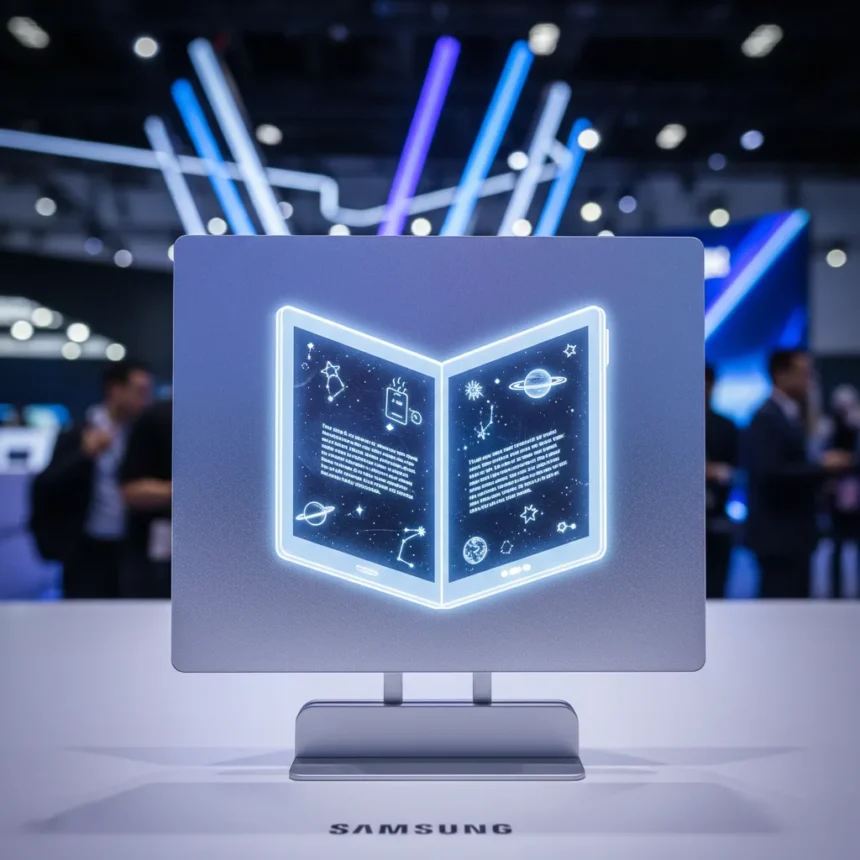
Samsung display tech demonstrated at MWC 2026 offers the clearest signal yet that Samsung is serious about building a Galaxy e-reader to challenge Amazon’s Kindle dominance. The innovations shown suggest Samsung has solved key technical hurdles that have kept the company out of the e-reader market for years.
Key Takeaways
- Samsung display tech shown at MWC 2026 includes advanced innovations for potential e-reader devices
- Alternative display technologies like RLCD offer advantages over traditional E Ink screens
- E Ink Android phones already exist, proving the ecosystem can support e-reader hardware
- A Galaxy e-reader would enter a market currently dominated by Amazon’s Kindle
- Samsung Display’s privacy features and display innovations position the company for e-reader entry
What Samsung display tech reveals about e-reader ambitions
Samsung has historically avoided the e-reader space, leaving that market almost entirely to Amazon and a handful of smaller players using E Ink technology. The Samsung display tech innovations unveiled at MWC 2026 suggest this calculation has changed. The company demonstrated display capabilities specifically suited to the reading experience—low power consumption, high contrast, and refresh rates optimized for text rather than video.
These technical improvements matter because they address the core tension in e-reader design: balancing battery life with screen responsiveness. Traditional E Ink displays excel at power efficiency but struggle with speed and color reproduction. Samsung display tech appears to offer a middle ground. If Samsung launches a Galaxy e-reader using these advances, it would represent a genuine technical alternative to E Ink, not just another me-too product.
How Samsung display tech compares to E Ink alternatives
The e-reader market is not monolithic. While Amazon dominates through the Kindle ecosystem, alternative display technologies have emerged. RLCD (Reflective Liquid Crystal Display) represents one such alternative, offering faster refresh rates and better color support than E Ink without sacrificing battery life as dramatically as traditional LCD. Samsung display tech shown at MWC 2026 appears to operate in this same technological space—competing on speed and visual quality rather than trying to match E Ink’s legendary power efficiency.

E Ink Android phones like the Bigme HiBreak Pro prove that Android devices with e-reader-style displays can work in practice. They demonstrate that the software ecosystem is ready. A Samsung Galaxy e-reader would not need to invent Android e-reading from scratch; the infrastructure already exists. What Samsung brings is brand recognition, design polish, and integration with its broader Galaxy ecosystem—advantages neither Bigme nor other niche e-reader makers possess.
Why a Galaxy e-reader makes strategic sense now
Samsung has invested heavily in display innovation across its tablet and smartphone lines. The Galaxy Tab S10 Plus and other recent devices showcase Samsung’s commitment to premium screens. An e-reader represents a natural extension of this expertise into a category where Samsung’s display prowess could genuinely differentiate a product. Amazon’s Kindle lineup, while dominant, has not evolved dramatically in recent years. Screen technology, design, and software integration all represent areas where a well-executed Galaxy e-reader could compete.



The timing also matters. As Samsung display tech advances, the company can offer features Kindle users have long wanted: faster page turns, color displays that do not destroy battery life, and deeper integration with Android and Google services. Whether Samsung actually builds a Galaxy e-reader remains unclear, but the display tech shown at MWC 2026 suggests the company is no longer asking whether it can—only whether it should.
Will Samsung actually launch a Galaxy e-reader?
Samsung has not announced a Galaxy e-reader, and the company’s track record in adjacent categories offers mixed signals. Samsung makes excellent tablets and phones but has largely stayed out of niche hardware categories. An e-reader sits between these two markets—not quite a phone, not quite a tablet, with its own unique user base and use cases. Samsung would need to commit to software support, content partnerships, and marketing to make it work.
The Samsung display tech innovations shown at MWC 2026 prove the company has solved the hardware puzzle. Whether Samsung decides to actually ship a product remains a business decision, not a technical one. Given the size of the e-reader market and Amazon’s entrenched position, Samsung may conclude that the return does not justify the effort. But for the first time, the company has the display technology to compete if it chooses to.
Could a Galaxy e-reader actually compete with Kindle?
Amazon’s Kindle ecosystem is formidable. The company controls a vast library of e-books, has built consumer loyalty over nearly two decades, and offers devices at multiple price points. A Samsung Galaxy e-reader would enter a market where Kindle already dominates through sheer network effects. However, Samsung’s advantages are real: brand strength, design capability, and the ability to integrate an e-reader into the broader Galaxy experience. Users who already own Galaxy phones and tablets might view a Galaxy e-reader as a natural addition rather than a standalone purchase.



The real question is whether Samsung can offer something meaningfully different. Faster screens, better color, Android integration, and Samsung Dex compatibility could appeal to power users. But casual readers who just want to buy books and read them might see little reason to switch from Kindle. Success would depend entirely on execution and how aggressively Samsung markets the device.
What display technology would a Galaxy e-reader actually use?
The Samsung display tech innovations shown at MWC 2026 remain proprietary, and Samsung has not disclosed which specific technology it might use in a hypothetical e-reader. RLCD represents one possibility, offering faster response times than E Ink while maintaining reasonable battery life. Samsung could also develop its own reflective display technology, leveraging its expertise in LCD and OLED manufacturing. The company has the engineering depth to create something genuinely novel rather than simply licensing E Ink or copying existing alternatives.
Whatever technology Samsung chooses, it would need to balance several competing demands: power consumption, image quality, speed, cost, and manufacturability at scale. The Samsung display tech shown at MWC 2026 suggests the company has made meaningful progress on these fronts, but moving from prototype to mass production always introduces new challenges.
FAQ
Has Samsung announced a Galaxy e-reader?
No. Samsung has not officially announced a Galaxy e-reader. The company demonstrated display innovations at MWC 2026 that could support such a device, but no product announcement has been made.
What makes Samsung display tech different from E Ink?
Samsung display tech innovations shown at MWC 2026 appear to offer faster refresh rates and potentially better color reproduction than traditional E Ink, while maintaining lower power consumption than standard LCD screens. E Ink remains the power efficiency leader, but Samsung’s approach may offer a better balance for devices that need both battery life and responsiveness.
Could a Galaxy e-reader run Android apps?
A Galaxy e-reader would almost certainly run Android, which means it could theoretically support any Android app. However, most e-reader users prefer dedicated reading software optimized for e-ink or similar displays. General Android apps designed for standard LCD screens would not display well on an e-reader display.
Samsung’s display tech innovations at MWC 2026 represent genuine progress toward a viable Galaxy e-reader, but whether Samsung actually builds one depends on business strategy, not technical capability. The company now has the tools. What remains to be seen is whether Samsung believes the e-reader market is worth entering in the first place.
Edited by the All Things Geek team.
Source: Android Central