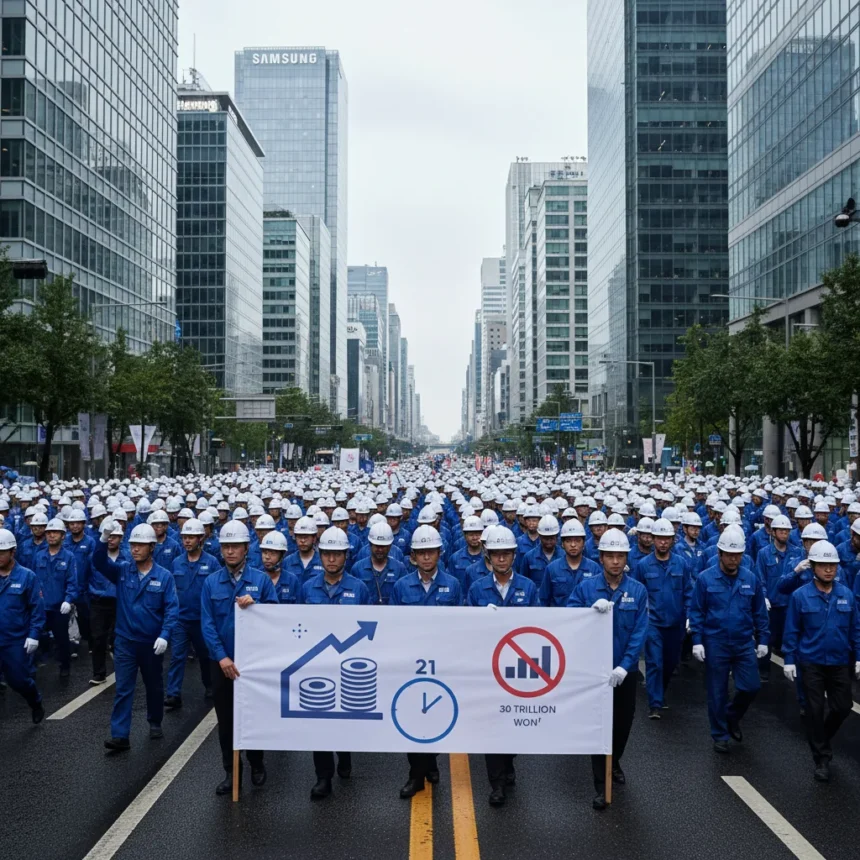
The Samsung union strike threat is reshaping labor relations at South Korea’s largest chipmaker. On April 23, 2026, more than 30,000 union members rallied at Samsung Electronics’ main semiconductor campus in Pyeongtaek, demanding the abolition of performance bonus caps and higher compensation. An 18-day full-scale strike is scheduled to begin May 21 if negotiations fail—a watershed moment for a company that has resisted unionization for decades.
Key Takeaways
- Samsung union strike threat runs May 21 to June 7, 2026, with potential 30 trillion won in losses
- First majority union at Samsung (~74,000 members) legally recognized April 15, 2026, ending “no-union management” era
- Workers demand uncapped bonuses; current cap limits performance pay to 50% of annual salary
- Rally attendance: 30,000-40,000 workers; police estimate 30,000, union claims up to 40,000
- SK hynix cited for granting higher bonuses, creating “huge pay gap” with Samsung workers
Samsung Union Strike: Why Now?
The Samsung union strike threat emerges at a critical moment. Samsung Electronics projects 30-45 trillion won in operating profit for 2026—roughly four times last year’s 11 trillion won dividend. Yet workers in the memory division earn an average annual salary of 158 million won, with performance bonuses currently capped at 50% of that base. Without the cap, bonuses could reach approximately 700 million won for those employees. The union views this gap as unjust when the company’s profitability has surged.
The rally itself signified unprecedented scale. Police deployed riot units and mobile police forces to manage traffic restrictions on an eight-lane road at the Pyeongtaek campus. The union’s show of force was intentional: a demonstration that the newly recognized majority union—verified by South Korea’s Ministry of Employment and Labor on April 15—now holds genuine leverage. Samsung has never faced a legally recognized majority union before, ending what the company called “no-union management”.
The Financial Stakes of a Samsung Union Strike
The potential cost of a Samsung union strike is staggering. Union representatives claim an 18-day production halt would create losses worth 18 to 30 trillion won. These projections are based on Samsung’s estimated daily operating profit, though independent verification of such figures remains limited. The union’s representative, Choi, stated: “If we halt production for 18 days in next month’s strike, it will create a gap worth nearly 18 trillion won. With the strike, we will make it crystal clear just how important the value of our labor union is”.

For context, Samsung’s semiconductor division is critical to global memory chip supply. Any disruption ripples through the industry—affecting data centers, AI infrastructure, and consumer electronics worldwide. The company cannot easily shift production overseas; the Pyeongtaek campus is one of its largest manufacturing hubs. This concentration of production is precisely why the union believes it holds genuine bargaining power.
Bonus Demands and Comparisons to SK Hynix
The union’s central demand is straightforward: abolish the performance bonus cap entirely. Currently, even high-earning employees cannot receive bonuses exceeding 50% of their annual salary. The union argues this structure ignores employee contribution and treats workers as “mere numbers rather than as dedicated contributors,” according to union leadership. The comparison to SK hynix—Samsung’s direct rival in memory chips—strengthens their case. The union points to SK hynix granting higher bonuses to its workforce, creating what workers describe as a “huge pay gap”. Though the brief does not specify exact SK hynix bonus figures, the comparison underscores the union’s argument that Samsung is underpaying relative to competitors.



Samsung’s management has resisted the demand, arguing that performance is determined by external market conditions rather than individual effort. This position has inflamed tensions. The union counters that workers deserve recognition for their labor, especially when company profits surge.
What Happens If the Samsung Union Strike Proceeds?
If negotiations collapse, the strike begins May 21 and runs through June 7. This is Samsung’s first encounter with a strike backed by a legally majority union. The inter-company union alliance includes the Samsung Electronics Labor Union (SELU), National Samsung Electronics Union (NSEU), and Samsung Electronics Co. Union (SECU)—representing approximately 74,000 members out of Samsung’s roughly 128,000 total employees. The union surpassed the majority threshold by more than 10,000 members.
A full production halt at Pyeongtaek would be unprecedented in scope. The facility produces critical memory chips for global markets. Supply chain disruptions would likely force customers to source alternatives or draw down inventory, creating cascading effects across the semiconductor industry.
Shareholder Interests vs. Worker Demands
Opposition to the union’s demands comes from shareholders and some legal experts. Lee Jae-gyo, a law professor at Sejong University, argued that “in capitalism, those who bear ultimate risk are the owners, and thus the company’s owners are shareholders, not workers. Harming shareholders’ interests for workers’ benefits cannot be justified”. This framing reflects a fundamental disagreement about who deserves the fruits of Samsung’s profitability.



Yet the union’s counterargument resonates: workers directly generate the value Samsung profits from. Without their labor, no production occurs. The standoff reflects broader tensions in South Korea’s labor market, where unions have historically faced resistance from management.
Is the Samsung union strike likely to happen?
Yes, unless Samsung significantly shifts its bonus structure before May 21. The union has demonstrated its willingness to mobilize tens of thousands of workers and has legal standing as a majority union for the first time. Samsung’s management shows no sign of accepting uncapped bonuses, making a strike highly probable.
What would uncapped bonuses cost Samsung?
The exact cost depends on how the company structures uncapped bonuses. If memory division workers earning 158 million won annually could receive bonuses approaching their base salary without a cap, costs could increase substantially. Across 74,000 union members, even modest increases in bonus structures could add billions of won annually to Samsung’s compensation bill.
How does this compare to other semiconductor companies?
SK hynix, Samsung’s primary competitor, reportedly grants higher bonuses to workers, creating the pay gap the union cites. However, the research brief provides no specific figures for SK hynix compensation, making direct numerical comparison impossible. What is clear: Samsung workers view themselves as underpaid relative to rivals in the same industry.
The Samsung union strike represents a fundamental shift in South Korea’s corporate labor landscape. A company that has resisted unionization for decades now faces a legally recognized majority union with real leverage during a period of record profitability. Whether Samsung yields on bonus demands or endures an 18-day production halt will set a precedent for labor negotiations across the semiconductor industry and beyond. The stakes are measured not just in won, but in the future relationship between workers and management at one of the world’s most important chipmakers.
Edited by the All Things Geek team.
Source: Tom's Hardware