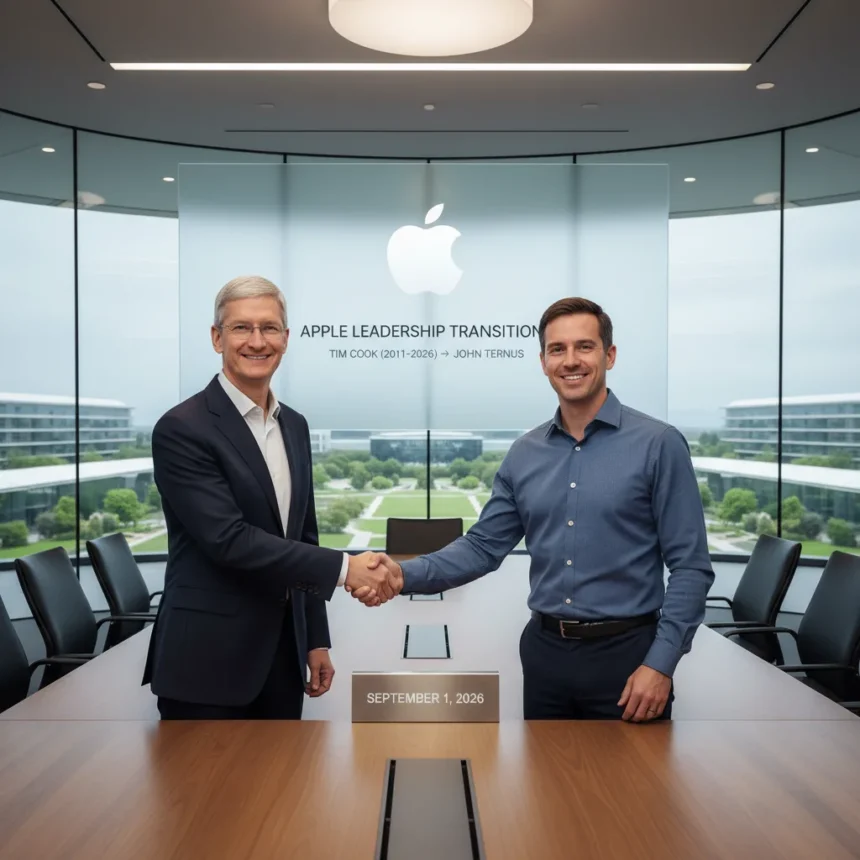
Tim Cook is stepping down as Apple CEO on September 1, 2026, marking the end of a 15-year tenure that transformed Apple into a $4 trillion company. John Ternus, Apple’s Senior Vice President of hardware engineering, will assume the role of CEO on the same date, while Cook transitions to Executive Chairman. This leadership shift represents the most significant executive change at Apple since Steve Jobs departed in 2011.
Key Takeaways
- Tim Cook steps down as CEO on September 1, 2026, after 15 years in the role
- John Ternus, SVP of hardware engineering, becomes the new CEO
- Cook will transition to Executive Chairman, remaining deeply involved in Apple’s direction
- Cook led Apple’s transformation into a $4 trillion company under his leadership
- Ternus represents continuity in Apple’s product-focused engineering strategy
Who Is John Ternus and Why Does He Matter?
John Ternus is Apple’s Senior Vice President of hardware engineering, a position that places him at the center of every major product decision the company makes. As the architect behind Apple’s most ambitious hardware initiatives, Ternus has proven himself capable of steering the company’s product vision during a period when hardware innovation remains central to Apple’s competitive edge. His elevation to CEO signals that Apple’s board believes engineering expertise and deep product knowledge are essential for the next chapter of leadership.
Ternus expressed his commitment to the transition in a statement to Apple staff: “It has been such a privilege to lead the hardware engineering team, to be part of such remarkable work, and to see all of you in action, determined as ever to do everything we can for our users. I look forward to working with you very closely in my new role”. This framing emphasizes continuity rather than radical change—Ternus is not an outsider brought in to shake things up, but a long-serving veteran who understands Apple’s culture and engineering philosophy.
Tim Cook’s Legacy and the Transition Plan
Cook’s 15-year run as CEO reshaped Apple from a computer company into a services-driven technology giant. Under his leadership, Apple expanded beyond the iPhone into wearables, expanded its Services division into a major revenue driver, and navigated the company through supply chain challenges and geopolitical tensions. Cook wrote in a community letter that Ternus is “the perfect person” to take over as CEO, signaling board confidence in the succession plan.

The transition will unfold gradually. Cook will remain as CEO through the summer of 2026, ensuring that knowledge transfer and strategic alignment occur before Ternus officially takes the helm on September 1. This measured approach differs sharply from abrupt CEO departures that can destabilize companies—Apple is deliberately engineering a soft handoff to minimize disruption.
Cook’s move to Executive Chairman is not a retreat from influence. In this role, he will continue to shape Apple’s long-term strategy, board decisions, and major initiatives, but without the day-to-day operational burden that the CEO position demands. For a company as large and influential as Apple, this arrangement allows Cook to remain a guiding force while giving Ternus the autonomy to establish his own leadership identity.



What This Means for Apple’s Product Direction
The selection of Ternus as CEO signals that Apple intends to double down on hardware innovation as its primary competitive advantage. Unlike a CEO drawn from finance, operations, or services, Ternus brings an engineering-first mindset to the role. This matters because Apple’s ecosystem—from the iPhone to the Apple Watch to upcoming spatial computing devices—depends on seamless hardware-software integration that only someone with Ternus’s technical depth can fully appreciate.
The comparison to previous tech leadership transitions is instructive. When operations-focused executives have led major hardware companies, product cycles sometimes slow or innovation priorities shift toward profitability over breakthrough design. By promoting an engineer, Apple is betting that the next decade will reward companies that prioritize product excellence over quarterly earnings management. Whether that bet pays off will define Ternus’s tenure and Apple’s competitive position against rivals like Samsung and Google, which have their own hardware ambitions.
Why the Timing Matters
The September 2026 date is significant because it gives Apple’s board time to prepare the market and the organization for change without creating uncertainty. A CEO transition at one of the world’s most valuable companies can spook investors and employees alike. By announcing well in advance and maintaining Cook’s presence through the summer, Apple is demonstrating confidence that the transition will be orderly and deliberate.
The timing also reflects Cook‘s personal choice. At 63 years old, Cook is stepping down while still at the height of his influence, rather than waiting until health or market conditions force the issue. This proactive approach suggests Cook has confidence in Ternus and the company’s direction, and that his departure is a planned evolution rather than a crisis response.



Will John Ternus Face Pressure That Cook Never Did?
Ternus inherits a company worth trillions but also one facing real challenges. The iPhone market is mature in developed economies, artificial intelligence competition is intensifying, and regulatory scrutiny of Big Tech continues to mount. Cook navigated these pressures over 15 years; Ternus will face them immediately in his first year as CEO.
One advantage Ternus has is that he will not be compared to Steve Jobs in the same way Cook was. The mythology around Jobs created an impossible standard for Cook’s early years as CEO. Ternus, by contrast, will be measured against Cook’s actual track record—a high bar, but one grounded in recent reality rather than legend. That may give him more room to establish his own leadership style without constant second-guessing.
Is Tim Cook really stepping down?
Yes. Tim Cook announced on April 20, 2026, that he will step down as CEO on September 1, 2026, after 15 years in the role. He will transition to Executive Chairman, remaining involved in Apple’s strategic direction while relinquishing day-to-day operational duties.
Who is John Ternus?
John Ternus is Apple’s Senior Vice President of hardware engineering. He has led the hardware engineering team and overseen the development of Apple’s major product lines, making him one of the company’s most senior technical leaders.
When does John Ternus become CEO?
John Ternus officially becomes CEO on September 1, 2026, the same date Tim Cook steps down. Cook will remain as CEO through the summer to ensure a smooth transition.
The leadership change at Apple represents a deliberate, planned transition designed to maintain momentum while introducing fresh perspective from someone who has spent decades mastering Apple’s engineering culture. Whether Ternus can maintain Cook’s track record of growth and innovation while charting his own course will define his early years as CEO and shape Apple’s competitiveness through the next decade.
Edited by the All Things Geek team.
Source: Android Central