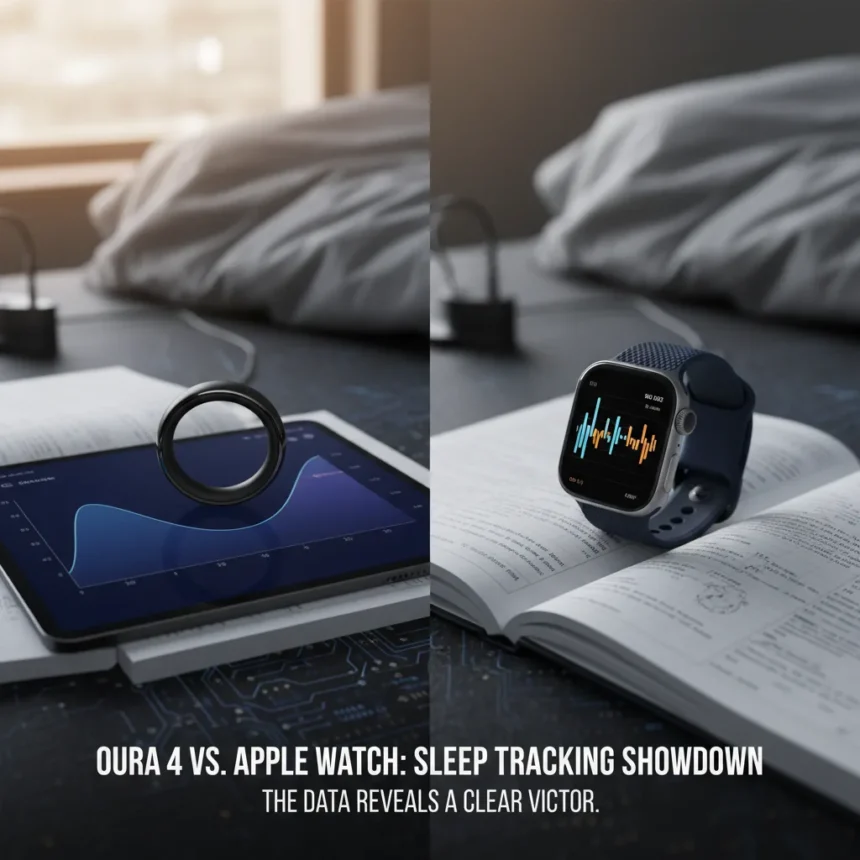
Oura Ring 4 vs Apple Watch sleep tracking is one of the most searched wearable comparisons right now, and for good reason. Apple’s introduction of Sleep Score has made its watch a far more credible bedside companion than it used to be. But after more than a year of wearing both devices to bed every night, the verdict from Tom’s Guide is clear: these two wearables are not measuring the same thing, and that difference matters enormously depending on what you actually want from a sleep tracker.
Key Takeaways
- Apple’s Sleep Score rates sleep out of 100 across five quality bands: Excellent, High, OK, Low, and Very Low.
- Oura Ring 4 evaluates seven metrics including REM sleep, deep sleep, latency, and efficiency — and counts naps too.
- On the same night, the two devices recorded meaningfully different sleep durations and wake times, showing their data is not interchangeable.
- Oura Ring 4 launched in fall 2024, starts at $296.65, and requires a $5.99/month or $69.99/year subscription to unlock full tracking.
- Samsung Galaxy Ring is a notable subscription-free alternative for those put off by Oura’s ongoing costs.
How does the Oura Ring 4 sleep score actually work?
The Oura Ring 4 builds its sleep score from seven distinct metrics, with REM sleep, deep sleep, sleep latency, and efficiency among the key inputs. Crucially, it incorporates all sleep — including naps — into its calculations, giving a more complete picture of your total rest across a 24-hour period. That breadth is one of the reasons Oura has become the benchmark for consumer sleep tracking.
The Oura Ring 4 is a premium smart ring launched in fall 2024, available in 6 finishes and 12 sizes, with a titanium finish to resist tarnishing over time. Pricing starts at $296.65 for silver and black colorways, rising to $424.15 for gold and rose gold. The catch: unlocking the full suite of health and fitness features requires a subscription — $5.99 per month or $69.99 per year. That ongoing cost is a genuine consideration, especially when Apple Watch delivers sleep data with no subscription attached.
What does Apple Watch’s Sleep Score measure — and what doesn’t it?
Apple’s Sleep Score is a software-based feature that assigns a score out of 100 and classifies it as Excellent, High, OK, Low, or Very Low. It draws on three inputs: total sleep duration, how often you woke up and for how long, and whether you fell asleep close to your typical scheduled bedtime. Apple is explicit that the score reflects how restorative your sleep was — not how you feel when you wake up. That’s an important distinction many users miss.


The Sleep Score works on compatible Apple Watches running watchOS 26, meaning it isn’t locked to the newest hardware alone. When paired with a bedtime schedule, the watch silences notifications during your sleep window, sets a gentle morning alarm, and then compares your actual sleep against your schedule — showing sleep stages and heart-rate trends in the morning. It’s a genuinely useful system. The question is whether it’s as useful as Oura’s.
Oura Ring 4 vs Apple Watch sleep tracking: the night the numbers diverged
The most telling evidence in this comparison is a single night’s data. On September 15, Apple recorded 7 hours 23 minutes of sleep, including 37 minutes of deep sleep, 2 hours 12 minutes of REM sleep, and just 3 minutes awake. Oura, worn simultaneously, recorded 6 hours 48 minutes of sleep, 1 hour 4 minutes of deep sleep, 1 hour 37 minutes of REM sleep, and 1 hour 9 minutes awake in the middle of the night. That’s a 35-minute gap in total sleep and a 66-minute gap in reported wake time. Both devices cannot be right. The divergence isn’t a minor rounding difference — it’s a fundamentally different account of the same night.



This is the core problem with using Apple Watch as a primary sleep tracker. Its score is clean, accessible, and easy to understand. But when the underlying data disagrees this sharply with a dedicated sleep wearable, it raises real questions about which numbers to act on. Oura’s seven-metric model, with its granular breakdown of deep and REM stages, gives you more to work with — even if the ring’s data isn’t infallible either.
Should you choose Oura Ring 4 or Apple Watch for sleep tracking?
The answer depends on what role sleep data plays in your life. If you already own an Apple Watch and sleep tracking is a secondary concern — something you glance at occasionally — the Sleep Score feature is a meaningful upgrade that costs nothing extra. It’s genuinely better than what Apple offered two years ago.
But if sleep quality is a priority and you want detailed recovery data you can actually act on, Oura Ring 4 is still the more serious tool. The seven-metric scoring, nap inclusion, and ring form factor (which many people find more comfortable than wearing a watch to bed) give it a clear edge for dedicated sleep monitoring. The Samsung Galaxy Ring is worth considering as a subscription-free smart ring alternative, though it doesn’t yet match Oura’s depth of sleep analysis.
Is the Oura Ring 4 subscription worth paying for sleep tracking?
For casual users, the $5.99 monthly fee may feel steep on top of the ring’s hardware cost. But for anyone using Oura as a genuine health tool — tracking sleep trends, recovery scores, and readiness over weeks and months — the subscription unlocks the features that make the ring worth owning. Paying annually at $69.99 reduces the ongoing cost meaningfully.



Can Apple Watch replace a dedicated sleep tracker?
For most people, no. Apple Watch’s Sleep Score is a solid addition to a general-purpose smartwatch, but it measures fewer inputs than Oura and produced significantly different results on the same night in real-world testing. If sleep is a health priority rather than a casual curiosity, a dedicated tracker like the Oura Ring 4 still offers more actionable data.
How does Oura Ring 4 compare to other smart rings?
The Samsung Galaxy Ring is the most prominent competitor and stands out for having no subscription requirement — a real advantage over Oura’s model. However, for users specifically focused on sleep depth and recovery metrics, Oura’s longer track record and more detailed scoring methodology remain compelling reasons to pay the premium.
Apple’s Sleep Score is a genuine step forward, and it will be good enough for millions of Apple Watch owners who don’t want another device on their wrist at night. But the data divergence from a single night tells the real story: when sleep quality actually matters to you, Oura Ring 4 is still the tracker that takes the job seriously.
Where to Buy
Apple Watch Series 10 : | Withings Sleep Analyzer | Garmin Index Sleep Monitor | Oura Ring 4
Edited by the All Things Geek team.
Source: Tom's Guide