





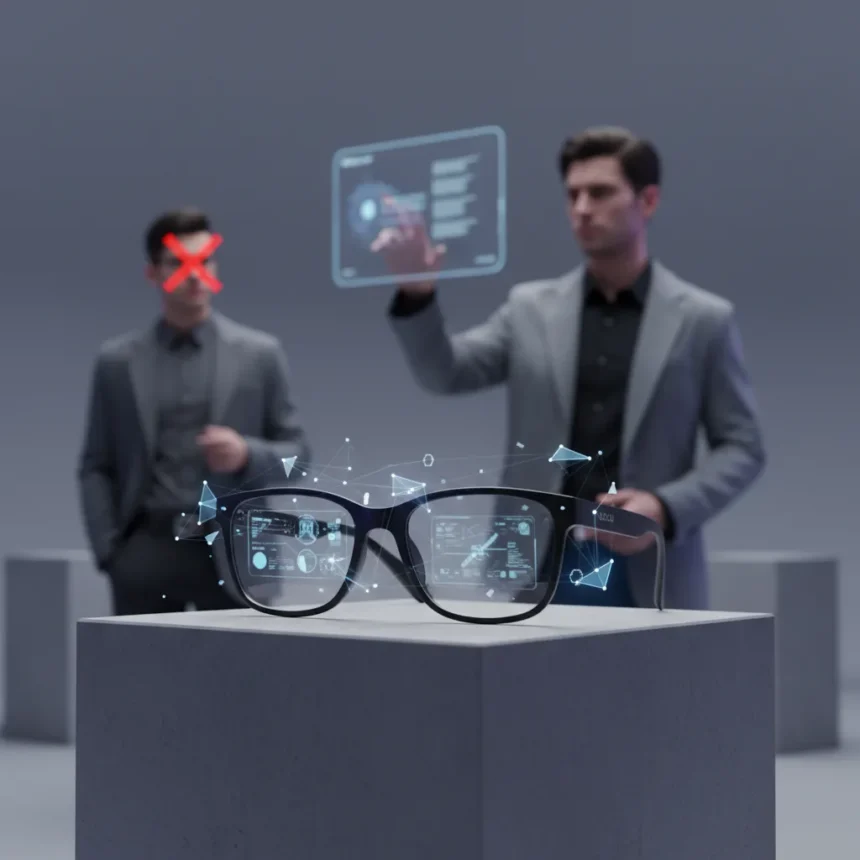
Rokid Glasses are a pair of AR smart glasses built around dual monochrome green Micro LED waveguide displays, powered by a Qualcomm Snapdragon AR1 Gen 1 chip, and designed to look indistinguishable from ordinary eyewear. Tested across a 5,000-mile journey, they position themselves as the most credible rival yet to the Meta Ray-Ban Smart Glasses Gen 2 — and on several fronts, they actually win.
Key Takeaways
- Rokid Glasses feature dual Micro LED displays at 480 x 398 resolution per eye, 1,500 nits brightness, and a 23-degree field of view.
- The Snapdragon AR1 Gen 1 chip enables on-board AI with support for ChatGPT, DeepSeek, and Qwen via a “Hi Rokid” wake word.
- A 12MP camera with F2.25 aperture and an in-display viewfinder makes photo framing far easier than on Meta’s glasses.
- The related Rokid AI Glasses Style model is priced at $299, though build quality is described as slightly flimsier than rivals.
- Rokid Glasses were showcased at IFA and are positioned as a 2026 alternative to Meta Ray-Ban at an accessible price point.
What Makes Rokid Glasses Different From Every Other Smart Frame
Most smart glasses force a choice: look normal or show you data. Rokid Glasses refuse that trade-off. The dual Micro LED waveguide displays push information into your peripheral vision rather than dominating your sightline, which means you stay present in the real world while still receiving navigation prompts, translation text, or AI responses. That peripheral-first philosophy is the design decision that sets them apart.
The display specs are deliberately modest. At 480 x 398 resolution per eye, 1,500 nits of brightness, and a 23-degree field of view, these are not trying to be a heads-up display for gaming or immersive media. They’re a distraction-free information layer — and the monochrome green palette reinforces that intent. Whether that minimalism is a feature or a limitation depends entirely on what you want smart glasses to do.
How Rokid Glasses Handle AI and Camera Features
Rokid Glasses support multimodal AI through a “Hi Rokid” wake word that connects to ChatGPT, DeepSeek, or Qwen depending on your region. Hands-free queries, photo descriptions, real-time summarization, and translation are all on the table — though ChatGPT access is region-locked, so international buyers should verify availability before committing.


The 12MP camera with an F2.25 aperture is one of the stronger selling points. Unlike the Meta Ray-Ban glasses, which require you to rotate your head to frame a shot, Rokid’s in-display viewfinder appears the moment you go to take a picture, guiding composition without any awkward head movements. For travel photography — the exact use case this review tested — that’s a meaningful practical advantage. The 4-mic array and dual directional speakers round out an audio system that handles voice commands cleanly, with interaction also possible via physical buttons and a touchpad on the right stem.
Rokid Glasses vs Meta Ray-Ban Smart Glasses: Which Should You Buy?
Rokid Glasses offer dual displays where Meta’s Gen 2 provides only a single-eye display — a structural advantage for anyone who wants balanced, symmetrical information delivery. The viewfinder camera system also gives Rokid an edge in photo usability. Meta, however, has a more mature ecosystem and broader regional AI availability, which matters if ChatGPT is your preferred assistant and you live outside Rokid’s supported zones.



The related Rokid AI Glasses Style, priced at $299, offers a strong feature set but has been described as slightly flimsier in build quality — a real concern for daily wearers who need durability over months, not just a 5,000-mile press trip. If you want to spend more and get significantly better display performance, the Rokid AR Lite steps up to a Micro-OLED panel at 1200p, 120Hz, and a 50-degree field of view, though that comes at $749 and without Google Play services. The Xreal Air 2 paired with the Beam Pro offers comparable features for up to $250 less than the AR Lite, making it a genuine alternative worth considering at that tier.
Google’s Android XR smart glasses prototype is also on the horizon, leaning heavily on Gemini as its core differentiator, though its field of view is narrower than some competing designs. The smart glasses market is moving fast, and Rokid is no longer just a challenger — it’s forcing the category conversation.
Are Rokid Glasses actually worth buying right now?
Rokid Glasses are worth serious consideration if you want dual AR displays, capable AI integration, and a camera system that beats Meta’s on usability. The peripheral display approach is genuinely clever for travel and daily life. The caveats are real — regional AI restrictions and questions about long-term build durability — but the core proposition is stronger than most rivals at this price tier.
How do Rokid Glasses compare to the Rokid AR Lite?
The Rokid AR Lite is a more powerful device with a Micro-OLED display running at 1200p and 120Hz with a 50-degree field of view, compared to the Rokid Glasses’ monochrome Micro LED panels at 480 x 398 and 23 degrees. The AR Lite costs $749 and lacks Google Play services, making it a different product for a different use case — spatial computing rather than lightweight daily wear.



What AI assistants do Rokid Glasses support?
Rokid Glasses support ChatGPT, DeepSeek, and Qwen through a “Hi Rokid” wake word. ChatGPT availability is region-dependent, so buyers outside supported markets may be limited to DeepSeek or Qwen for AI queries.
Rokid Glasses aren’t perfect — no smart glasses are at this stage of the category’s development. But dual displays, a genuinely useful camera viewfinder, and multimodal AI packed into a frame that looks like ordinary eyewear is a combination that Meta can’t currently match. If the build quality holds up and AI availability expands globally, Rokid won’t just be making Meta nervous — it’ll be taking sales.
Edited by the All Things Geek team.
Source: Tom's Guide




