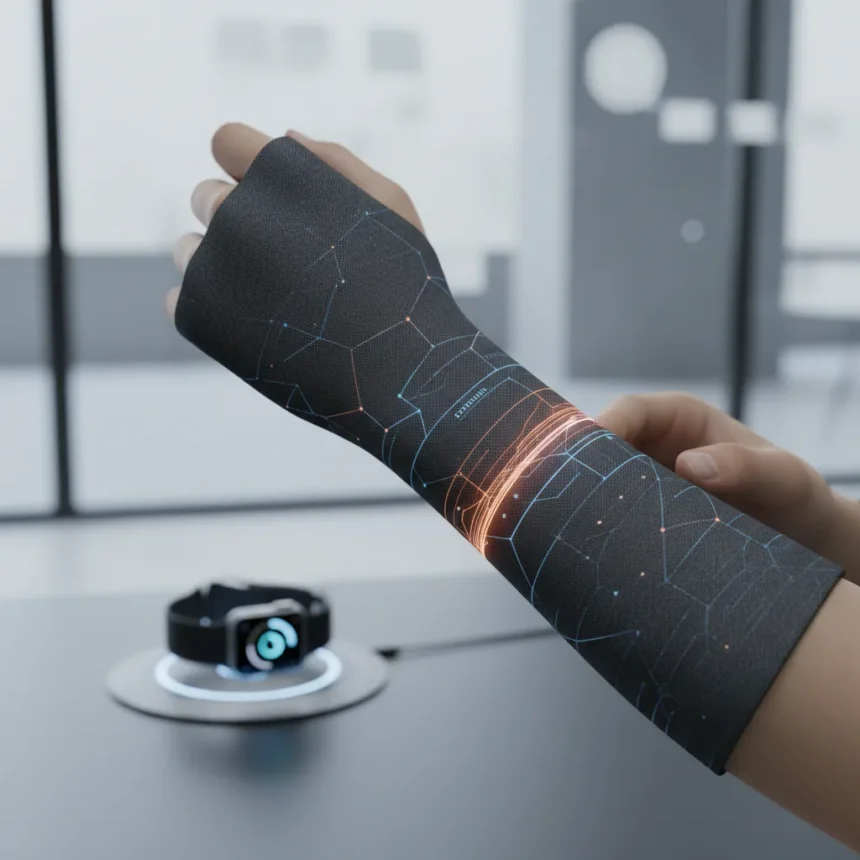
Smart textiles self-powered by body heat represent a fundamental shift in how we monitor health. Unlike the Apple Watch and other rigid wearables that require daily charging, researchers at the University of Waterloo have developed fabric materials that convert body heat and solar energy into continuous electrical power. These aren’t prototypes gathering dust in labs—they’re advancing toward practical applications that could reshape the entire wearables industry.
Key Takeaways
- University of Waterloo researchers developed smart fabrics that generate power from body heat and solar energy without batteries
- Fabrics integrate sensors for temperature, heart rate, stress, pressure, and movement tracking via MXene and conductive polymers
- Penn State and Loughborough University use electrospinning and triboelectric nanogenerators to create power-generating textiles from motion and temperature changes
- Smart textiles are breathable, durable after washing, and eliminate the need for recharging—key advantages over traditional wearables
- Applications extend beyond fitness to wound-healing bandages, smart face masks for virus detection, and continuous clinical monitoring
How Smart Textiles Self-Powered Systems Actually Work
The core innovation behind smart textiles self-powered technology lies in converting ambient energy sources into usable electricity. Professor Yuning Li and his team at the University of Waterloo engineered a fabric that harvests both body heat and solar radiation simultaneously. The material uses MXene—a two-dimensional nanomaterial—combined with conductive polymers integrated directly into textile fibers, allowing the fabric to function like a wearable power plant.
Penn State researchers took a different approach using electrospinning, a process where liquid polymer (PVDF-TrFE) is stretched into microscopic fibers using electric force. By adjusting polymer concentration and molecular weight, they increased crystallinity and charge alignment, making the fabric more efficient at converting mechanical stress into electricity. The result feels like regular cloth but generates power whenever you move.
Loughborough University employs triboelectric nanogenerators (TENGs) embedded in textiles, which exploit the physics of static electricity. When two textile layers with opposite charges move against each other—which happens naturally during walking or arm movement—an electrical current flows between them via electrostatic induction. This approach has been demonstrated lighting LEDs directly from body motion, proving the concept works at scale.


Sensors Embedded in Fabric: What Health Data Can They Capture?
Smart textiles self-powered designs integrate multiple sensor types into a single material, eliminating the need for separate devices. The Waterloo fabric simultaneously monitors temperature, stress, pressure, chemical composition, heart rate, and movement patterns. This multifunctional approach addresses a critical limitation of current wearables: the Apple Watch excels at heart rate but offers limited chemical sensing or detailed pressure mapping.
The applications extend far beyond basic fitness tracking. Researchers propose smart face masks that monitor breath temperature and respiratory rate while detecting viruses or lung cancer markers through breath chemical analysis. Wound-healing bandages could track moisture levels and infection markers in real time. Bedsheets embedded with sensors could monitor sleep quality and detect health anomalies without requiring the user to wear anything. Undergarments with integrated sensors could provide continuous glucose monitoring or blood pressure tracking throughout the day.


What makes this feasible is the fabric’s inherent properties: breathability, moisture management, odor inhibition, and durability after repeated washing. Unlike strapping an electronic device to your wrist, smart textiles integrate smoothly into everyday clothing. You would not need to remember to charge them, sync them, or even acknowledge they exist.
Why Smart Textiles Self-Powered Beats Traditional Wearables
The advantages over devices like the Apple Watch are structural, not incremental. A traditional smartwatch is a rigid electronic device that sits on your skin, creating a thermal barrier and requiring daily charging. Smart textiles conform to your body, breathe naturally, and generate power continuously from the energy you already produce. This eliminates what many users find most frustrating about wearables: the charging ritual.
Sustainability matters too. The wearables industry generates substantial electronic waste from discarded devices and batteries. Smart textiles reduce this burden by operating indefinitely without replacement batteries. The University of Waterloo team specifically emphasized cost-effectiveness and durability over existing wearables through their use of established textile manufacturing techniques.
Loughborough’s TENG approach and Penn State’s electrospun polymers both scale through conventional textile production methods, meaning manufacturers could adopt this technology without building entirely new factories. This is critical for commercial viability—a technology that requires exotic manufacturing will never reach mainstream adoption.



The Timeline and Remaining Challenges
These are not products you can buy today. Penn State researchers are actively seeking industrial partners to scale up electrospun textile production. The Waterloo team has published their research and demonstrated working prototypes, but the jump from lab to consumer product typically takes years. Clinical validation—particularly for the proposed virus detection and cancer screening applications—remains incomplete.
The research brief contains no specific launch timelines, pricing, or commercial availability dates. What exists now is proof of concept and the beginning of partnership discussions with manufacturers. Yamaha and Nippon have entered the smart medical textiles market, suggesting commercial interest is rising. When these fabrics do reach consumers, they will likely appear first in clinical settings—hospitals monitoring post-operative patients or chronic disease management—before expanding to consumer fitness.
Could Smart Textiles Replace Your Apple Watch?
Partially, yes. For health monitoring, continuous tracking, and basic fitness data, smart textiles would outperform traditional wearables by operating indefinitely without charging. For notifications, app control, and voice interaction, they would not—at least not in their current development stage. The realistic scenario is complementary use: smart textiles handle passive health monitoring while a smartwatch provides active interaction.
The comparison also depends on your priorities. If you value comfort, sustainability, and passive monitoring over notifications and app ecosystems, smart textiles represent a clear upgrade. If you rely on your watch as a control interface or smartphone companion, that functionality would need to be addressed separately.
What applications could smart textiles enable that current wearables cannot?
Smart textiles could enable continuous chemical sensing through fabrics worn against skin, detecting biomarkers in sweat or breath that smartwatches cannot access. Bedsheet sensors could monitor sleep without wearing anything. Face mask sensors could detect respiratory infections or lung disease markers in real time during normal breathing. These applications require the sensor to be in direct, prolonged contact with the body or biological fluids—something a wrist-worn device simply cannot do.
When will smart textiles be commercially available?
No verified launch date exists. Research teams are currently seeking industrial partners for manufacturing scale-up. Clinical validation for health claims is ongoing. Based on typical timelines for medical device development, commercial availability for consumer health applications could be several years away, though clinical deployments may arrive sooner.
Are smart textiles more durable than smartwatch bands?
Yes. Smart textiles maintain functionality after repeated washing, and the sensors are integrated into fibers rather than attached as separate components. A smartwatch band eventually cracks, degrades, or fails; smart textile fibers can be rewoven or replaced without losing the entire garment. This durability advantage directly supports the sustainability claim—you replace the garment when it wears out, not the embedded electronics.
The shift from wearables to wear-ables—clothing that works for you rather than devices you strap on—is not hype. The University of Waterloo, Penn State, and Loughborough have demonstrated the physics works. Manufacturing partnerships are forming. What remains is the grinding work of scaling production, validating health claims, and integrating these fabrics into garments people actually want to wear. When that happens, your Apple Watch will look quaint.
Edited by the All Things Geek team.
Source: TechRadar