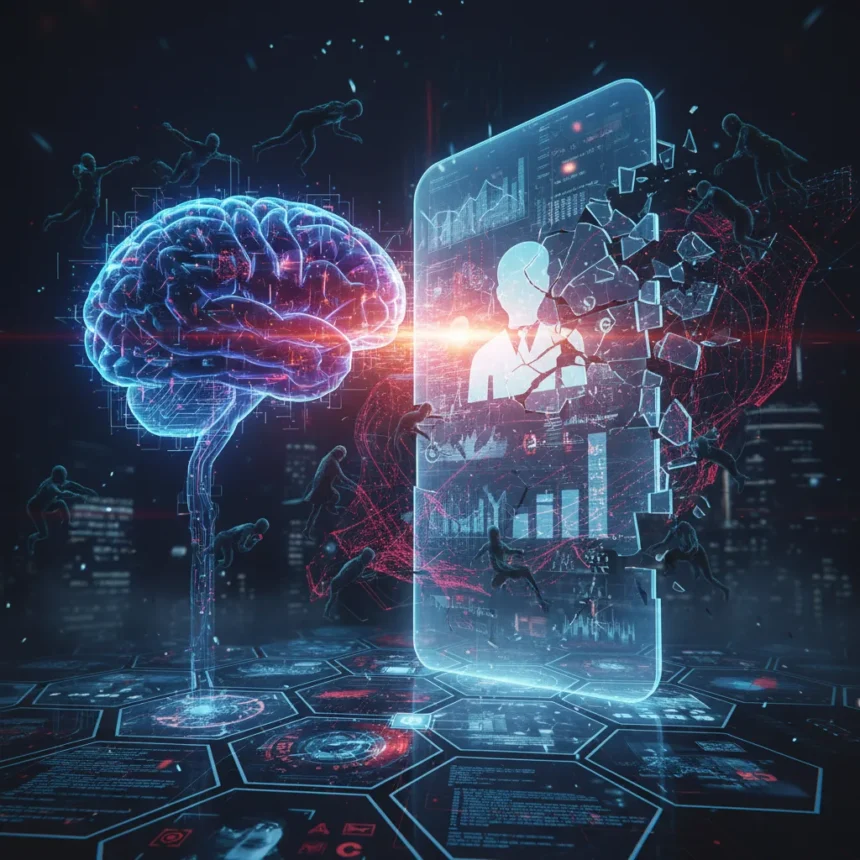
AI-generated threats are reshaping how criminals attack businesses, turning what once took hours into operations that run in minutes. The shift is not about new scam types—it is about speed, scale, and personalization that traditional defenses cannot match. Attackers are using AI to create convincing fake personas, bypass identity verification, and generate phishing emails so polished they slip past human scrutiny. For business leaders and security teams, the stakes have never been higher.
Key Takeaways
- AI has reduced data exfiltration time from five hours to 72 minutes, according to Palo Alto’s Unit 42 report.
- Identity weakness was a major factor in 9 out of 10 security incidents.
- Email-based scams jumped 70 percent year over year, driven largely by AI-powered phishing.
- AI is compressing fraud setup from 16 hours to under 5 minutes, turning fraud into a 400 billion dollar global industry.
- 76 percent of UK organizations have faced deepfake attacks, with most unprepared to respond.
How AI is Making Phishing and Impersonation Unstoppable
AI-generated threats have made phishing unrecognizable. Where old phishing emails were clumsy—full of typos, awkward phrasing, and obvious urgency tactics—AI-powered versions are now polished, contextual, and deeply personal. Attackers use AI to mimic executive tone, reply within existing email threads, and deploy lookalike domains that fool even cautious users. The result is that email-based scams have surged 70 percent year over year, and a report claims 86 percent of phishing attacks are now driven by AI.
What makes this worse is polymorphic phishing. These campaigns change subject lines, sender details, and message text in real time to evade signature-based filters. A traditional email gateway cannot catch what morphs every few seconds. The attacker is not trying to fool a person anymore—they are trying to outrun the machine.
Deepfake scams add another layer of danger. Attackers increasingly impersonate executives and other trusted figures, making fraudulent requests harder to question. In the UK alone, 76 percent of organizations have faced deepfake attacks, and most were not ready. A voice message asking a finance manager to transfer funds sounds like the CEO. A video call looks like the board member. By the time verification happens, the money is gone.


The Identity Weakness That Puts Every Business at Risk
AI-generated threats exploit a fundamental vulnerability: identity. Identity weakness was a major factor in 9 out of 10 security incidents, according to Palo Alto’s Unit 42 report. Attackers hunt for OAuth tokens and API keys to move laterally, steal data, lock systems, and deploy malware. Once inside, they move fast. AI has compressed the time attackers need to exfiltrate data from about five hours to just 72 minutes.
Social engineering remains the primary entry point. Roughly 65 percent of initial access came from social engineering, while only 22 percent came from vulnerabilities. This means no firewall or patch will stop an AI-powered phishing campaign that tricks a human into handing over credentials. The attacker does not need to find a zero-day—they need a convincing email, and AI makes that trivial.



Third-party SaaS supply-chain attacks have become a favored vector. These attacks have risen almost 4 times since 2022 and now make up about 23 percent of all attacks. An attacker compromises a vendor, then uses that access to hit dozens of downstream customers. AI makes this scalable: generate a fake invoice from the vendor, deploy it to hundreds of companies, wait for someone to click.
Fraud is Becoming Faster and Cheaper to Deploy
The economics of fraud have shifted dramatically. AI is compressing fraud setup time from more than 16 hours to under 5 minutes in some scam operations. That speed advantage means attackers can test, refine, and deploy new campaigns faster than security teams can detect and block them. Global losses from financial fraud have been estimated at over 400 billion dollars in a single year—and that number is climbing as AI lowers the barrier to entry for criminal operations.
From the attacker’s perspective, AI makes fraud faster, quieter, and creates immediate pressure without the signals defenders once relied on to detect attacks. A ransomware campaign that once took days to execute now runs in hours. A phishing campaign that once needed manual personalization now generates thousands of variants in seconds. The asymmetry favors the attacker.
What Businesses Should Watch For
AI-generated threats share common tells, though they are becoming harder to spot. Watch for emails that are unusually polished but ask for urgent action—especially requests to bypass normal approval workflows. Look for requests from executives that arrive outside business hours or use slightly off communication channels. Check for sender addresses that mimic internal domains but use subtle variations. Verify any request for credentials, tokens, or administrative access through a separate, known communication channel.



Deepfake attacks often lack the minor imperfections of real video—they can be too smooth, too perfect. Listen for audio that sounds slightly synthetic or video that does not sync perfectly with speech. Request a callback to a known number before acting on any request from an executive. Implement multi-factor authentication everywhere, especially on email and administrative accounts.
Supply-chain attacks are harder to spot because they come from vendors you trust. Verify any unexpected invoice or software update through direct contact with the vendor. Use API keys and OAuth tokens with strict scope limitations—do not hand out admin access when read-only access suffices. Monitor for unusual data access patterns, especially from service accounts that normally sit idle.
Can traditional defenses stop AI-generated threats?
Traditional signature-based email filters cannot stop polymorphic phishing that changes every few seconds. Behavioral analysis and machine learning detection work better, but they require constant tuning as attackers evolve. The best defense combines technology (multi-factor authentication, zero-trust architecture) with human judgment—training employees to verify requests and question urgency.
How fast can AI-powered attacks move through a network?
Once an attacker has valid credentials, AI can exfiltrate sensitive data in 72 minutes, compared to about five hours before AI acceleration. This means detection windows are shrinking. Organizations need real-time monitoring, not end-of-day log reviews. If you do not catch the attack in the first hour, the data is already gone.
What is the biggest risk AI-generated threats pose to my business?
The biggest risk is speed and scale. AI makes it possible for a small criminal operation to attack thousands of businesses simultaneously with highly personalized, convincing messages. Traditional defenses were built for slower, less sophisticated threats. Businesses that rely only on email filters and basic password policies are sitting targets.
AI-generated threats are not a future problem—they are here now, accelerating faster than most organizations can adapt. The companies that survive will be those that move beyond hoping employees spot fakes and instead build defenses that assume breach, limit damage, and detect intrusions in real time. The question is not whether your business will face an AI-powered attack. It is whether you will be ready when it arrives.
Edited by the All Things Geek team.
Source: TechRadar