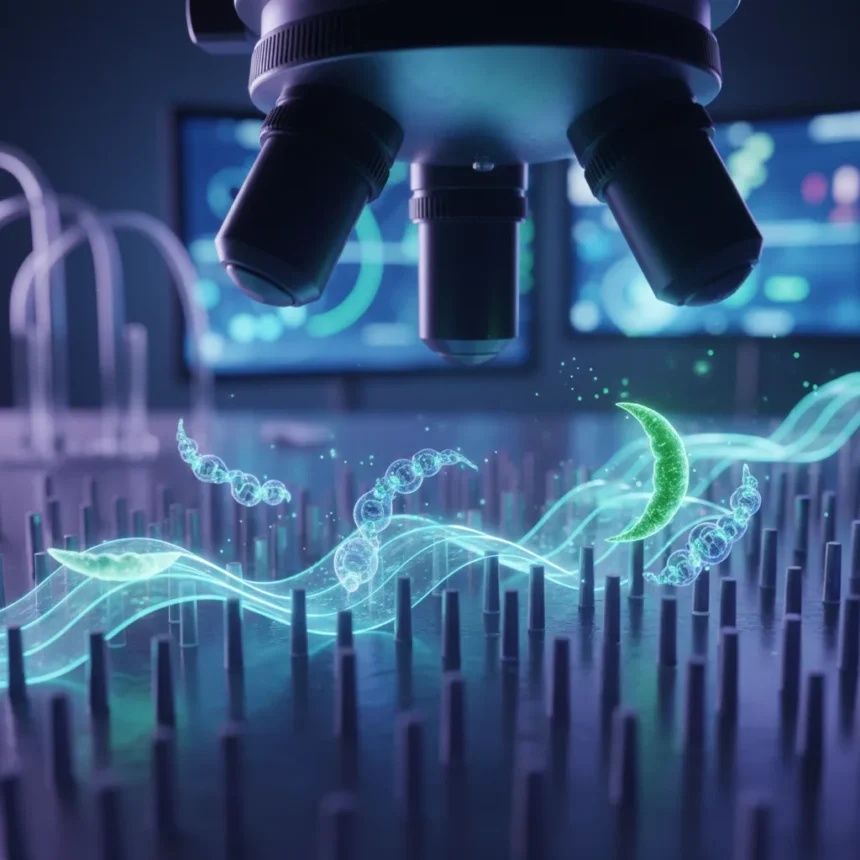
Researchers at Leiden University have demonstrated that brainless microrobots navigate and move through their environment without sensors, software, or any form of central control—a breakthrough that challenges assumptions about what autonomous movement requires. The achievement bridges a critical gap in microrobotics: previous devices were either small and rigid or large and flexible, but never both simultaneously.
Key Takeaways
- Leiden University created flexible microrobots just tens of micrometers long, far smaller than a human hair.
- The devices move at 7 micrometers per second using self-propelled elements activated by an electric field.
- No brain, sensors, software, or external control needed—behavior emerges purely from shape and environmental interaction.
- Design inspired by how worms and snakes adapt their shapes to navigate, scaled down to microscopic dimensions.
- Printed using a Nanoscribe 3D-printer at the edge of technical possibility.
How brainless microrobots navigate without a brain
Brainless microrobots navigate by leveraging their physical structure and the environment around them, not computational intelligence. Professor Daniela Kraft and Mengshi Wei at Leiden University created a flexible chain of self-propelling elements connected by bar-joints, each measuring 5 micrometers in size with joints just 0.5 micrometers across. When an electric field activates these elements, the robot’s inherent flexibility allows it to swim, sense obstacles, and adapt its path—all without processing information or making decisions. The behavior emerges from the interaction between the robot’s shape and the physical forces acting on it, similar to how a simple mechanical system can produce complex motion.
The speed achieved—7 micrometers per second—may seem glacial, but at this scale it represents meaningful autonomous locomotion. What makes this approach radical is its simplicity. Traditional microrobots, particularly those developed at the University of Pennsylvania, pack onboard computers, sensors, and memory into devices the size of a paramecium. The Leiden robots eliminate all of that, proving that intelligence and sensors are not prerequisites for directed movement at the microscale.
Why shape and environment matter more than a brain
The design philosophy behind brainless microrobots navigate stems from observing how animals solve navigation problems. Worms and snakes constantly reshape their bodies as they move, using this flexibility to navigate cluttered environments—they do not compute optimal paths, they physically adapt. Kraft’s team translated this principle into synthetic materials, creating microrobots that respond to their surroundings through pure mechanics rather than circuitry. The flexible chain structure allows the robot to conform to obstacles, squeeze through tight spaces, and adjust its swimming gait based on local conditions.


This approach contrasts sharply with rigid microrobots, which cannot adapt their shape and therefore require external guidance or onboard intelligence to navigate effectively. By making the robot flexible and small enough to interact meaningfully with its environment, the Leiden researchers achieved autonomous behavior without adding computational complexity. The robot essentially “thinks” with its body, using physical properties that evolution has refined over millions of years.
Practical implications for biomedical applications
The ability to create small, flexible microrobots without brains opens possibilities for biomedical applications that rigid, sensor-laden devices cannot address. A device this small—just tens of micrometers long—could potentially navigate within living tissue, blood vessels, or cellular environments where larger robots cannot fit. Because the robot requires no onboard electronics, power supply, or wireless communication, it avoids the thermal and electromagnetic interference issues that plague conventional microrobots in biological settings.



The Leiden robots remain laboratory prototypes with no announced commercial timeline or pricing. However, the proof of concept demonstrates that miniaturization does not require sacrificing autonomous behavior. Researchers can now explore whether these principles scale to different sizes, materials, and environments. The next phase likely involves testing whether brainless microrobots navigate effectively in biological fluids, whether they can be modified to perform sensing or delivery tasks, and whether they can operate reliably for extended periods.
The technical limits of 3D printing at microscale
Creating these microrobots pushed the Nanoscribe 3D-printer to the edge of its technical capabilities. Printing structures at the micrometer scale requires precision that conventional manufacturing cannot achieve. The bar-joints measuring just 0.5 micrometers represent some of the smallest features ever produced via 3D printing. This technical achievement is as significant as the robotics itself—it demonstrates that additive manufacturing can now produce functional mechanical systems at scales previously reserved for silicon-based semiconductor processes.
The comparison to University of Pennsylvania microrobots, which use semiconductor fabrication techniques and cost roughly one penny per unit to produce, highlights the trade-off between complexity and manufacturability. The Leiden approach trades onboard intelligence for manufacturing simplicity and scalability. As 3D printing technology improves, producing these flexible microrobots may eventually become faster and cheaper than semiconductor-based alternatives, especially if mass production techniques emerge.
Could brainless microrobots eventually replace smart microrobots?
The Leiden research does not render intelligent microrobots obsolete. Instead, it suggests that different applications may benefit from different approaches. Brainless microrobots navigate and move efficiently in relatively simple environments or when the task requires only autonomous locomotion and passive sensing through shape interaction. Smart microrobots with onboard sensors and computers excel when precise decision-making, data collection, or complex task execution is required. The choice between the two depends on the specific biomedical application—a drug delivery system that simply needs to reach a target tissue might use a brainless design, while a diagnostic robot that must collect and analyze biological samples would need onboard intelligence.



The real innovation is proving that brainless microrobots navigate at all. This expands the design space for microrobotics and forces engineers to reconsider whether every autonomous system truly needs a brain.
What does “brainless” really mean in this context?
When researchers say these microrobots lack a brain, they mean there is no onboard processor, no decision-making logic, and no software controlling behavior. The robot has no sensors feeding information to a computational system. Instead, the robot responds directly to physical stimuli—the electric field activates the self-propelled elements, and the flexible structure determines how the robot moves in response. It is brainless in the sense that a falling leaf is brainless; it responds to air currents and gravity through pure physics, not computation.
When will brainless microrobots become available for medical use?
The Leiden microrobots are currently laboratory prototypes with no commercial availability or timeline announced. Researchers must first demonstrate that the devices work reliably in biological environments, can survive without degrading, and can be steered or controlled effectively in medical applications. These steps typically require years of additional research and testing before any transition to clinical use.
How do brainless microrobots compare to other microscale robots?
The Leiden brainless microrobots navigate using flexibility and environmental interaction, while University of Pennsylvania microrobots achieve autonomous behavior through onboard computation, sensors, and memory. The Penn robots are larger (210-340 micrometers wide) and more complex but can sense temperature, make decisions, and adapt behavior based on collected data. The Leiden approach sacrifices decision-making capability for extreme miniaturization and mechanical simplicity. Neither approach is universally superior—the choice depends on whether the application prioritizes size, cost, computational ability, or energy efficiency.
The Leiden University breakthrough proves that autonomous movement at the microscale does not require intelligence, sensors, or software. By returning to principles observed in nature—where organisms use shape and flexibility to navigate—researchers created something genuinely novel: a robot that moves and adapts without thinking. This challenges the assumption that all autonomous systems must be smart, opening a new chapter in microrobotics where simplicity and mechanical elegance replace computational complexity.
Edited by the All Things Geek team.
Source: Tom's Hardware