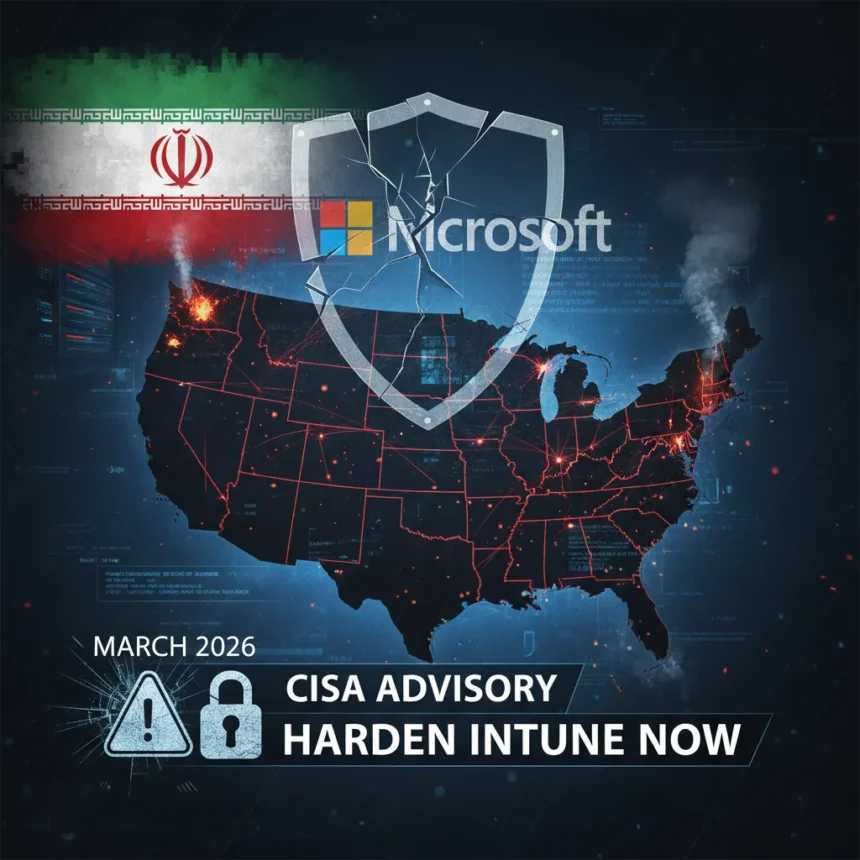
Microsoft Intune security has become a critical vulnerability in American corporate infrastructure. On March 18, 2026, the US Cybersecurity and Infrastructure Security Agency (CISA) issued a direct warning to US organizations after attackers linked to Iran targeted endpoint management systems, triggered by a devastating cyberattack against Stryker Corporation on March 11, 2026, that crippled the medical device maker’s Microsoft environment for over five days.
Key Takeaways
- CISA issued emergency guidance on March 18, 2026, after Stryker’s March 11 cyberattack disrupted its Microsoft systems for five days.
- Attackers linked to Iran targeted Stryker, America’s largest medical device manufacturer.
- Microsoft Intune requires multi-factor authentication (MFA) and multi-admin approval for sensitive operations.
- Companies must enforce phishing-resistant MFA and privileged access controls across endpoint management systems.
- Conditional Access policies in Microsoft Entra ID can block unauthorized access to critical Intune functions.
What Happened to Stryker and Why It Matters
On March 11, 2026, attackers compromised Stryker Corporation’s Microsoft environment, triggering a disruption that lasted more than five days and forced the company to investigate with government and law-enforcement partners. Stryker, which manufactures surgical instruments, orthopedic implants, and medical imaging systems, disclosed the incident publicly and reported that no ransomware was involved, though the full scope of the breach remained under investigation. The timing is critical: CISA’s alert came just one week later, citing Stryker’s incident as evidence that endpoint management systems are now primary targets for state-sponsored attackers.
What makes Stryker’s case a watershed moment is not just the disruption itself—it is what the attack reveals about Microsoft Intune’s default configurations. Endpoint management systems like Intune control how organizations deploy software, manage devices, and enforce security policies across their entire IT infrastructure. When attackers compromise Intune, they gain the ability to wipe devices, install malicious software, or lock users out of critical systems. Stryker’s five-day outage demonstrates the real-world consequences of weak endpoint security in a sector where downtime directly impacts patient care.
Microsoft Intune Security Hardening: What Companies Must Do Now
CISA recommends a three-layer defense strategy to harden Microsoft Intune security against similar attacks. The first layer is phishing-resistant multi-factor authentication (MFA), which blocks attackers even if they steal a user’s password. The second layer involves using Microsoft Entra ID’s Conditional Access policies to enforce risk-based authentication—denying access from unusual locations or devices even if credentials are valid. The third and most critical layer is multi-admin approval, a feature that requires a second administrator to authorize sensitive operations like device wiping, application deployment, or role-based access control (RBAC) changes.


Multi-admin approval is the significant shift here. If a compromised account attempts to wipe 10,000 devices or deploy malware across the organization, the system pauses and demands approval from another administrator. An attacker with a single stolen credential cannot act alone. This simple friction—requiring human verification for high-impact actions—would have likely prevented or significantly slowed Stryker’s attackers. Microsoft has already begun requiring MFA for Azure portal, Microsoft Entra admin center, and Microsoft Intune admin center sign-ins as part of its Secure Future Initiative, but organizations must go further and configure multi-admin approval policies themselves.
Beyond Intune-specific controls, companies should deploy Privileged Identity Management (PIM) across their entire Microsoft ecosystem—Entra ID, Intune, and other administrative tools—to ensure that privileged access is continuously verified and time-limited. The principle is straightforward: assume every account can be compromised, and design systems to minimize the damage a single compromised account can inflict.



Why Iranian Attackers Targeted Intune
The choice of Stryker as a target reveals a strategic shift in how state-sponsored attackers operate. Rather than targeting customer-facing applications or databases, Iranian-linked attackers focused on Stryker’s internal endpoint management infrastructure. This is a supply-chain play: if an attacker controls a company’s Intune environment, they can potentially reach downstream customers, partners, and healthcare providers who rely on Stryker’s devices and software. A medical device manufacturer’s Intune system is a chokepoint with enormous leverage.
This attack pattern mirrors broader trends in advanced persistent threat (APT) activity. In early 2024, Russian APT29 compromised Microsoft corporate email accounts through password spraying against legacy authentication systems, affecting Microsoft’s own leadership, cybersecurity, and legal staff. The lesson was identical: administrative systems are honeypots for nation-state attackers because they grant access to everything downstream. Stryker’s incident confirms the lesson applies equally to private-sector infrastructure.
What Endpoint Management Systems Beyond Intune Should Do
CISA’s alert applies to all endpoint management platforms, not just Microsoft Intune. Organizations using alternative systems—whether from other vendors or hybrid deployments—should audit their configurations against the same principles: enforce phishing-resistant MFA, require multi-admin approval for sensitive operations, and implement risk-based conditional access policies. The vulnerability is not unique to Microsoft; it is endemic to any endpoint management system where a single compromised administrative account can inflict organization-wide damage.
The broader implication is that companies can no longer rely on perimeter security alone. If your endpoint management system is configured with weak defaults, attackers who breach your network can escalate from a single compromised user account to full infrastructure control in minutes. Stryker’s five-day outage is a warning: hardening these systems is not optional, and it is not a future project—it is an immediate priority.



Is multi-admin approval available in all Microsoft Intune deployments?
Multi-admin approval is a feature available in Microsoft Intune and is being expanded as part of Microsoft’s Secure Future Initiative. Organizations must configure it manually—it is not enabled by default. Check your Intune admin center settings and enable multi-admin approval for all high-impact operations immediately.
What is the difference between MFA and phishing-resistant MFA?
Standard MFA (like SMS codes or authenticator apps) can be bypassed if an attacker tricks a user into approving a login or intercepts the code. Phishing-resistant MFA uses hardware security keys or biometric methods that cannot be phished. CISA and Microsoft both recommend phishing-resistant MFA for administrative accounts.
How long did Stryker’s outage last?
Stryker’s Microsoft environment was disrupted for over five days following the March 11, 2026 cyberattack. The company was still investigating the incident with government and law-enforcement partners as of March 13, 2026.
The Stryker incident is a watershed moment for corporate security. It proves that even large, sophisticated organizations can be crippled by endpoint management vulnerabilities and that state-sponsored attackers now prioritize these systems as high-value targets. Companies that delay hardening their Microsoft Intune configurations are not managing risk—they are gambling that they will not be the next headline. CISA has sounded the alarm. The window to act is now.
Edited by the All Things Geek team.
Source: TechRadar