





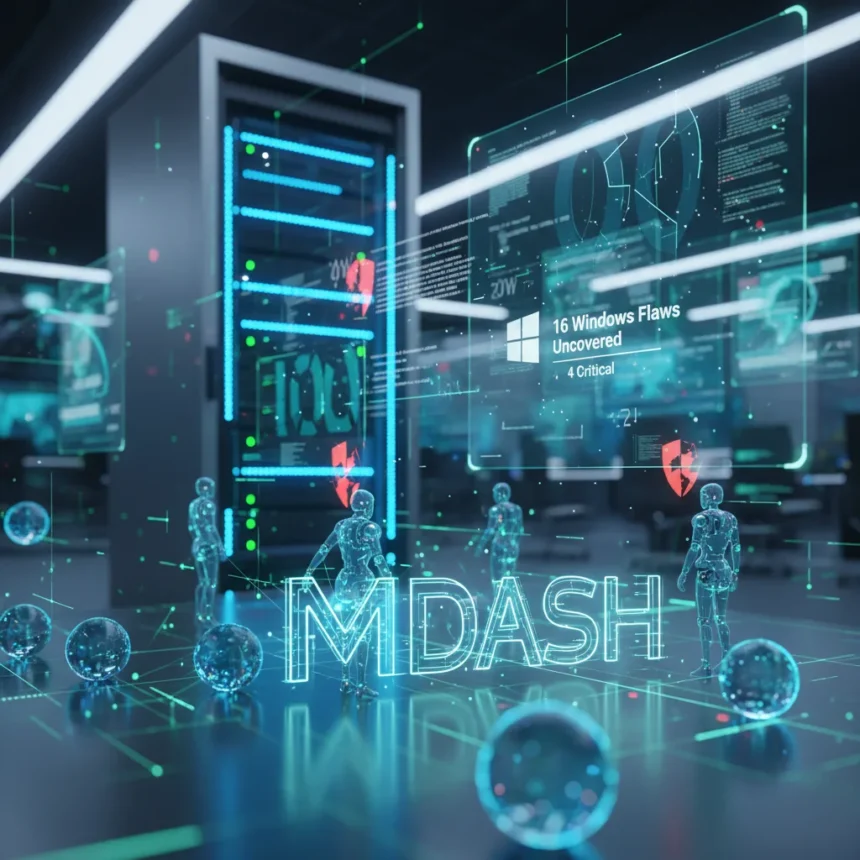
Microsoft MDASH AI agents represent a fundamental shift in how enterprises hunt for security vulnerabilities. The platform deploys over 100 specialized AI agents working autonomously to discover threats, detect anomalies, and respond to incidents without human intervention at every step. Within weeks of launch, these agents identified 16 new vulnerabilities in Windows, including 4 critical-severity flaws that could have exposed millions of users.
Key Takeaways
- Microsoft MDASH uses 100+ AI agents to autonomously discover vulnerabilities and respond to threats
- Agents found 16 Windows flaws (4 critical severity) shortly after deployment
- Multi-model AI approach differs from traditional single-model security systems
- Security Copilot agents available to Microsoft 365 E5 customers at no extra cost starting April 2025
- Microsoft detected over 30 billion phishing emails in 2024, underscoring the scale of threats MDASH addresses
What Makes Microsoft MDASH Different From Traditional Security Platforms
Microsoft MDASH stands apart because it abandons the single-model AI approach that dominates enterprise security today. Instead of relying on one AI model to handle detection, triage, and response, MDASH coordinates over 100 specialized agents, each trained for specific security tasks. This multi-agent architecture allows the platform to parallelize vulnerability discovery and threat hunting in ways that conventional SOAR and XDR platforms cannot match.
The agents integrate directly with Microsoft’s existing security stack—Defender, Purview, Entra, and Sentinel—creating a unified security operations layer powered by generative AI. Rather than requiring analysts to manually correlate alerts across tools, the agents automatically contextualize threats, prioritize incidents, and recommend actions. One pilot showed the Defender phishing triage agent improved detection accuracy by up to 77%, freeing analysts to spend 53% more time investigating confirmed phishing cases instead of wading through false positives.
This represents a departure from partner-built agents in Security Copilot, where five external partners contributed agent designs. MDASH includes six in-house agents built by Microsoft, giving the company tighter control over security automation and faster iteration cycles.


The Real-World Impact: 16 Windows Flaws in Weeks
The headline metric speaks for itself. Shortly after deployment, Microsoft MDASH AI agents autonomously discovered 16 previously unknown vulnerabilities in Windows, with 4 rated as critical severity. This is not a theoretical capability—it is active threat hunting happening at machine speed. The timing matters: Microsoft detected more than 30 billion phishing emails targeting its customers between January and December 2024, illustrating the scale and velocity of modern attacks. Manual vulnerability discovery cannot keep pace with that threat density.
These findings validate Microsoft’s bet on agentic AI for security. Rather than waiting for external researchers to report flaws or relying on reactive incident response, MDASH proactively hunts for weaknesses in core Windows components. The agents examine code, test edge cases, and flag suspicious patterns without fatigue or cognitive bias—work that would require teams of human security researchers months to complete.



How Microsoft MDASH Agents Actually Work
The agents operate across Microsoft’s security infrastructure, which processes over 100 trillion signals per day from Defender, Purview, Intune, Sentinel, and Entra. Each agent specializes in a narrow task: one might focus on phishing classification, another on privilege escalation detection, a third on supply-chain vulnerability correlation. They communicate with each other, share context, and escalate findings to human analysts when confidence drops below a threshold.
Security Copilot agents, which MDASH builds upon, represent an evolution beyond traditional chatbot-style security assistants. They move from answering questions to autonomously handling repetitive work like alert prioritization and incident triage. A phishing triage agent no longer requires an analyst to manually review each suspicious email—it classifies, ranks, and bundles related messages, surfacing only the highest-risk items for human review.
Availability and Enterprise Rollout Timeline
Microsoft is rolling out MDASH capabilities in phases. Security Copilot agents (the foundation for MDASH) will be available in preview starting April 2025 for customers with Microsoft 365 E5 enterprise licenses at no additional cost. New AI detections for OWASP risks and other attack patterns will become generally available in May 2025 within Microsoft Defender for Azure OpenAI Service and Azure AI Foundry.
This staged rollout suggests Microsoft is cautious about deploying autonomous agents at scale. Early preview access allows enterprises to test the agents in controlled environments, measure impact, and provide feedback before general availability. The no-additional-cost model for E5 customers removes a financial barrier to adoption, though it ties MDASH tightly to Microsoft’s enterprise licensing ecosystem.



How MDASH Compares to Existing Security Approaches
Traditional SOAR platforms automate workflows but require humans to define those workflows upfront. MDASH agents learn patterns and adapt autonomously, making decisions without explicit playbooks. Conventional XDR platforms correlate alerts from multiple tools; MDASH agents go further by predicting threats and proactively hunting for unknown vulnerabilities.
Single-model AI systems, like those built on a single large language model, struggle with multi-step reasoning across complex security domains. MDASH’s multi-model approach allows specialized agents to excel at their narrow domain while a coordination layer orchestrates their findings into actionable intelligence. This architectural difference translates to faster detection and fewer false positives in real-world deployments.
What About Security and Bias in AI-Driven Responses?
Autonomous agents making security decisions raises legitimate concerns. If an agent misclassifies a threat or incorrectly prioritizes an incident, the consequences ripple through the entire security operation. Microsoft addresses this by keeping human analysts in the loop for high-stakes decisions and setting confidence thresholds below which agents escalate to humans rather than acting independently.
The 16 Windows vulnerabilities discovered by MDASH agents were flagged for human verification before disclosure, ensuring that the findings are genuine flaws rather than false positives generated by the AI. This human-in-the-loop model is essential for enterprise security, where a false positive can trigger costly incident response procedures.
Is Microsoft MDASH ready for your enterprise?
Microsoft MDASH is not a standalone product you purchase separately. It arrives as part of Security Copilot agent expansions bundled into Microsoft 365 E5 licenses. If your organization already runs Defender, Sentinel, and Entra, the agents integrate smoothly into your existing workflows. If you are on older Microsoft security tools or a competitive platform, adoption requires upgrading your infrastructure first.
How long until Microsoft MDASH agents are available in my region?
The April 2025 preview availability is global, but Microsoft typically staggeres general availability by region. Check the Microsoft Security Copilot documentation closer to April for your specific geography. Enterprise customers can request early access through their Microsoft account team.
Can MDASH agents replace my security operations center (SOC) analysts?
No. The agents handle repetitive, high-volume work like phishing triage and alert prioritization, freeing analysts to focus on complex investigations and strategic threat hunting. The 77% improvement in detection accuracy and 53% more analyst time on critical cases demonstrates that agents augment human expertise rather than replace it. A leaner, more focused SOC is the goal—not a fully automated one.
Microsoft MDASH signals a watershed moment in enterprise security. For years, the industry has talked about AI-driven threat detection without delivering real results. MDASH’s discovery of 16 Windows vulnerabilities in weeks proves that multi-agent AI systems can find flaws that traditional approaches miss. The question for enterprises is not whether to adopt agentic security platforms, but how quickly they can integrate them before competitors do. The agents are already hunting. The question is whether your security team is ready to work alongside them.
Edited by the All Things Geek team.
Source: TechRadar




