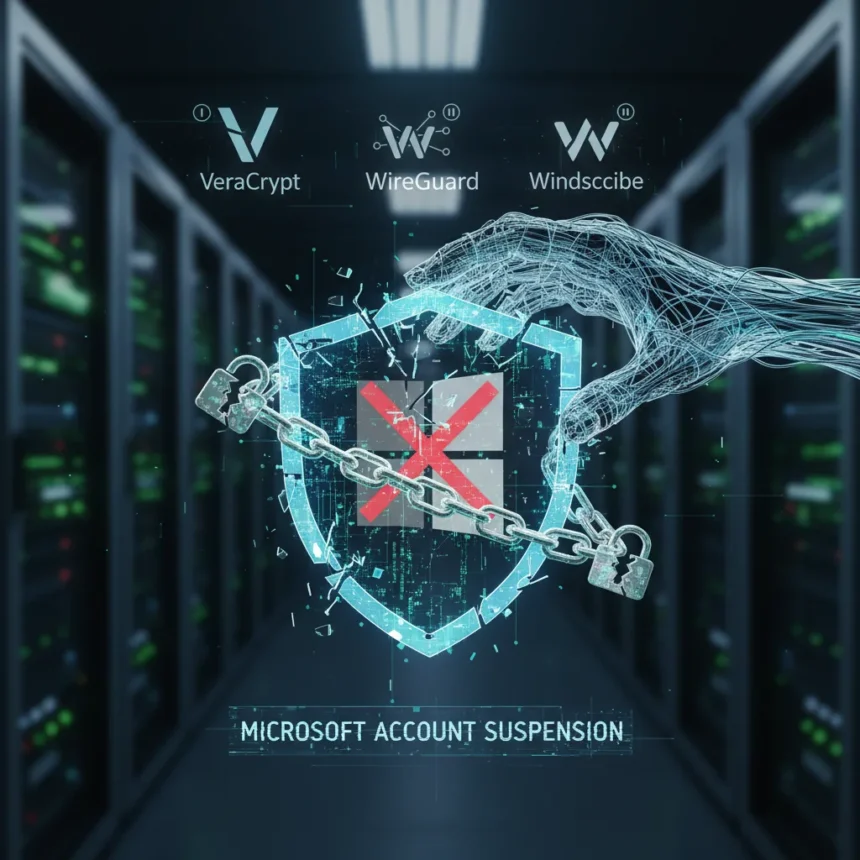
Microsoft account suspensions have frozen driver signing capabilities for some of the world’s most trusted open-source security and privacy tools, preventing critical updates from reaching millions of Windows users. The suspensions affected developer accounts tied to VeraCrypt, WireGuard, Windscribe, and MemTest86—tools relied upon by enterprise users, privacy advocates, and everyday Windows users for disk encryption, VPN connectivity, and system diagnostics.
Key Takeaways
- Microsoft suspended developer accounts without prior warning, blocking driver signing for security tools used by millions.
- Affected developers include WireGuard creator Jason Donenfeld and VeraCrypt maintainer Mounir Idrassi, whose accounts had been verified for 8+ years.
- Microsoft claims it sent emails, banners, and reminders since October 2023 about account verification requirements.
- The suspensions prevent critical security patches from reaching Windows users; Linux and macOS users remain unaffected.
- Microsoft VP Scott Hanselman intervened publicly, confirming accounts are being reinstated.
Why Microsoft Account Suspensions Matter for Windows Security
When Microsoft suspends developer accounts, it does not just inconvenience maintainers—it breaks the update pipeline for millions of Windows users. Driver signing is a security requirement on Windows; unsigned drivers cannot be installed without triggering warnings or system instability. WireGuard creator Jason Donenfeld told PCMag: “I cannot sign drivers, which means I cannot ship updates for WireGuard for Windows”. This is not a minor inconvenience. It means users of these tools cannot receive patches, security fixes, or feature improvements until their accounts are restored.
The timing amplifies the problem. These are not niche utilities—VeraCrypt is the successor to TrueCrypt and provides full-disk encryption for millions of users worldwide. WireGuard is a modern VPN protocol praised for its simplicity and security. Windscribe is a commercial VPN service. MemTest86 tests system memory reliability. Together, they protect data, privacy, and system integrity for tens of millions of people. A suspension that lasts weeks or months translates to prolonged exposure for users who cannot apply security updates.
The Conflict Over Prior Warning and Compliance
Microsoft and the affected developers tell sharply different stories about notification. According to the developers, Microsoft account suspensions arrived without warning. Mounir Idrassi, VeraCrypt’s maintainer, posted on SourceForge: “Microsoft terminated the account I have used for years to sign Windows drivers and the bootloader. Microsoft did not send me any emails or prior warnings. I have received no explanation for the termination and their message indicates that no appeal is possible”.


Microsoft’s account differs. A Microsoft representative stated the company “worked hard to make sure partners understood this was coming, from emails, banners, reminders” since October 2023, with a 30-day compliance deadline in April 2024. The policy change required account verification for Windows Hardware Program partners. If Microsoft’s timeline is accurate, developers had roughly six months of notice. If the developers’ account is accurate, critical communications were lost or never received.
This discrepancy matters because it reveals either a catastrophic email delivery failure or a communication breakdown that exposed security tools to suspension without recourse. Even if Microsoft sent emails, the fact that multiple established developers—whose accounts had been verified for 8+ years—received no usable warning suggests the notification system failed. A developer cannot verify an account they did not know needed verification.



Microsoft Account Suspensions and the Open-Source Dilemma
The incident exposes a structural vulnerability in how Windows depends on open-source developers. Unlike commercial software vendors with dedicated compliance teams, open-source maintainers often operate with minimal infrastructure. They may not monitor email addresses tied to old developer accounts. They may miss platform-wide announcements buried in notification feeds. Yet Microsoft’s policies treat them the same as large enterprises.
This asymmetry is particularly acute for security tools. VeraCrypt, WireGuard, and similar projects exist precisely because developers distrust centralized control and corporate gatekeeping. Ironically, those same developers now depend entirely on Microsoft’s goodwill to distribute updates on the world’s most widely used operating system. A single policy enforcement action—even one Microsoft claims was properly communicated—can paralyze millions of users.
Microsoft’s Public Intervention and Path Forward
The situation escalated on social media, where developers and security researchers criticized Microsoft’s handling of the suspensions. Microsoft VP Scott Hanselman responded publicly on X, acknowledging the issue and committing to resolution. “All being fixed as we speak,” Hanselman stated after speaking directly with Donenfeld and Idrassi. He also pushed back on the narrative, writing: “Hey, I love dumping on my company as much as the next guy, because Microsoft does some dumb stuff, but sometimes it’s just check emails and verify your accounts”.
Hanselman’s intervention signals that Microsoft is taking the matter seriously at a leadership level. However, his comment also reveals the core tension: even if developers missed the notification, Microsoft’s position is that verification should have been straightforward. The underlying assumption—that open-source maintainers actively monitor corporate compliance systems—does not reflect how many projects actually operate. A single person maintaining VeraCrypt in their spare time may not check a Microsoft developer account for months.



What This Means for Windows Users
While Microsoft works to reinstate accounts, the suspension period creates a real security window. No urgent patches were reported as blocked, but the inability to ship updates on demand is a structural problem. Linux and macOS users of these tools face no such restrictions; their update mechanisms are decentralized and do not require corporate approval. Windows users, by contrast, are entirely dependent on Microsoft’s infrastructure and policies.
This incident will likely prompt open-source projects to diversify their distribution strategies, explore alternative signing mechanisms, or reduce their Windows support. Some may even migrate development to Linux-first models where they retain full control. The long-term cost to the Windows ecosystem could be significant if developers decide the compliance burden is too high.
Are affected tools still safe to use?
Yes. The suspensions prevent new updates from being signed and distributed, but existing installations remain functional. However, users cannot receive security patches until developer accounts are restored and new signed drivers are released. If you rely on VeraCrypt, WireGuard, or Windscribe, check for updates once accounts are fully reinstated.
Why did Microsoft suspend these accounts without explanation?
Microsoft claims it sent notifications about account verification requirements since October 2023, with a deadline in April 2024. Developers dispute receiving adequate warning. The suspensions appear to have been automatic enforcement of this policy, triggered when verification was not completed by the deadline.
How long will it take for accounts to be reinstated?
Microsoft VP Scott Hanselman stated the issue is “being fixed as we speak,” but no specific timeline was provided. Reinstatement should allow developers to resume signing and distributing driver updates, though the exact rollout schedule remains unclear.
The Microsoft account suspensions reveal a dangerous gap between corporate compliance systems and the decentralized reality of open-source development. When policy enforcement is automated and communication channels fail, the collateral damage extends far beyond a few developer accounts—it reaches millions of users who depend on these tools for security and privacy. Microsoft’s rapid intervention suggests the company recognizes this risk, but the incident underscores the need for better coordination between platform gatekeepers and the open-source community they increasingly depend upon.
Edited by the All Things Geek team.
Source: Windows Central