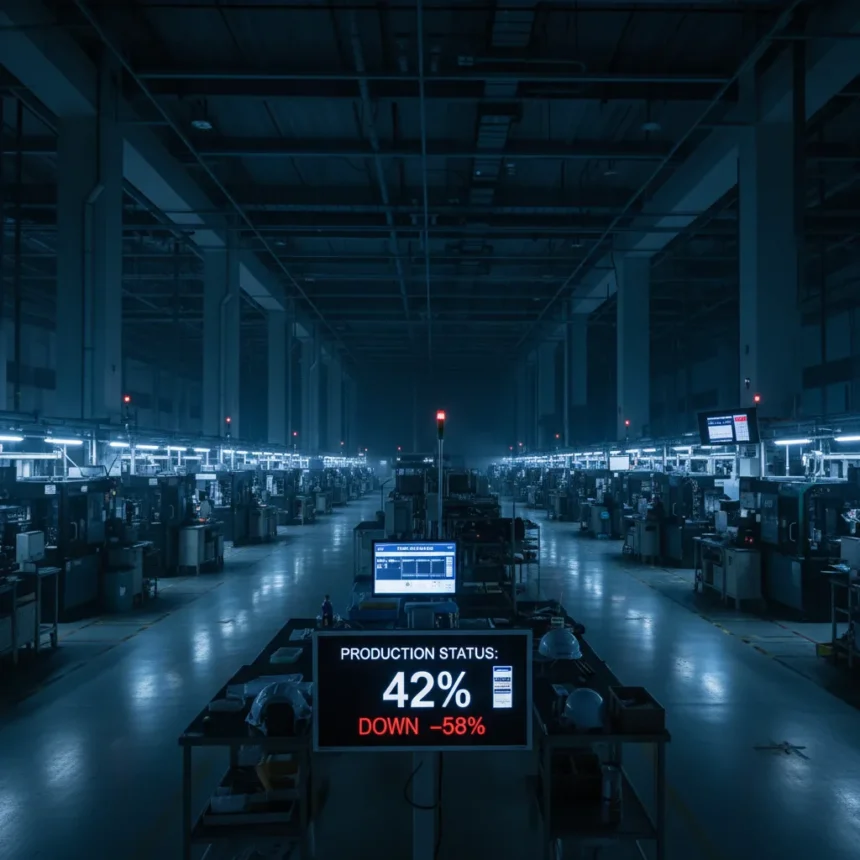
The Samsung semiconductor strike action on April 23, 2026 delivered a stark lesson in how fragile modern chip manufacturing can be when workers walk out. Samsung Electronics’ overall semiconductor production fell 18% during a single rally day, but the headline figure buried a far more dramatic story: foundry production — the contract chip manufacturing side of the business — collapsed by 58.1% during the night shift. That is not a rounding error. That is a near-shutdown.
Key Takeaways
- Samsung’s overall semiconductor production dropped 18% on April 23, 2026 during a union rally day.
- Foundry production fell 58.1% during the night shift, with the S1 Giheung line down 74.3%.
- Memory fab production declined 18.4% during the same night shift, far less than foundry lines.
- Over 40,000 union members attended the rally, organized by the Joint Struggle Headquarters.
- The union is threatening an 18-day general strike next month if demands are not met.
What the Samsung semiconductor strike production data actually shows
The production figures from the Samsung semiconductor strike break down in ways that reveal the structural vulnerabilities of different chip manufacturing processes. Foundry lines — which produce chips to customer specifications rather than Samsung’s own memory products — suffered the most severe disruptions. The S1 line at Giheung dropped 74.3%, S3 at Hwaseong fell 67.8%, and S5 at Pyeongtaek declined 42.7%. Memory fabs, by contrast, saw Line 15 drop 33.1%, Line 16 fall 11.3%, and Line 17 decline 13.1% during the same night shift.
Why the gap? Foundry lines rely more heavily on human labor because they have fewer overhead hoist transport systems — the automated equipment that physically moves wafers between processing stages. Memory lines have higher automation density, which means production can continue at a reduced rate even when staffing drops sharply. Foundry lines cannot absorb that kind of labor shock in the same way. One night’s rally attendance translated directly into a 58.1% production collapse.
How foundry lines compare to memory fabs under labor pressure
The contrast between foundry and memory performance during the Samsung semiconductor strike is the most important technical detail in the entire story. Memory fab production fell 18.4% during the night shift — significant, but manageable. Foundry production fell more than three times as hard. This is not about worker commitment or line management; it is about automation architecture. The lower the automation density, the more directly headcount translates to output.


This distinction matters enormously for Samsung’s customers. Companies that rely on Samsung’s foundry services for custom chip production face a different risk profile than those buying standardized memory. A 58% overnight output drop at a foundry does not just affect Samsung’s revenue — it disrupts the supply chains of every customer waiting on wafer starts from those lines. That is a leverage point the union clearly understands.
What the union is demanding and why the threat escalates
The Joint Struggle Headquarters, the union body organizing the action, is demanding that Samsung distribute 15% of operating profit to workers. The rally drew approximately 40,000 union members — a turnout that, combined with the production data, gives the union a concrete argument: a single day’s attendance at a rally caused measurable, documented damage to output. That data is now a negotiating tool.



The union has signaled it will escalate to an 18-day general strike next month if its demands are not met. A previous strike threat had projected production losses exceeding 30 trillion won, though that figure has not been independently verified in the current data. Even setting aside unverified projections, the April 23 figures alone make the case that a prolonged work stoppage would be operationally catastrophic — particularly for foundry operations where human labor cannot be substituted by automation at short notice.
Is the 58% production drop figure reliable?
These production decline figures come from union-disclosed data, which means they carry an inherent credibility question. The union has every incentive to present numbers that maximize pressure on management. Samsung has not publicly confirmed or disputed the specific figures. Until Samsung releases its own operational data, the 58.1% foundry decline should be treated as the union’s account of events, not a verified corporate disclosure. That said, the directional story — that foundry lines are more vulnerable to labor action than memory lines — is structurally sound regardless of the precise percentage.
Will Samsung’s foundry business recover quickly from the strike?
Semiconductor manufacturing is not like assembly-line production where you can simply restart and catch up overnight. Wafer fabrication involves processes measured in days and weeks, not hours. A night shift lost to a rally cannot be fully recovered by running extra shifts the following week — some in-process wafers may be affected, and customer delivery schedules will shift. The speed of recovery depends heavily on whether the union and management reach an agreement before the threatened 18-day strike materializes.
What does this mean for Samsung’s foundry customers?
Any company that placed orders with Samsung’s foundry division and is waiting on deliveries should be watching this situation closely. The S1 Giheung and S3 Hwaseong lines, which saw the steepest declines, are among Samsung’s key foundry facilities. A prolonged dispute that extends the kind of disruption seen on April 23 into weeks rather than hours would force customers to assess alternative foundry capacity — a difficult task given the global shortage of advanced node manufacturing slots.



The Samsung semiconductor strike has put a number on something the industry has long understood in theory: chip manufacturing is more labor-dependent than its high-tech image suggests. The 58.1% foundry production drop in a single night is not just a bargaining chip in a wage dispute — it is a data point that every customer, investor, and policymaker with exposure to Samsung’s supply chain should take seriously. If the union follows through on its 18-day strike threat, the April 23 figures will look like a preview.
Edited by the All Things Geek team.
Source: Tom's Hardware