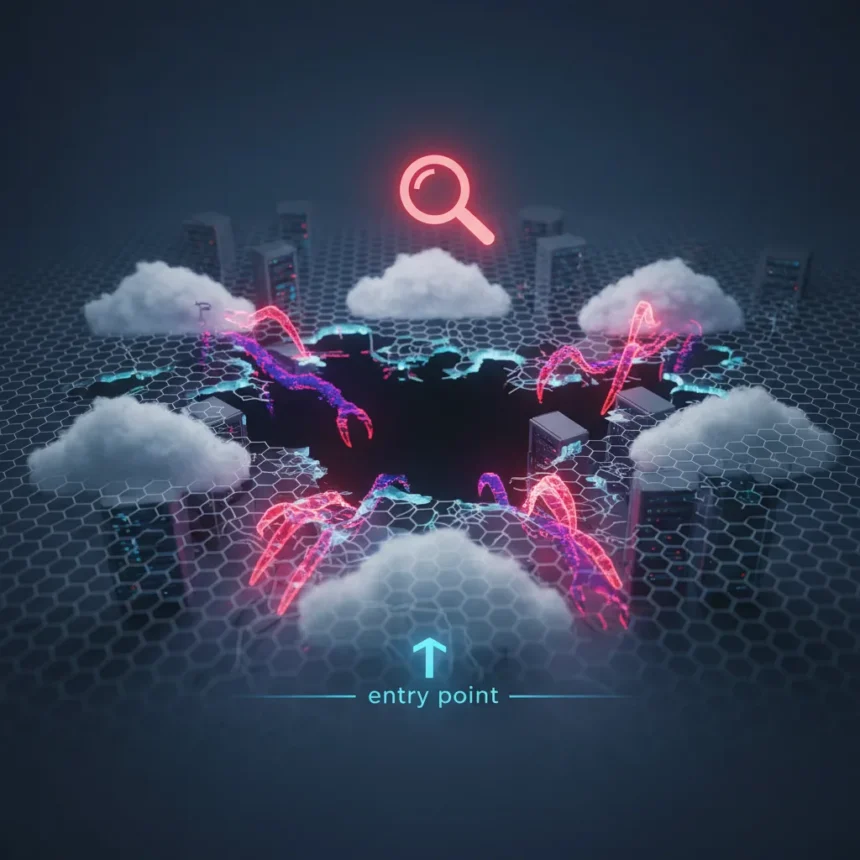
Security blind spots—the hidden vulnerabilities and invisible gaps in your infrastructure—are more dangerous than the attacks organizations obsess over. As cloud and hybrid environments grow more complex, these blind spots have become prime targets for cybercriminals looking for unmonitored entry points.
Key Takeaways
- Hidden vulnerabilities in cloud environments attract attackers more reliably than heavily defended perimeters.
- 91 percent of security and IT leaders admit they compromise security posture to manage complexity.
- APIs were the primary entry point for more than 40,000 security incidents in just six months last year.
- Tool sprawl increases attack surface by creating more entry points without improving visibility or control.
- Observability across identities, workloads, and east-west traffic is critical in hybrid security strategies.
Why Blind Spots Beat Sophisticated Attacks
Organizations spend billions on firewalls, intrusion detection, and perimeter defenses. Yet the real entry point for attackers is often something simpler: the vulnerability nobody sees. In dynamic cloud environments, security blind spots attract cybercriminals precisely because they are invisible. Hidden weaknesses are easier to exploit than hardened targets, and by the time defenders notice the breach, attackers have already moved laterally through the network.
The paradox is that organizations create blind spots while trying to improve security. Every new tool added to the stack increases the number of potential entry points attackers can target. Without robust governance and oversight, new tools introduce new vulnerabilities and expand the attack surface rather than shrinking it. The result: more tools, more complexity, less visibility, and more places for attackers to hide.
The Hidden Threats in Cloud and API Environments
Cloud complexity masks a specific category of blind spot: unmanaged APIs and undocumented connections. APIs have become a primary entry point for cyberattacks, with more than 40,000 security incidents in just six months last year. Many organizations lose track of which APIs are active, which are deprecated, and which are still accessible. These decommissioned connections—called “Zombie APIs”—remain available and unmaintained, creating exploitable gaps.


Agentic AI amplifies this risk. Autonomous agents deployed without central governance can access sensitive data and execute workflows using APIs without human oversight, a phenomenon described as “Shadow AI”. Each new agent connection creates another potential blind spot if visibility and control are absent. Organizations that build agentic systems without a centralized data hub as a single source of truth are essentially handing attackers a roadmap of undocumented entry points.
The problem extends beyond digital infrastructure. Modern facilities increasingly rely on remote monitoring, automation, and centralized control systems that can let threats go undetected for longer periods. High-profile cyberattacks in 2024 and 2025 targeted data center operators and cloud providers, disrupting services and exposing vulnerabilities in interconnected systems. Attackers often begin with cyber reconnaissance against IT and operational technology vulnerabilities, then escalate to physical surveillance, potentially using drones to map access points and security weaknesses.



Why Visibility Gaps Lead to Missed Threats
Effective defense in hybrid environments depends less on blocking every threat and more on spotting attacks already inside the perimeter. This requires observability across identities, workloads, cloud services, and east-west traffic—not just perimeter logs. Yet 91 percent of security and IT leaders admit they are making compromises in their security posture, often sacrificing visibility to manage tool sprawl and complexity.
These upstream compromises in visibility, data quality, and tool integration show up downstream as missed threats and delayed response times. Threats increasingly exploit gaps between organizational silos rather than staying within one domain. A security team monitoring only network traffic will miss lateral movement through shared cloud services. A team focused solely on IT vulnerabilities will miss the operational technology blind spot that attackers exploit next.
Detection strategies must shift away from signature-based alerts toward behavior and relationship analysis, backed by threat hunting and hypothesis-driven investigation. Automation and AI can accelerate this process, but only when grounded in high-quality, contextualized data. Without that foundation, automation amplifies blind spots rather than closing them.
Closing the Gaps: From Visibility to Action
Regaining control requires a three-part approach. First, reduce tool sprawl by consolidating solutions and improving governance over the ones that remain. Second, build a connected view of the environment rather than isolated signals from separate tools. Third, invest in observability that spans the entire hybrid estate—not just one domain or layer.



In API and agentic AI environments, a centralized data hub acting as a single source of truth becomes the foundation. This hub should catalog every API, every agent, every connection, and every data flow. Undocumented agents and zombie APIs cannot hide if everything is visible and actively maintained.
Supply chain security introduces another blind spot category. Organizations often lack visibility into third-party vendors and their access to critical systems. The recommendation is straightforward: reduce attack surface, verify third parties, and use strong incident response planning based on an assumed attack. In the public sector, 51 percent of IT leaders uncovered hidden participants in their software supply chains last year—a stark reminder that blind spots extend beyond your own infrastructure.
What happens when security blind spots go undetected?
Undetected blind spots allow attackers to establish persistence and move laterally before defenders notice. By the time a breach is discovered, attackers have typically accessed sensitive data and compromised multiple systems. The longer the blind spot remains invisible, the greater the damage and the longer the incident response takes.
How do APIs create security blind spots?
APIs create blind spots when organizations lose track of active connections, fail to monitor API traffic for anomalies, and deploy agentic systems without central oversight. Zombie APIs—decommissioned but still accessible—are particularly dangerous because they bypass modern security controls and are often forgotten during security audits.
Can automation and AI close security blind spots?
Automation and AI can accelerate threat detection and response, but only if built on high-quality, contextualized data and grounded in strong governance. Deploying AI agents without central oversight creates new blind spots rather than closing existing ones. The technology is a tool, not a solution by itself.
Security blind spots are not a technology problem—they are a visibility and governance problem. Organizations that treat them as such, investing in observability, consolidating tools, and maintaining a complete inventory of connections and assets, will dramatically reduce their attack surface. Those that ignore blind spots will continue to be surprised by breaches that seemed to come from nowhere.
Edited by the All Things Geek team.
Source: TechRadar