





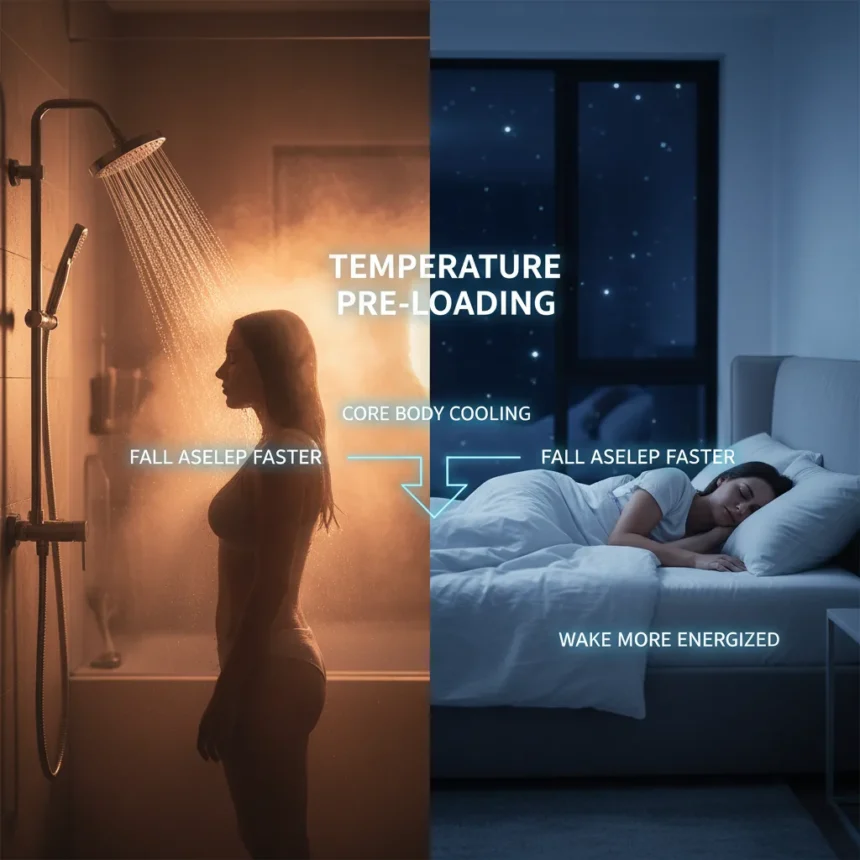
Temperature pre-loading is a sleep technique that uses external heat to trigger rapid internal cooling, signaling your body to initiate sleep. Rather than fighting your body’s natural temperature rhythms, this method exploits them. A hot shower taken 1-2 hours before bed raises skin temperature, which prompts blood vessel dilation and sweat evaporation that drops core body temperature by 1-3°F (0.5-1.7°C)—the exact biological signal your circadian rhythm needs to initiate sleep.
Key Takeaways
- Temperature pre-loading uses a hot shower to trigger rapid core body cooling, a primary sleep-onset signal.
- Core body temperature must drop to initiate sleep; this is a non-negotiable biological trigger.
- Ideal shower timing: 1-2 hours before bed, with water temperature around 40-43°C (104-109°F).
- Bedroom temperature should be 18°C (65°F) with hands and feet exposed to maximize cooling.
- Natural morning temperature rise enhances alertness if nighttime cooling was effective.
Why Core Temperature Drop Is Non-Negotiable for Sleep
Your circadian rhythm controls core body temperature as a master lever for sleep onset. This drop in core temperature is a non-negotiable biological trigger—without it, your body resists sleep regardless of how tired you feel. Most people rely passively on nighttime cooling, which can take hours. Temperature pre-loading compresses this timeline by creating an artificial heat spike that your body aggressively cools, accelerating the natural process. Think of it as priming the pump: you heat up deliberately so your body works harder to cool down, reaching the sleep threshold faster.
Dr. Andrew Huberman, a Stanford neuroscientist, has emphasized that temperature is one of the most powerful levers you can pull to fall asleep faster. This insight cuts against the popular focus on blue light avoidance and sleep supplements—temperature control is often overlooked despite being equally or more potent. Your body’s thermal state matters more than most sleep advice suggests.
How to Execute Temperature Pre-Loading Correctly
The technique requires precise timing and environment setup to work effectively. Start with a hot shower (not scalding) at water temperature around 40-43°C (104-109°F) taken 1-2 hours before your desired bedtime. The heat raises your skin temperature and increases blood flow to the surface, preparing your body for the cooling phase. Finish the shower and allow your body to cool naturally over the next 60-90 minutes—this is when the peak temperature drop aligns with entering bed.


Upon finishing your shower, enter a bedroom set to 18°C (65°F). This is critical: keep your hands and feet exposed to air rather than wrapped in blankets, as extremities are major heat-dissipation points. Many people make the mistake of bundling up immediately after a shower; instead, let your body cool in the open air for the first 30-45 minutes. Only once you feel the internal cooling effect should you add layers. This counterintuitive approach—heating up to cool down—is what makes temperature pre-loading work.
Temperature Pre-Loading vs. Alternative Sleep Methods
The simplest alternative is exposing your hands and feet to cool air without a preceding shower—a zero-cost method that works but lacks the potency of pre-loading. The shower creates a stronger thermal gradient, triggering more aggressive cooling. Conversely, cool showers are counterproductive; they raise core temperature and delay sleep rather than accelerate it. This is why hot showers dominate sleep science despite seeming counterintuitive to most people.



Other temperature-adjacent practices—avoiding late exercise and heavy meals—prevent core temperature elevation but do not actively accelerate cooling the way pre-loading does. Temperature pre-loading is offensive rather than defensive: you are not just avoiding temperature spikes, you are hacking your circadian rhythm to trigger sleep faster by creating a controlled thermal event.
Why Morning Energy Improves When Temperature Drops at Night
If temperature pre-loading works correctly, your core temperature drops significantly during sleep, then naturally rises upon waking. This natural morning temperature rise enhances alertness and energy levels. The mechanism is straightforward: your circadian rhythm uses temperature oscillation as a signal for sleep and wakefulness. A proper nighttime drop sets up a stronger morning rise, amplifying the natural energy boost you feel upon waking. Readers who struggle with morning grogginess often have shallow temperature swings—temperature pre-loading deepens these swings, making mornings feel more energized.
Common Mistakes That Sabotage the Technique
Timing is everything. Taking a hot shower immediately before bed defeats the purpose; your core temperature will still be elevated when you try to sleep. Waiting too long (3+ hours) means the cooling effect peaks before you enter bed. The 60-90 minute window allows peak cooling to coincide with sleep onset. Another mistake is keeping hands and feet covered immediately after showering—this traps heat and slows the cooling process. Finally, a bedroom warmer than 18°C (65°F) reduces the temperature gradient, making cooling less efficient.
Is temperature pre-loading backed by sleep science?
Yes. Core body temperature drop is a primary biological trigger for sleep onset controlled by your circadian rhythm. Temperature pre-loading accelerates this natural process by creating a controlled heat spike that your body aggressively cools. Dr. Andrew Huberman’s research emphasizes temperature as one of the most powerful sleep levers available.



Can temperature pre-loading work year-round?
The technique works in any season, though summer heat may reduce the temperature gradient between your body and the environment. In hot climates, using fans or air conditioning to maintain a 18°C (65°F) bedroom becomes more important. Winter naturally supports the cooling phase, making the hack more effortless in colder months.
How long does it take to see results from temperature pre-loading?
Most people notice faster sleep onset within 3-7 nights of consistent practice. The effect compounds as your body learns to recognize the thermal cue, strengthening the circadian response. Consistency matters more than perfection—even occasional use provides benefit, but nightly practice trains your sleep system most effectively.
Temperature pre-loading is free, requires no supplements or devices, and exploits biology rather than fighting it. If you struggle to fall asleep or wake groggy, this single behavioral change often outperforms expensive sleep aids. The counterintuitive nature of heating to cool down makes it easy to dismiss, but the science is clear: core temperature drop is non-negotiable for sleep, and pre-loading accelerates it dramatically.
Edited by the All Things Geek team.
Source: Tom's Guide




