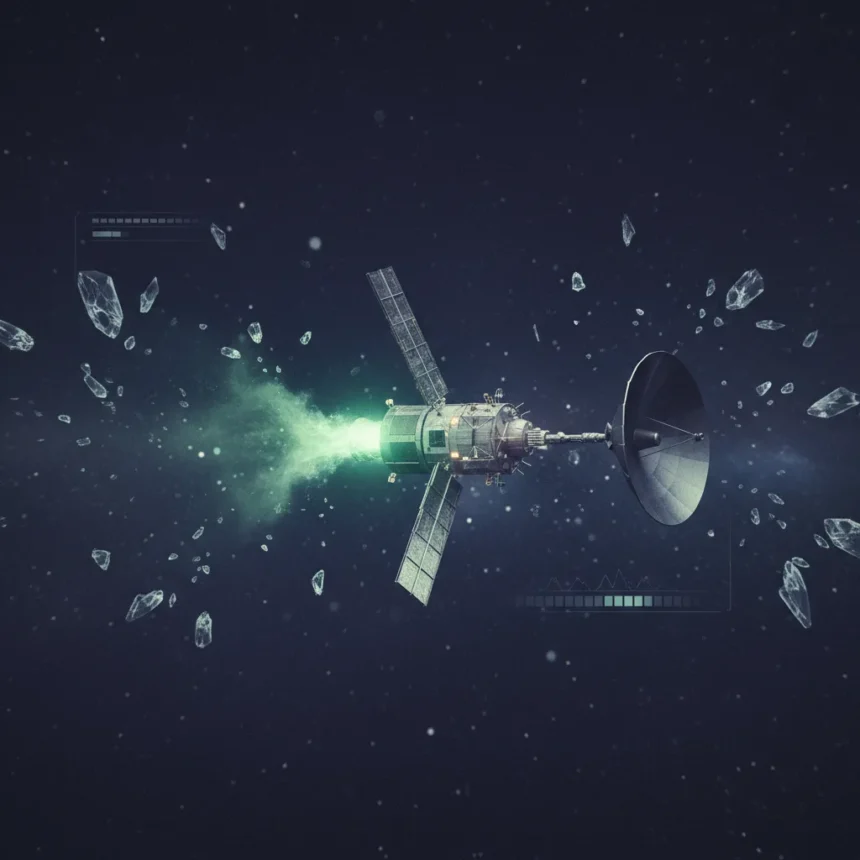
The Voyager 1 power crisis has reached a critical inflection point. On April 17, 2026, NASA engineers sent commands to deactivate the Low-energy Charged Particles experiment, one of the spacecraft’s last operational science instruments, in a desperate bid to prevent a catastrophic fault-protection shutdown. Nearly 49 years after its 1977 launch, Voyager 1 is burning through its radioisotope thermoelectric generator at an accelerating rate, and this emergency move buys the interstellar probe roughly one year of breathing room before the next crisis arrives.
Key Takeaways
- Voyager 1 power crisis forces shutdown of LECP instrument on April 17, 2026, after February power drop nearly triggered fault protection.
- RTG fuel declines 4 watts annually; Voyager 1 has lost significant power over nearly five decades of continuous operation.
- Emergency shutdown provides approximately one year of operational runway before further countermeasures become necessary.
- NASA engineers developing “the Big Bang” plan to swap multiple components for lower-power alternatives and extend mission life.
- Voyager 1 retains two science instruments after LECP shutdown: plasma wave detector and magnetic field sensor.
Understanding the Voyager 1 Power Crisis
The Voyager 1 power crisis stems from a fundamental constraint: the spacecraft relies entirely on a single radioisotope thermoelectric generator to convert heat from decaying plutonium into electricity. Unlike modern satellites with solar panels and rechargeable batteries, Voyager 1 has no backup power source. The RTG loses approximately 4 watts of electrical output every year—a seemingly modest decline that becomes catastrophic over decades. After nearly half a century in the void, those accumulated losses now threaten the mission itself.
On February 27, 2026, during a routine roll maneuver, Voyager 1’s power levels dropped unexpectedly, approaching the threshold that would automatically trigger the spacecraft’s undervoltage fault protection system. Such a shutdown would be nearly impossible to recover from at this distance—commands take over 22 hours to reach the spacecraft, and by then, critical systems may have already frozen or failed. The Voyager 1 power crisis had become acute.
The LECP Shutdown and Its Implications
The Low-energy Charged Particles experiment had operated almost continuously since Voyager 1’s launch in 1977, making its deactivation a significant sacrifice. The LECP was one of only three remaining science instruments still gathering data about the interstellar medium—the plasma, radiation, and magnetic environment surrounding the spacecraft. By shutting it down, NASA engineers eliminated a power consumer and bought time, but at the cost of losing a decades-old scientific capability.


This is not the first time. Voyager 2, Voyager 1’s sister spacecraft, had its LECP shut down in March 2025 as part of the same escalating power management strategy. Both probes face identical challenges: aging nuclear fuel, no resupply missions possible, and an engineering team forced to choose which instruments live and which die. After the LECP shutdown, Voyager 1 now operates with only two active science instruments: a plasma wave detector and a magnetic field sensor.
The expected duration of this reprieve—about one year—underscores how dire the Voyager 1 power crisis has become. This is not a long-term solution. It is a bridge to the next emergency measure.



The Big Bang Plan and Future Countermeasures
NASA’s Jet Propulsion Laboratory team is developing an ambitious coordinated strategy nicknamed “the Big Bang,” designed to extend operations further by swapping multiple powered components for lower-power alternatives and addressing thermal challenges. The plan involves turning off heaters and non-essential systems while replacing them with lower-power equivalents, a delicate engineering dance that must account for the spacecraft’s extreme cold and the brittleness of 49-year-old hardware.
Power margins are razor-thin after five decades of operation. Every watt counts. Every shutdown brings risk—systems that have been running continuously may fail to restart in the deep cold of interstellar space. Yet the alternative is mission failure. The Voyager 1 power crisis is forcing engineers to make choices that would have seemed unthinkable during the mission’s early years: deactivate instruments, shut off heaters, and hope the spacecraft survives the transition.
The comparison to Voyager 2 is instructive. Both spacecraft are losing 4 watts per year and both face identical RTG degradation. Both are undergoing the same emergency shutdown protocols. Yet Voyager 2 remains slightly ahead in the power timeline—its LECP shutdown occurred a year earlier, suggesting that Voyager 1 may have slightly more aggressive power demands or that the two spacecraft’s RTGs are degrading at slightly different rates. Either way, both are on borrowed time.
Why This Matters Beyond the Spacecraft
Voyager 1 is humanity’s most distant active spacecraft, transmitting data from beyond the heliopause—the boundary where the solar wind gives way to the interstellar medium. No other probe has reached this frontier. The Voyager 1 power crisis is not merely about keeping an old spacecraft alive; it is about maintaining humanity’s only real-time window into the interstellar environment. Once Voyager 1 falls silent, that window closes for years or decades until another mission reaches similar distances.



The engineers managing this crisis are not replacing components or refueling the RTG. They are managing the inevitable decline of a machine that has far outlived its original design life. The original Voyager mission was planned for five years. It has lasted nearly ten times that long, a testament to engineering excellence and careful stewardship. But physics does not negotiate. Radioactive decay follows its own schedule, and the Voyager 1 power crisis is simply the universe collecting its debt.
What Happens When the Breathing Room Runs Out?
In approximately one year, the Voyager 1 power crisis will intensify again. By then, NASA engineers hope to have the “Big Bang” plan ready for execution. If successful, it could extend operations into the 2030s. If not, Voyager 1 may enter a cascade of automated shutdowns from which recovery becomes impossible. The spacecraft will not explode or vanish—it will simply go silent, drifting through the interstellar void as a monument to human achievement, no longer sending back its precious data.
For now, the team has bought time. One year of breathing room is not much, but it is enough to plan, to test, and to prepare for the next emergency. The Voyager 1 power crisis is not ending. It is evolving, and humanity’s most distant messenger is teaching us what it means to engineer for the truly long term.
How much power does Voyager 1 have left?
Voyager 1’s RTG currently provides enough power to run two science instruments and basic spacecraft systems, but with razor-thin margins. The spacecraft loses about 4 watts of power annually, meaning the buffer shrinks continuously. The LECP shutdown bought approximately one year before critical power thresholds are reached again.
Can NASA send a repair mission to Voyager 1?
No. Voyager 1 is over 15 billion miles from Earth, and no spacecraft in existence can reach it or carry replacement components that would survive the journey. NASA’s only option is remote management—shutting down systems and optimizing power consumption from Earth. This is why the “Big Bang” plan relies on coordinated component swaps rather than hardware replacement.
Will Voyager 1 stop transmitting data soon?
The Voyager 1 power crisis will likely force additional instrument shutdowns within the next year or two, but the spacecraft is not expected to go completely silent immediately. However, each shutdown reduces the amount of scientific data it can collect. Eventually, if the “Big Bang” plan succeeds, operations could extend into the 2030s, but the mission is clearly in its final chapter.
The Voyager 1 power crisis is a stark reminder that even humanity’s greatest engineering achievements are finite. But in managing this slow decline, NASA is writing one of the most impressive chapters in space exploration history—not through launching new missions, but through keeping an aging one alive through sheer ingenuity and will.
Edited by the All Things Geek team.
Source: Tom's Hardware