






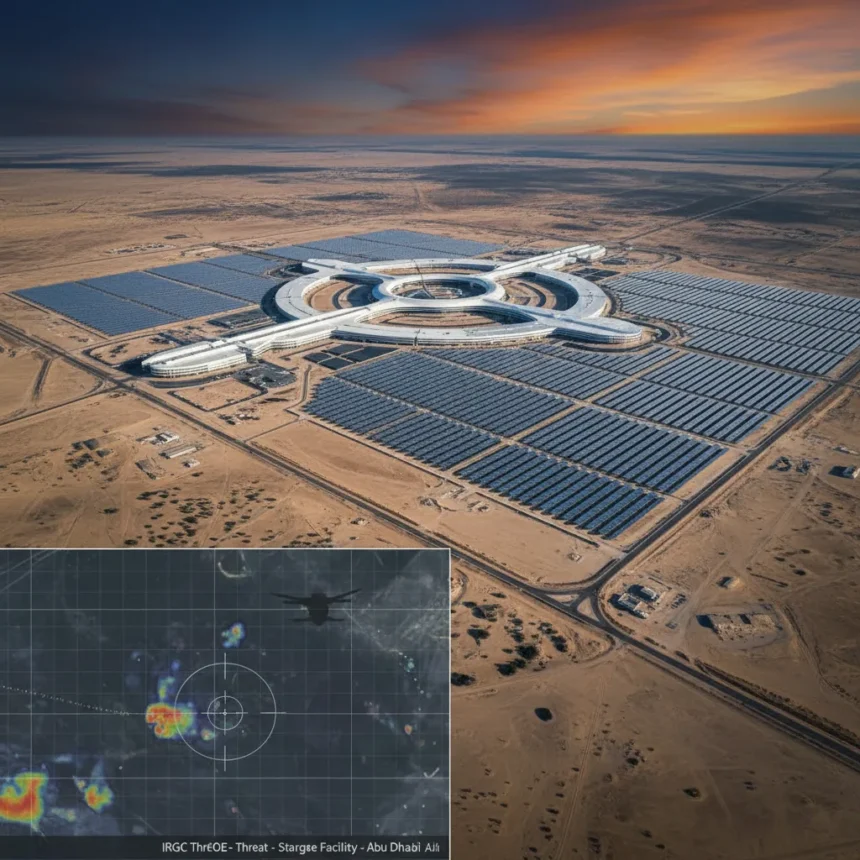
The Stargate AI data center in Abu Dhabi — a $30 billion facility backed by OpenAI, SoftBank, Oracle, Cisco, Nvidia, and UAE’s G42 — has become an explicit military target. Iran’s Islamic Revolutionary Guard Corps issued a video threat of “complete and utter annihilation” against the project, releasing satellite imagery of its desert location and framing it as retaliation for potential US strikes on Iranian power infrastructure. This is no longer a hypothetical risk for Gulf-based tech investment. It’s a named, geolocated threat from a state-linked military body.
Key Takeaways
- Iran’s IRGC threatened OpenAI’s Stargate AI data center in Abu Dhabi with destruction in a video message including satellite imagery.
- The Stargate facility is valued at $30 billion and planned as one of the largest AI computing clusters outside the US.
- An initial 200MW phase is planned for 2026, scaling eventually to 1GW capacity.
- Iran has issued similar threats against at least 18 US tech companies operating in the region, including Microsoft, Apple, Google, Meta, and Anthropic.
- Prior Iranian rocket strikes reportedly damaged Amazon AWS data centers in the region, disrupting operations.
What Is the Stargate AI Data Center and Why Does It Matter?
The Stargate AI data center refers to OpenAI’s flagship international AI computing project, located in Abu Dhabi and described by the US Commerce Department as the largest data center deployment outside the United States. Backed by SoftBank, Oracle, Cisco, Nvidia, and UAE sovereign-linked tech firm G42, the project represents a $30 billion bet that the Gulf can anchor global AI infrastructure. Its initial 200MW phase is set to launch in 2026, with a long-term target of 1GW capacity.
What makes the IRGC’s threat particularly striking is the specificity of it. The video released by Iran’s Khatam al-Anbiya HQ didn’t just name the project — it showed satellite imagery of the facility’s desert location, including what the source describes as a site obscured on Google Maps. Pinpointing a “hidden” installation in a public threat is a deliberate escalation, designed to signal intelligence capability as much as intent to strike.
Iran’s IRGC Threat: What Was Actually Said
IRGC spokesperson Brigadier General Ebrahim Zolfaghari delivered the threat directly, warning that US and Israeli facilities — and companies with American shareholders operating in the region — face destruction if the US moves against Iranian power plants. The exact language from Iran’s Khatam al-Anbiya HQ was unambiguous: “All power plants, energy infrastructure, and information and communication technology of the Zionist regime, and all similar companies in the region that have American shareholders, shall face complete and utter annihilation”.


That framing is significant. The IRGC isn’t just targeting military assets — it’s explicitly categorising commercial AI and ICT infrastructure as legitimate retaliation targets. The Stargate AI data center, by virtue of its American shareholders and strategic value, sits squarely in that category.
How Serious Is the Threat to Regional Tech Infrastructure?
The IRGC’s threats against the Stargate AI data center sit within a broader pattern of escalation. Iran issued similar warnings against at least 18 US tech companies with regional operations — including Microsoft, Apple, Google, Tesla, Boeing, Meta, Intel, and Anthropic — with a separate warning on April 1, 2026 advising employees to evacuate facilities by 8 PM Tehran time. The stated justification was those companies’ alleged role in tracking targets via AI and ICT systems.



Prior Iranian rocket strikes reportedly damaged Amazon AWS data centers in the region, disrupting operations. That precedent matters. It means these threats aren’t purely rhetorical — there’s at least one instance of physical damage to comparable infrastructure. Whether the Stargate facility, which isn’t yet operational in its first phase, presents a viable strike target is a separate question, but the intent has been publicly stated and the location apparently identified.
Compared to traditional military targets, data centers are structurally vulnerable in different ways. A 1GW AI computing cluster requires enormous power infrastructure, cooling systems, and network connectivity — all of which are easier to disrupt than to defend comprehensively. The Stargate AI data center’s scale, paradoxically, makes it a more prominent target.
Is the Stargate AI Data Center in Abu Dhabi still going ahead?
Nothing in the available information suggests the project has been paused or reconsidered. The initial 200MW phase remains planned for 2026, with the full 1GW build-out as the long-term target. The UAE has not publicly responded to the IRGC’s threat in the context of this project, and OpenAI and its partners have not issued public statements about the security situation as it relates to the facility.
What US tech companies has Iran threatened in the region?
Iran’s IRGC has issued threats against at least 18 US tech companies with operations in the Middle East, including Microsoft, Apple, Google, Tesla, Boeing, Meta, Intel, and Anthropic, in addition to OpenAI’s Stargate project. The April 1, 2026 warning specifically cited those companies’ alleged use of AI and ICT systems in tracking targets, and advised employees to evacuate regional facilities.



Has Iran actually attacked tech infrastructure before?
Iranian rocket strikes reportedly damaged Amazon AWS data centers in the region, disrupting operations. The extent of that damage isn’t fully confirmed, with the strikes described as possible opportunistic hits rather than precision attacks. No confirmed strikes have followed the April 1, 2026 warning against the 18 named tech firms, but the AWS precedent establishes that threats against commercial tech infrastructure have previously translated into physical action.
The IRGC’s targeting of the Stargate AI data center marks a genuine shift in how state actors are thinking about tech infrastructure as a geopolitical lever. Whether or not Iran follows through, the fact that a $30 billion AI facility in Abu Dhabi has been named, located via satellite imagery, and publicly threatened should force every company investing in Gulf AI infrastructure to reckon seriously with security in ways that server uptime and cooling efficiency don’t capture.
This article was written with AI assistance and editorially reviewed.
Source: Tom's Guide