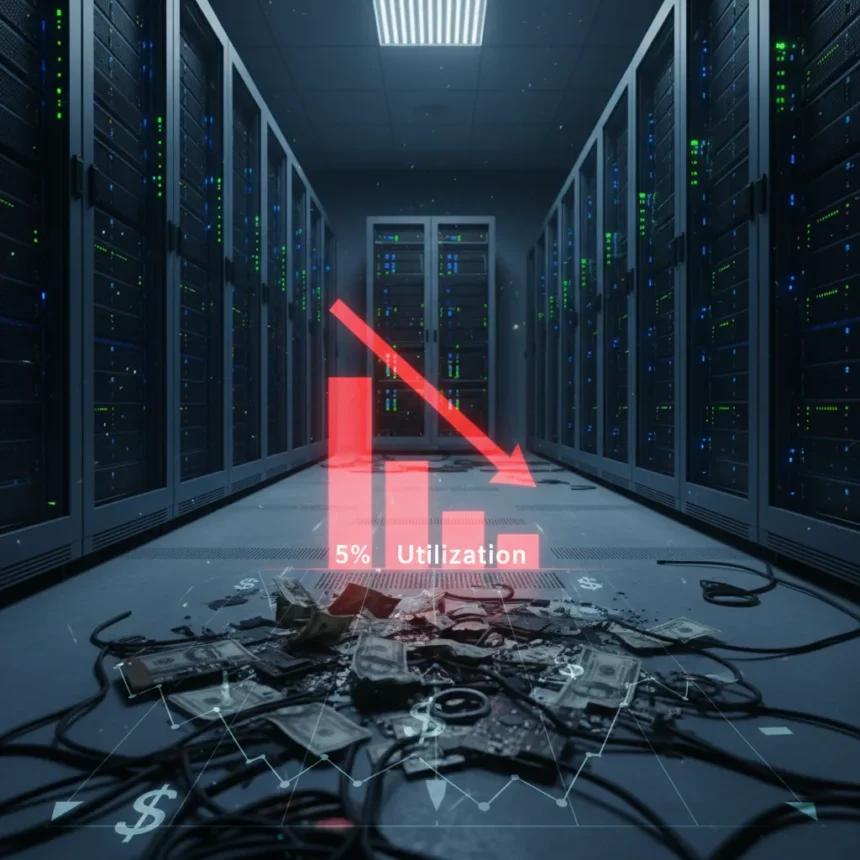
GPU utilization efficiency has become the industry’s dirty secret. A new report finds that GPU utilization efficiency across companies averages just 5%, meaning millions of GPUs worth billions of dollars sit mostly idle while companies burn cash on power, cooling, and maintenance for hardware that barely works. This is not a scaling problem—it is a planning failure.
Key Takeaways
- Average GPU utilization stands at just 5%, described as a “math fail” by industry experts.
- Millions of GPUs collectively worth billions are underutilized across enterprise AI setups.
- Fear-driven overprovisioning, not data-driven planning, is the primary cause of idle resources.
- Poor automation and inadequate resource management amplify the efficiency crisis.
- Rising operational costs make underutilization increasingly expensive as AI infrastructure scales.
The 5% Problem: How Fear Killed Efficiency
Companies massively overprovision AI infrastructure out of fear of shortages, not out of actual demand. The result is catastrophic waste. GPU utilization efficiency at 5% means 95% of deployed hardware is doing nothing—yet still consuming electricity, generating heat, and requiring maintenance crews. The same problem extends to CPUs in AI setups, which also show significant underutilization. This is not a technical limitation. It is a psychological one. Fear of being caught without capacity during a spike drives companies to buy first and plan later, if at all.
The “math fail” framing cuts to the heart of the absurdity. If you deploy a GPU cluster worth millions and use 5% of it, you are not being cautious—you are being reckless with shareholder money. Yet this has become standard practice across the industry. Companies justify the waste by pointing to unpredictable demand spikes, but that argument collapses under scrutiny. Unpredictability is exactly why you need better automation and resource scheduling, not blind overbuying.
Why Automation Remains the Missing Piece
Poor automation is the enabler of this waste. Without intelligent resource management systems, companies cannot route workloads efficiently or scale capacity on demand. They cannot tell whether a GPU is idle because demand is low or because their orchestration layer is broken. So they buy more hardware instead of fixing the software. This creates a vicious cycle: more idle hardware requires more management overhead, which is harder to automate, which drives demand for even more capacity.


The operational cost burden makes this cycle unsustainable. Power consumption, cooling infrastructure, and physical space in data centers are not free. As companies add more idle GPUs to their fleet, these costs compound. A single wasted GPU might cost thousands per month in electricity and cooling alone. Multiply that across millions of idle units and the financial picture becomes staggering. Companies are literally paying billions to store computing capacity they do not use.
The Path Forward: Data-Driven Resource Planning
GPU utilization efficiency will only improve when companies shift from fear-based provisioning to data-driven capacity planning. This means investing in automation tools that can monitor workload patterns, predict demand spikes, and dynamically allocate resources. It means setting utilization targets and treating underutilization as a performance failure, not a safety margin. It means asking hard questions: Why is this GPU idle? What automation gap allowed this to happen? How do we prevent it next time?



The alternative is continued waste. As AI workloads grow and infrastructure costs rise, the penalty for poor planning compounds. A company that achieves 20% utilization instead of 5% does not just save money—it fundamentally changes its competitive position. It can invest those savings in better models, more research, or faster iteration. Companies stuck at 5% are simply burning capital while their competitors move faster.
Is GPU utilization efficiency a solvable problem?
Yes, but it requires systematic change. Better automation, clearer capacity planning, and willingness to challenge the fear-based provisioning mindset are all necessary. Companies that treat utilization as a key performance metric rather than an afterthought will pull ahead.
Why do companies overprovision AI infrastructure if utilization is so low?
Fear of shortages drives overprovisioning. Companies buy capacity to avoid being caught without resources during demand spikes, even though better automation could handle those spikes without massive idle capacity.
What role does poor automation play in low GPU utilization?
Without intelligent resource management systems, companies cannot route workloads efficiently or scale dynamically. This forces them to buy excess capacity as a workaround, creating the idle hardware problem.



The GPU utilization efficiency crisis is not inevitable. It is the result of choices—choices to overprovision instead of automate, to buy instead of plan, to accept waste instead of measure it. Companies that break this pattern will find themselves with billions in freed-up capital and a significant competitive advantage. The rest will keep paying for hardware they do not use.
Edited by the All Things Geek team.
Source: TechRadar