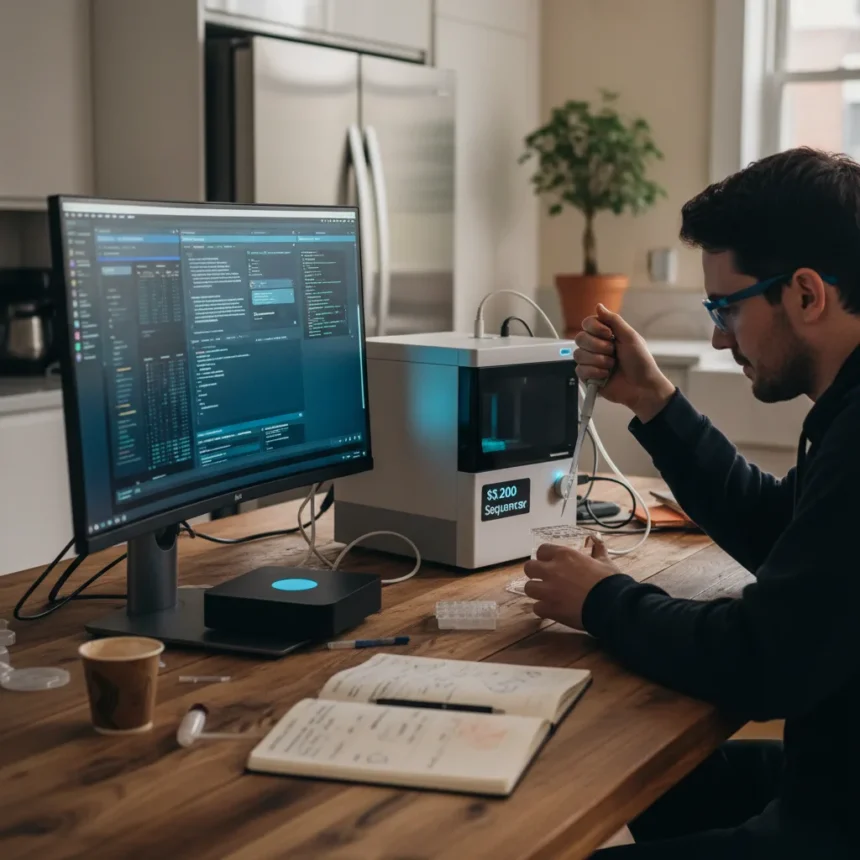
Home genome sequencing just shifted from fringe biohacking fantasy to practical reality. A biohacker recently sequenced their own genome at a kitchen table using an M3 Ultra Mac Studio, Claude AI, and a $3,200 sequencer, driven by a desire to investigate a family history of autoimmune disease. The project demonstrates that institutional labs no longer hold a monopoly on genetic analysis—consumer-grade hardware and AI assistance have democratized access to personal genomic data.
Key Takeaways
- M3 Ultra Mac Studio handled 100GB of sequencing data per run with sufficient RAM for real-time processing.
- Claude AI provided workflow guidance for genome analysis without requiring bioinformatics expertise.
- Total equipment cost around $3,200 for the sequencer, making personal genomics accessible to motivated individuals.
- DIY genome sequencing enables targeted health investigations, such as exploring autoimmune disease genetics.
- Home sequencing projects demand substantial storage and computational resources, not casual weekend tinkering.
What Home Genome Sequencing Actually Requires
Home genome sequencing is not a casual hobby. Each sequencing run generates 100GB of data, demanding both serious storage infrastructure and computational muscle to process raw genetic information into usable results. The M3 Ultra Mac Studio provided the horsepower needed—oodles of RAM became essential for handling datasets that would choke consumer laptops. This is not a $99 gadget; it is a $3,200+ commitment to hardware plus the cost of the Mac itself. The barrier to entry has dropped dramatically compared to five years ago, but it remains a project for people serious about genomic investigation.
The workflow itself required Claude AI to guide analysis steps. Rather than hiring a bioinformatician or spending months learning command-line tools, the biohacker leveraged AI to interpret sequencing output and suggest next steps. This is where the real democratization happens—AI removes the expertise gatekeep that once forced amateur biologists into institutional partnerships or online communities. A motivated person with curiosity and resources can now conduct investigations that previously required a PhD in genetics.
How This Compares to Other DIY Biology Approaches
Home genome sequencing sits at the ambitious end of the DIY biology spectrum. Other biohacking projects demand far less infrastructure. The ODIN kits by Josiah Zayner enable CRISPR gene-editing on simple organisms like yeast and bacteria, accessible via tutorials and equipment sold directly to consumers. The Synbiota Rainbow Factory kit costs $395 and lets users engineer E. coli to produce fluorescent proteins—a weekend project compared to the months-long commitment of full genome sequencing. These alternatives prove that biohacking exists on a sliding scale: you can edit bacteria for under $400, or you can sequence your own genome for thousands and a serious time investment.



The genome sequencing approach differs fundamentally because it targets human genetic data rather than microbial manipulation. That escalation in ambition brings ethical and practical considerations that simpler kits avoid. You are not just learning molecular biology; you are generating personal health information that may reveal unexpected genetic risks or carrier status for hereditary conditions. The technical barrier is lower than ever, but the interpretive and psychological barriers remain substantial.
Why This Matters Right Now
Consumer AI and specialized hardware converged at exactly the right moment to make this possible. Five years ago, Claude did not exist, and Mac Studios did not offer the M3 Ultra chip. The sequencer cost would have been double or triple. Each component alone would have been a barrier; together, they created a viable pathway for independent investigation. The biohacker’s motivation—uncovering genetic roots of autoimmune disease in their family—represents a growing trend: people taking personal health into their own hands rather than waiting for institutional research to answer their questions.



This matters because it signals a shift in who gets to ask genetic questions and when. Institutional genomics moves slowly, bound by IRB approvals, funding cycles, and research priorities that may not align with individual curiosity. A kitchen-table setup answers to no committee. That freedom is powerful. It is also why the DIY biology community raises legitimate concerns about biosecurity and the potential for misuse—the same tools that enable personal health investigation could theoretically enable dangerous research. For now, the biohacker’s project remains a proof of concept rather than a validated methodology, but it proves the technical feasibility exists.
Is Home Genome Sequencing Practical for Most People?
Not yet, and probably not for years. The $3,200 sequencer is just the entry fee; add the Mac Studio cost, storage infrastructure, and the time investment to learn bioinformatics basics, and you are looking at a five-figure project with a steep learning curve. Most people investigating genetic health questions will continue using commercial services like 23andMe or Ancestry, which handle the sequencing and analysis for a fraction of the cost and complexity. The biohacker’s achievement proves it is possible, not that it is practical for the average person curious about their genetics.
That said, the existence of a working kitchen-table setup accelerates the timeline. As sequencers become cheaper and more refined, as Claude and other AI tools improve at bioinformatics guidance, and as storage costs drop, the barrier will continue falling. In ten years, home genome sequencing might be the domain of serious amateur scientists rather than fringe biohackers. For now, it remains a remarkable feat of technical integration and personal determination.
Could AI Make Home Genome Sequencing Easier?
Claude already proved it can guide the workflow, but future AI improvements could simplify the analysis layer significantly. Imagine an AI trained specifically on genomic interpretation, capable of flagging disease variants, explaining inheritance patterns, and suggesting clinical follow-up steps without requiring the user to learn bioinformatics terminology. That is not science fiction—it is the logical next step as AI systems become more specialized. The computational bottleneck is not interpretation; it is data processing. Raw sequencing output is meaningless without analysis, and that is where AI added the most value in the biohacker’s project.


What Happens After the Sequencing is Done?
Raw genetic data is only the beginning. Interpreting a personal genome requires understanding which variants matter, which are benign, and which carry disease risk. The biohacker’s investigation into autoimmune disease genetics requires cross-referencing their variants against published disease associations, which is possible but not trivial. This is where the lack of expert validation becomes a real limitation. A bioinformatician or genetic counselor would catch nuances that an AI or an amateur might miss. The DIY approach generates the data; it does not guarantee the interpretation is correct or clinically useful.
FAQ
How much does a home genome sequencing setup cost?
The sequencer itself costs around $3,200. Add the price of an M3 Ultra Mac Studio (several thousand dollars), adequate storage infrastructure, and software tools, and you are looking at a five-figure investment. This is a serious commitment, not a casual project.
Can Claude AI really guide genome sequencing without a bioinformatician?
Claude can provide workflow guidance and help interpret results, but it is not a substitute for formal bioinformatics training or clinical validation. The AI removes some expertise barriers but does not eliminate the need for careful interpretation of genetic findings.
Is home genome sequencing safe or legal?
The technical and legal safety of home genome sequencing remains largely unregulated. Generating personal genetic data is legal in most jurisdictions, but the interpretation and use of that data raises questions about privacy, informed consent, and the potential for misuse. Individuals should approach personal genomics with caution and ideally seek clinical guidance when interpreting results.
The biohacker’s kitchen-table genome sequencing proves that the technical barriers to personal genomics have crumbled. What remains is a question not of capability but of wisdom—knowing what to do with genetic information once you have it. As tools become cheaper and AI becomes smarter, that question will matter more, not less.
Edited by the All Things Geek team.
Source: Tom's Hardware