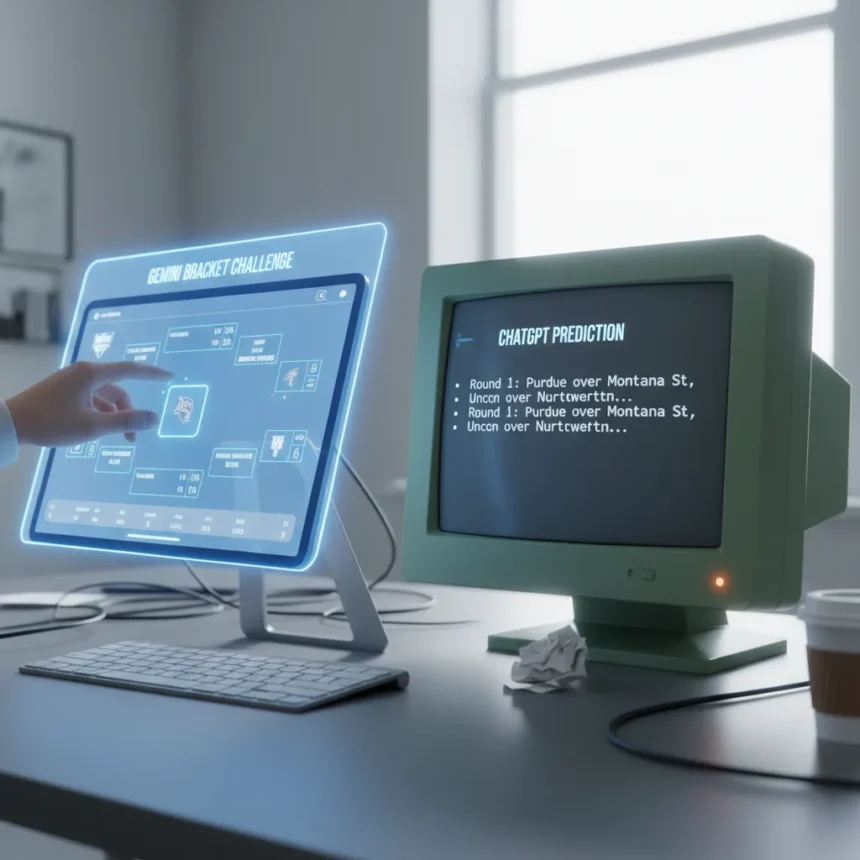
When you ask AI to build your March Madness bracket, you expect a solid prediction. What you might not expect is one AI to hand you an interactive web application while the other hands you a text list. Both ChatGPT and Gemini tackled AI bracket predictions for the 2026 NCAA tournament, but only one delivered the kind of execution that made you think, “Wait, it can do that?”
Key Takeaways
- Gemini generated a fully interactive web page bracket visualization; ChatGPT produced only text-based predictions.
- Both AIs predicted Arizona as the tournament champion, but diverged sharply on Cinderella picks.
- Gemini championed 11-seed South Florida as a Final Four threat; analytics experts strongly disagreed.
- ChatGPT played it safer with a Final Four featuring 1-seed Duke, 1-seed Arizona, a 2-seed, and a 6-seed.
- SportsLine’s statistical model flagged Gemini’s USF projection as statistically indefensible.
Gemini’s Web App Blew ChatGPT Out of the Water
Here’s the thing about AI bracket predictions: they’re only useful if you can actually see them. ChatGPT gave users a text-based breakdown of its picks. Gemini did something different. It generated a full HTML/CSS/JavaScript interactive web page—a functioning bracket you could click through, explore, and share. That’s not a minor difference. That’s the difference between reading a recipe and getting a working kitchen appliance.
For anyone building a March Madness bracket, the visual presentation matters. You want to see the matchups, trace the path to the Final Four, understand the logic at a glance. Gemini understood that and built for it. ChatGPT‘s text output, by comparison, felt like something you’d have to manually transcribe into your own bracket builder. The execution gap here wasn’t subtle—it was the difference between a tool and a reference document.
Both AIs Picked Arizona, But Their Reasoning Diverged
When it comes to AI bracket predictions, consensus can be a good sign or a red flag depending on who’s agreeing. Both ChatGPT and Gemini selected Arizona to win the entire tournament. That’s where the agreement stopped.



ChatGPT’s Final Four included 1-seed Duke, 1-seed Arizona, a 2-seed, and a surprising 6-seed. The picks were conservative, favoring blue-blood programs and high-seeded teams. Gemini, meanwhile, went bolder. It highlighted Cinderella stories like 10-seed Santa Clara, 11-seed South Florida, 12-seed High Point, and 12-seed Northern Iowa as potential Sweet 16 threats. Gemini was particularly bullish on South Florida, calling it “a well-oiled machine that hasn’t lost since January, the Bulls lead the nation in free-throw rate and feature elite shooters Wes Enis and Joseph Pinion.”
That confidence in South Florida became the flashpoint for criticism. While Gemini’s willingness to embrace upsets showed creative thinking, it also exposed a fundamental problem: AI doesn’t always check its own claims against actual statistics.



The Data Contradicted Gemini’s Cinderella Darling
This is where things got uncomfortable for Gemini’s AI bracket predictions. SportsLine’s statistical model, which simulates games 10,000 times and has beaten 91 percent of CBS bracket players in four of the past seven tournaments, took a hard look at the South Florida pick and found it wanting.
The numbers don’t support Gemini’s narrative. South Florida ranked 261st in field-goal percentage, 225th in three-point percentage, and 227th in scoring defense, allowing 76.3 points per game. Those aren’t the stats of a machine primed for a Final Four run. Gemini’s description of the Bulls as elite shooters sounded persuasive, but the actual shooting percentages told a different story. SportsLine’s model, by contrast, predicted more defensible upsets like 12-seed Colorado State over 5-seed Memphis and 6-seed BYU reaching the Sweet 16.
The lesson here is sharp: impressive presentation and confident language can mask statistical reality. Gemini’s web page was objectively better as a user experience. Its bracket picks, however, showed that AI can sound authoritative while being statistically naive. ChatGPT‘s safer approach, while less flashy, at least didn’t make claims that contradicted publicly available data.
Why This Matters for AI Bracket Predictions
The 2026 tournament starts March 19, and brackets lock before the first game. That deadline creates urgency, and urgency makes people reach for shortcuts—including AI. But this test reveals something important: AI bracket predictions work best when they’re grounded in actual statistics, not just plausible-sounding narratives.


Gemini proved it can build better tools. ChatGPT proved it can make safer bets. Neither proved it should be your primary bracket strategy. The real edge comes from AI that combines Gemini’s presentation skills with statistical rigor. Until then, use AI as inspiration, not gospel. Check the numbers. Verify the claims. And if an AI tells you a team is elite, ask yourself whether the stats back it up.
Can AI really predict March Madness brackets better than humans?
Not consistently. SportsLine’s model has outperformed human bracket players in four of the past seven tournaments, but that’s a statistical model running 10,000 simulations, not a conversational AI. ChatGPT and Gemini are better at generating ideas and explaining logic than at predicting outcomes. Use them to stress-test your own picks, not to replace them.
Why did Gemini pick South Florida as a Final Four threat?
Gemini highlighted South Florida’s free-throw rate and named shooters Wes Enis and Joseph Pinion as reasons for a deep run. However, the team’s actual shooting percentages (261st in FG%, 225th in 3P%) and defensive ranking (227th) don’t support that projection. Gemini appears to have overweighted recent momentum without checking cumulative season statistics.
Which AI bracket is better for March Madness?
If you care about user experience and visual appeal, Gemini’s interactive web page bracket is objectively superior. If you care about conservative, defensible picks, ChatGPT’s approach is safer. For actual accuracy, neither beats a statistical model like SportsLine’s, which factors in pace, shooting efficiency, and defensive metrics across 10,000 simulations.
The takeaway from this test is simple: AI bracket predictions are improving, but they’re not a replacement for statistical rigor. Gemini showed that AI can build better tools and think creatively about upsets. ChatGPT showed that playing it safe with top seeds still makes sense. The real lesson is that the best bracket isn’t built by any single AI—it’s built by you, using AI as one input among many, and always checking the numbers before you lock it in.
Edited by the All Things Geek team.
Source: TechRadar