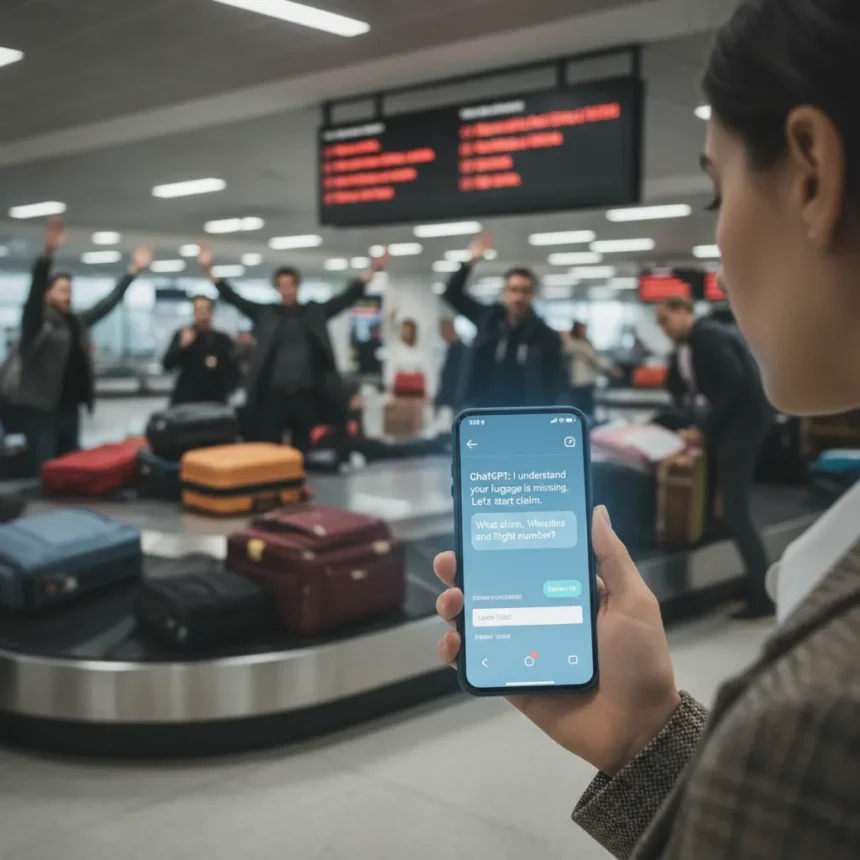
Lost luggage at airport baggage claim is a nightmare most travelers dread, but it happens more often than airlines admit. When your friend’s bag vanished into the void, the instinct was to panic—until ChatGPT offered a structured, actionable plan that proved far more useful than wandering airport terminals asking confused staff members.
Key Takeaways
- ChatGPT provided a structured step-by-step response that covered immediate reporting, essentials reimbursement, and follow-up procedures.
- Filing a Property Irregularity Report (PIR) at the airline desk before leaving the airport is the critical first move.
- Formal claims must be filed within 7–21 days depending on airline policy; DOT escalation applies after 30 days of no resolution.
- ChatGPT’s guidance proved faster and more comprehensive than traditional airport information channels.
- Real-world success depends on immediate action at the airport, not just AI advice alone.
Why ChatGPT Beats Traditional Lost Luggage Responses
When lost luggage at airport happens, most travelers face a chaotic triage: long queues, inconsistent information, and staff who seem to know less than you do. ChatGPT cut through that noise by delivering a clear hierarchy of actions, starting with the most critical step: reporting the loss immediately at the airline’s baggage service desk before leaving the airport. This is not optional—it is the legal foundation for every claim that follows. The AI provided realistic timelines, specific document names (like the Property Irregularity Report), and escalation paths that would have taken hours to research manually.
Traditional methods—calling the airline later, hoping your bag shows up, filing a claim weeks after the fact—fail because they lack urgency and documentation. ChatGPT structured the response around airline operations, not passenger assumptions, which meant it anticipated questions and obstacles the traveler would actually face.
The Immediate Steps ChatGPT Recommended for Lost Luggage at Airport
ChatGPT’s first recommendation was non-negotiable: obtain a Property Irregularity Report (PIR) with a reference number at the baggage service desk before leaving the airport. This single document becomes the thread connecting every subsequent action. Without it, you have no claim. The AI then recommended requesting an amenity kit or reimbursement for essentials—typically $50–$100 per day for toiletries and clothing—and keeping all receipts for later submission.



The second phase was tracking and follow-up. ChatGPT advised using the airline app or website to monitor the bag’s status via the PIR number, contacting baggage services daily rather than waiting passively, and documenting every interaction. This active stance differs sharply from the passive approach most travelers take, assuming the airline will simply call when the bag is found.
The third phase addressed formal claims. ChatGPT specified that claims must be filed within 7–21 days depending on the airline’s policy—a critical window that many travelers miss. If the airline did not resolve the claim within 30 days, the AI recommended escalating to the Department of Transportation (DOT), which has authority to investigate carrier non-compliance. This escalation path is rarely explained by airport staff but is essential for travelers who encounter resistance.



Where ChatGPT’s Advice Succeeded and Where It Required Real-World Backup
ChatGPT’s recommendations succeeded because they matched airline operational reality. The emphasis on immediate reporting, the specific document names, and the timeline windows all aligned with actual carrier procedures. However, the AI’s advice also carried an implicit caveat: none of it works without the traveler’s willingness to act immediately and persistently.
The real test came when the traveler had to actually interact with airline staff. ChatGPT had prepared them for what to ask for (PIR, amenity reimbursement, escalation contacts), but it could not negotiate with tired baggage agents or override a carrier’s initial resistance to compensation claims. The AI’s strength was in structuring the problem and removing the guesswork; its limitation was that it could not replace on-site advocacy.
One area where ChatGPT proved superior to traditional methods was compensation expectations. The AI explained that full automatic refunds are not guaranteed, that compensation is capped at the bag’s current value minus depreciation (roughly 15% per year of use, with a maximum 70% reduction), and that airlines often require proof of contents and receipts. This realistic framing prevented the traveler from expecting outcomes the airline would never deliver, saving time and frustration.
ChatGPT vs. Airline Apps and DOT Portals
Airline apps and the DOT complaint portal are valuable, but they serve different purposes than ChatGPT. The airline app tracks your bag once it is reported, but it does not tell you what to do before that moment or how to escalate if the carrier stalls. The DOT portal is a last resort, not a first step. ChatGPT integrated all three into a coherent strategy, telling the traveler when to use each tool and in what sequence. This is the advantage of AI triage: it asks the right questions in the right order, rather than leaving the traveler to figure out the workflow alone.


Why Real-Time AI Application Matters for Travel Disruptions
Lost luggage at airport is a perfect test case for AI’s real-world utility because it combines time pressure, incomplete information, and high stakes. The traveler needed guidance immediately—not hours later, not the next day—and ChatGPT delivered it in minutes. Traditional customer service lines would have had the traveler on hold, then transferred between departments. Searching Google would have returned conflicting advice from blogs and forums written years ago, when airline policies were different.
The broader implication is that AI can automate the triage phase of travel disruptions, freeing humans to focus on negotiation and persistence. ChatGPT cannot force an airline to pay a claim, but it can ensure that the traveler has done everything correctly to make that claim inevitable.
Does ChatGPT Replace Immediate Airport Action?
No. ChatGPT’s guidance is only as good as the traveler’s willingness to act on it immediately. The AI stressed that reporting at the airport desk is non-negotiable; consulting ChatGPT at home the next day is too late. The algorithm cannot file the PIR for you or negotiate with baggage services. What it does is remove the paralysis that comes from not knowing what to do, which often leads travelers to delay action until the window for effective claims has closed.
What Happens if the Airline Resists Compensation?
ChatGPT’s roadmap included escalation. If the airline did not respond within 30 days, the traveler should file a complaint with the DOT, which has enforcement authority over carrier conduct. This is not widely advertised by airlines, and many travelers assume they have no recourse. ChatGPT’s inclusion of this step transformed a potential dead end into a known escalation path.
Can You Trust ChatGPT’s Airline-Specific Advice?
ChatGPT can be prompted with airline-specific policies (e.g., Delta, United), and it will synthesize that information into actionable steps. However, the AI’s knowledge of current policies has a cutoff date, and airlines update their procedures frequently. The traveler should use ChatGPT’s framework as a starting point, then verify specific timelines and compensation limits with the airline directly. The AI’s real value is in the structure and sequencing, not in memorizing every carrier’s fine print.
The verdict is clear: when lost luggage at airport happens, ChatGPT is a faster, more organized alternative to traditional airport information channels. It does not replace immediate action or persistence, but it removes the guesswork and panic that usually leads travelers to miss critical deadlines. For anyone facing baggage chaos, consulting an AI before consulting the airline desk is now standard practice—and it works.
Edited by the All Things Geek team.
Source: Tom's Guide