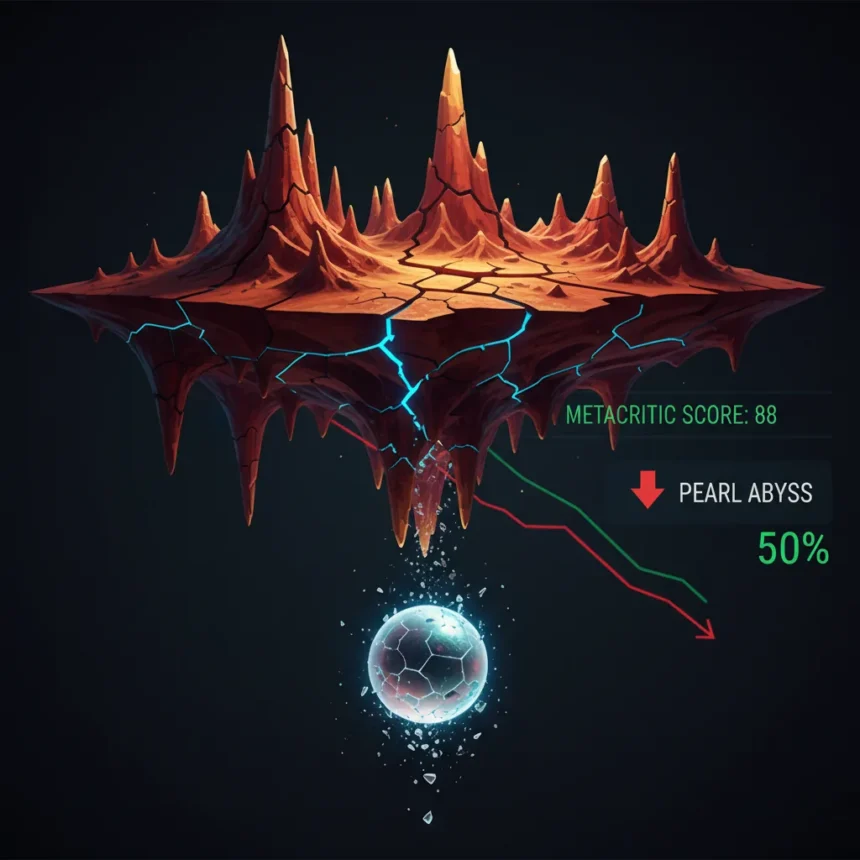
Crimson Desert stock decline has become an unexpected story of disconnect between critical reception and investor confidence. Pearl Abyss, the South Korean developer behind the action RPG, saw its share price tank following the game’s launch, even as reviewers praised its quality on Metacritic.
Key Takeaways
- Crimson Desert received strong critical reviews on Metacritic despite mixed player reception.
- Pearl Abyss shares fell sharply after the game’s release, contradicting positive review scores.
- The stock decline suggests investor concerns extend beyond critical acclaim to commercial viability.
- Market reaction reveals skepticism about the game’s long-term monetization and player retention.
- Critical success does not guarantee financial success in the gaming industry.
Why Critical Acclaim Did Not Save Pearl Abyss Stock
Crimson Desert earned respectable reviews from critics, with Metacritic reflecting positive sentiment from major gaming outlets. However, the market’s response contradicted this critical consensus. Pearl Abyss shares dropped significantly following the game’s launch, a pattern that reveals a fundamental split between what critics value and what investors fear. The Crimson Desert stock decline raises a critical question: what drives shareholder confidence in the gaming sector if not critical reviews?
The disconnect points to deeper concerns about the game’s commercial trajectory. Investors likely focused on player retention metrics, monetization models, and long-term engagement rather than launch-day reviews. A strong Metacritic score does not guarantee a healthy live-service economy or sustained player populations, both critical to Pearl Abyss’s revenue projections. The stock decline suggests the market has already priced in doubts about Crimson Desert’s ability to compete for sustained attention in a crowded action RPG market.
Crimson Desert Stock Decline and Market Expectations
Pearl Abyss entered Crimson Desert’s launch with significant expectations. As a major publisher with a track record of live-service games, the studio needed more than critical praise—it needed proof of commercial momentum. The Crimson Desert stock decline reflects investor disappointment that critical success has not translated into demonstrated player interest or early financial indicators that would support long-term growth.


The gaming market has learned harsh lessons about the gap between review scores and financial reality. Games with strong Metacritic ratings have failed to retain players or generate expected revenue, while others with mixed reviews have become unexpected commercial successes. Pearl Abyss shareholders appear to have discounted the critical reception entirely, focusing instead on tangible metrics: concurrent player counts, session duration, and spending patterns. The Crimson Desert stock decline is a market verdict that these numbers disappointed.
What the Market Reaction Reveals About Gaming Investments
The Pearl Abyss share price drop offers a broader lesson about how financial markets evaluate gaming launches. Critical reviews matter to consumers and marketing teams, but they carry little weight with institutional investors analyzing quarterly earnings potential. A game can be well-reviewed and still fail commercially if it lacks the hooks needed for sustained monetization or if it launches into an oversaturated genre.


Crimson Desert stock decline also reflects uncertainty about Pearl Abyss’s overall strategy. The studio has invested heavily in this title as a flagship release, and early financial signals appear to have missed targets. Whether the issue stems from player acquisition costs exceeding projections, retention rates below expectations, or simply slower-than-anticipated uptake, the market has responded by repricing Pearl Abyss’s valuation downward. This is how equity markets work: critical acclaim is nice, but revenue growth is what matters.
Does Crimson Desert’s Metacritic Score Matter Anymore?
Crimson Desert received favorable critical coverage, yet the Crimson Desert stock decline accelerated regardless. This raises a provocative question: do Metacritic scores carry any weight in modern gaming investment decisions? The answer appears to be no—at least not when institutional capital is at stake. Review aggregators measure critical consensus among journalists and outlets. They do not measure player sentiment at scale, monetization efficiency, or market timing.
The disconnect between critical and financial success has widened over the past decade. Players increasingly trust community reviews, streamer opinions, and peer recommendations over traditional game critics. Investors, meanwhile, have learned to ignore review scores entirely and focus on concrete engagement metrics available within days of launch. Pearl Abyss shareholders made a calculation based on early player data, not Metacritic numbers, and that calculation led them to sell.
What Happens Next for Pearl Abyss and Crimson Desert?
The Crimson Desert stock decline will force Pearl Abyss to reassess its live-service strategy. The studio has options: accelerate content updates to improve retention, adjust monetization to improve per-player revenue, or accept that the game will underperform initial projections. Each path carries risk. Aggressive monetization may drive away the players the game has attracted. Rapid content cycles may strain development resources. Acceptance of underperformance could trigger further shareholder pressure.


Pearl Abyss is not unique in facing this challenge. Many gaming studios have launched critically acclaimed titles only to watch share prices fall when commercial reality diverged from expectations. The lesson is clear: critical success and financial success are separate currencies in the gaming industry. A strong Metacritic score opens doors with consumers and media, but it does not guarantee investor returns. Crimson Desert stock decline reflects this harsh truth.
Is Crimson Desert worth playing despite the stock decline?
Critical reception suggests Crimson Desert offers solid gameplay and production values that justify time investment for action RPG fans. The Metacritic score reflects positive reviews from major outlets. Whether the game is worth your time depends on your tolerance for live-service mechanics, monetization models, and the likelihood of long-term support—factors that stock prices may actually predict better than critical reviews.
Why do gaming stocks sometimes fall after strong reviews?
Gaming stocks respond to financial fundamentals: player acquisition costs, retention rates, monetization efficiency, and competitive positioning. Critical reviews influence consumer perception but not investor returns directly. A well-reviewed game that fails to retain players or monetize effectively will see its parent company’s stock decline regardless of Metacritic scores. Investors bet on revenue, not reviews.
Can Pearl Abyss recover from the Crimson Desert stock decline?
Recovery depends on whether the game’s financial metrics improve over the next quarter. Content updates, seasonal events, and community engagement can stabilize player bases and improve retention. If Pearl Abyss demonstrates that Crimson Desert can generate sustainable revenue, investor confidence may return. Critical acclaim alone will not achieve this—only demonstrated financial performance will.
The Crimson Desert stock decline is a reminder that gaming is a business first and an art form second. Pearl Abyss built a well-reviewed game, but the market demanded more: proof that players would stay, spend, and sustain the title long-term. Critical success is a necessary condition for financial success in gaming, but it is far from sufficient. The stock market has spoken, and its verdict contradicts the review aggregators.
Edited by the All Things Geek team.
Source: TechRadar