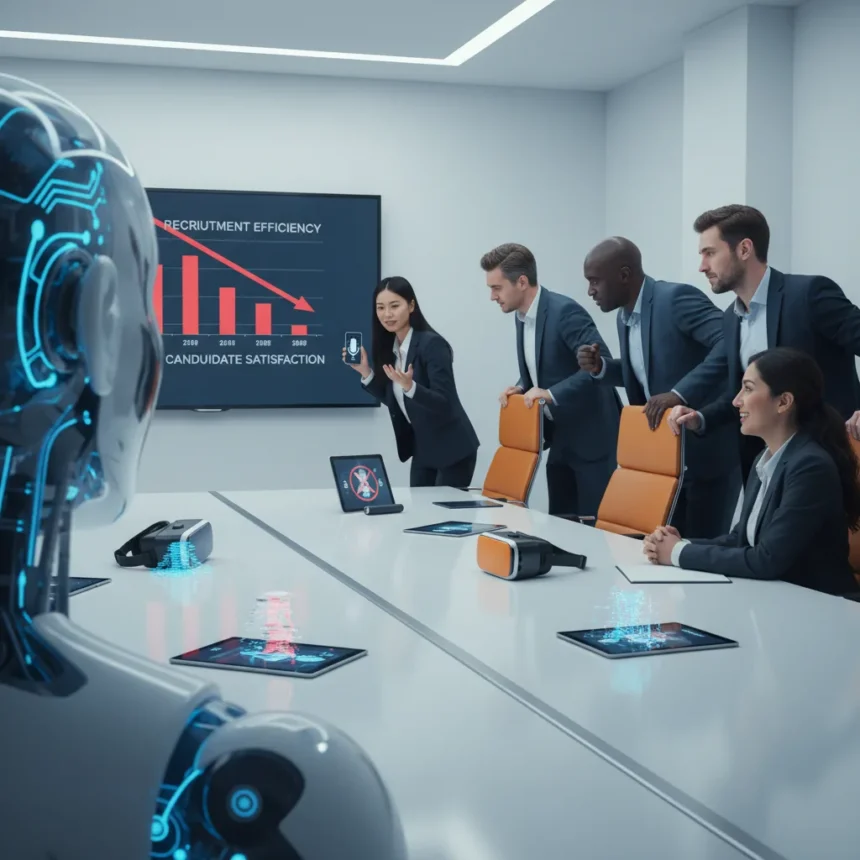
AI hiring interviews are supposed to streamline recruitment and remove human bias. Instead, they are amplifying existing problems and pushing candidates toward the exit. Employers betting on AI-powered screening tools are discovering that efficiency gains mean nothing if top talent refuses to participate.
Key Takeaways
- Candidates are increasingly rejecting employers who use AI hiring interviews in their recruitment process.
- AI hiring interviews are being criticized as making an already flawed system worse, not better.
- White-collar workers are fighting back against AI in hiring, with many prepared to withdraw from opportunities.
- The problem lies not in AI’s capability but in how employers are implementing these tools without addressing underlying recruitment dysfunction.
- Employers admit they are struggling to detect fraud when candidates use AI deepfakes and identity deception during AI-driven hiring.
Why AI hiring interviews are backfiring
The promise was simple: AI hiring interviews would eliminate bias, speed up screening, and identify the best candidates faster. The reality is messier. These tools are not fixing broken recruitment systems—they are automating their worst features. Candidates report feeling evaluated by machines that cannot understand context, cannot read tone, and cannot account for nervousness or cultural differences. The result is a system that feels impersonal, unfair, and worse than traditional interviews.
What makes this backlash significant is that it is not coming from job seekers with few options. Candidates with skills in demand are actively choosing to walk away from opportunities rather than submit to AI screening. They are signaling that no job is worth the dehumanizing experience of being evaluated by an algorithm. For employers, this means losing access to the talent they most want to recruit.
The gap between AI capability and human implementation
Here is the uncomfortable truth: the problem is not AI’s capability. The problem is how employers are deploying these tools without fixing the underlying dysfunction in hiring. According to research cited in industry analysis, the issue is not AI’s ability to evaluate candidates—it is the human side of recruitment that remains broken. Employers are layering AI on top of flawed processes, biased job descriptions, and rushed decision-making. The machine simply amplifies these existing problems at scale.



Employers are also discovering they cannot detect fraud when candidates fight back with their own AI tools. Candidates are using deepfakes and identity deception to game AI hiring systems, and employers admit they are struggling to catch these fraudulent applications before hiring. This creates a perverse outcome: the same technology meant to improve hiring quality is being outmaneuvered by candidates using AI to fabricate credentials. Neither side is winning.
What candidates want instead of AI hiring interviews
The message from candidates is clear: they would rather have a real conversation with a real person. Even a flawed human interview beats an AI screening that feels arbitrary and impersonal. Candidates are not rejecting AI because they fear technology—they are rejecting it because AI hiring interviews strip away the human elements that actually matter in evaluating fit: judgment, empathy, and the ability to explain why you are right for a role.



For employers, the choice is stark. Double down on AI screening and accept that your best candidates will opt out, or invest in fixing the hiring process itself. That means clearer job descriptions, faster decision cycles, and humans actually talking to humans. It means using AI where it genuinely adds value—like resume parsing or scheduling—rather than as a replacement for human judgment. The candidates are already voting with their feet. The question is whether employers will listen before it is too late.
Are AI hiring interviews here to stay?
AI hiring interviews are not going away, but their role may shift. As candidates continue to resist and employers discover that AI screening is not delivering promised results, the technology may be repositioned as a tool for initial filtering rather than final evaluation. The backlash suggests that employers who rely too heavily on AI for candidate assessment will lose access to talent. Those who use AI as a supplement to human judgment, not a replacement, will likely see better outcomes.
Can employers fix AI hiring interviews without scrapping them?
Yes, but it requires acknowledging that the problem is implementation, not the technology itself. Employers need to be transparent about how AI is being used in their hiring process, allow candidates to opt for human review, and validate that their AI tools are actually improving hiring outcomes rather than just speeding them up. Without these safeguards, the backlash will only intensify.
What should candidates do if they encounter AI hiring interviews?
Candidates have leverage. If an employer is using AI hiring interviews and you are uncomfortable with it, you can ask for a human alternative, request transparency about how the AI is evaluating you, or simply choose to apply elsewhere. In a competitive talent market, employers need you more than you need them. Use that leverage to push back against AI hiring processes that feel unfair.


The future of hiring will likely include AI, but not in the form it takes today. The current backlash is not a rejection of technology—it is a rejection of using technology to make hiring worse. Employers who listen to this feedback and redesign their processes around human judgment, supported by AI tools rather than replaced by them, will win the talent war. Those who do not will find their candidate pools shrinking and their hiring costs rising.
Edited by the All Things Geek team.
Source: TechRadar