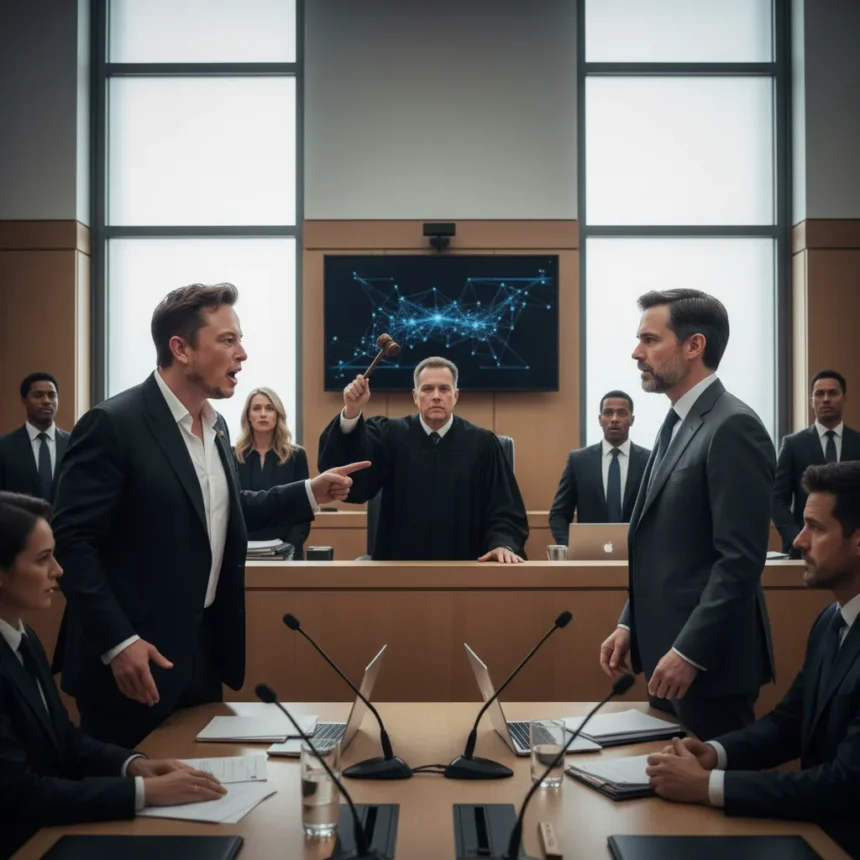
Artificial intelligence extinction risk became the unexpected flashpoint in the Elon Musk v. OpenAI trial, transforming a corporate dispute into a high-stakes debate about humanity’s survival. During courtroom proceedings, Musk and Altman faced off directly over whether AI systems pose an existential threat to human civilization, with the judge ultimately forced to intervene and shut down the discussion.
Key Takeaways
- Musk and Altman clashed in court over artificial intelligence extinction risk and its real-world implications.
- The judge intervened to stop the debate, preventing further discussion of AI existential threats.
- The exchange highlighted fundamental disagreements between the two figures on AI safety priorities.
- The trial centers on OpenAI’s alleged departure from its nonprofit mission.
- Courtroom tensions escalated as both parties presented contrasting views on AI danger.
The Courtroom Collision Over AI Safety
The confrontation emerged when Musk raised the specter of artificial intelligence extinction risk as central to OpenAI’s original purpose. Musk argued that the company was founded specifically to address existential threats posed by advanced AI systems, and that abandoning this mission represented a fundamental betrayal of the organization’s founding principles. Altman countered with a different perspective on how to manage AI development responsibly, but the exact nature of his counterargument became overshadowed by the dramatic nature of the exchange itself.
What began as a legal argument about corporate governance quickly escalated into a philosophical clash about humanity’s relationship with artificial intelligence. The courtroom became an arena for two of tech’s most prominent figures to articulate their competing visions of artificial intelligence extinction risk—one emphasizing the catastrophic potential of unaligned superintelligence, the other focusing on near-term responsible deployment. The intensity of their disagreement was palpable enough to prompt judicial action.
Why the Judge Shut Down the Debate
The court intervened because the discussion of artificial intelligence extinction risk, while philosophically significant, strayed beyond the legal scope of the case. The lawsuit centers on whether OpenAI breached its nonprofit charter and abandoned its founding mission for profit, not on abstract debates about existential AI threats. The judge recognized that allowing the trial to become a forum for theoretical AI safety arguments would derail the proceedings and consume time better spent on contractual and organizational evidence.



This judicial restraint reflects a broader tension in tech law: when companies claim their founding purpose involved preventing catastrophic outcomes, how much courtroom time should be spent debating whether those catastrophes are real? The judge’s decision to shut down the discussion suggests courts prefer to focus on concrete organizational actions rather than speculative future harms. Whether that approach serves the public interest remains an open question.
What This Reveals About the OpenAI Dispute
The eruption of artificial intelligence extinction risk discourse during the trial exposes the philosophical gulf between Musk and Altman on AI’s future. Musk’s lawsuit alleges that OpenAI transformed from a safety-focused nonprofit into a profit-maximizing entity, abandoning its original mission to prevent AI from becoming dangerous. The courtroom clash demonstrates that this is not merely a financial dispute—it reflects fundamentally different beliefs about what OpenAI should prioritize and why it was created in the first place.



The fact that artificial intelligence extinction risk became the flashpoint, rather than specific business decisions or financial arrangements, underscores how deeply Musk’s critique cuts. He is not simply arguing that OpenAI made bad management choices; he is arguing that the company betrayed its core ethical mandate to address existential threats. Altman’s response, by contrast, appears to center on the belief that responsible AI development happens through iteration and deployment, not through indefinite precaution.
Implications for AI Governance and Corporate Accountability
The trial’s dramatic turn signals that artificial intelligence extinction risk is no longer confined to academic papers and safety conferences—it is now a matter of legal contention. How courts handle disputes involving existential AI claims will shape how tech companies frame their missions and accountability. If companies can claim to be founded on preventing catastrophic AI outcomes, they may face legal scrutiny when those priorities appear to shift.
This case also highlights the challenge regulators and courts face in evaluating AI safety claims. The judge’s decision to avoid engaging with the substance of artificial intelligence extinction risk arguments sidesteps the question of whether such risks deserve serious institutional consideration. As AI systems become more powerful, courts may find it increasingly difficult to separate corporate governance disputes from the underlying technical and safety questions that prompted them.
Is artificial intelligence extinction risk a real concern in AI development?
Experts and researchers across the AI field hold divergent views. Some researchers, particularly those focused on AI alignment and safety, argue that sufficiently advanced AI systems could pose existential risks if their goals are misaligned with human values. Others contend that near-term harms like bias, misinformation, and labor displacement are more pressing than speculative long-term scenarios. The courtroom clash between Musk and Altman reflects this genuine scientific and philosophical disagreement.


What is OpenAI’s original nonprofit mission?
OpenAI was founded in 2015 as a nonprofit research company with the stated goal of ensuring artificial intelligence systems are developed safely and beneficially. According to Musk’s allegations in the lawsuit, the organization was meant to prioritize safety and societal benefit over profit maximization. Musk claims the company has since shifted toward commercial interests, which prompted his legal action to hold the organization accountable to its founding charter.
Why does the Musk v. Altman trial matter beyond the two individuals involved?
The lawsuit establishes precedent for how courts evaluate claims that companies have abandoned their founding missions, particularly when those missions involve preventing catastrophic outcomes. As AI becomes more central to society, disputes about corporate responsibility for artificial intelligence extinction risk and other existential concerns may become more common. The trial’s outcome could influence how tech companies frame their safety commitments and how courts assess whether those commitments are genuine.
The courtroom exchange between Musk and Altman over artificial intelligence extinction risk revealed that the OpenAI lawsuit is ultimately about competing visions of responsibility in AI development. Whether the courts focus on corporate governance or allow deeper engagement with AI safety philosophy will shape how the tech industry approaches existential risk in years to come. For now, the judge’s decision to shut down the debate suggests that courts prefer to leave such philosophical questions to researchers and policymakers, not juries.
Edited by the All Things Geek team.
Source: TechRadar