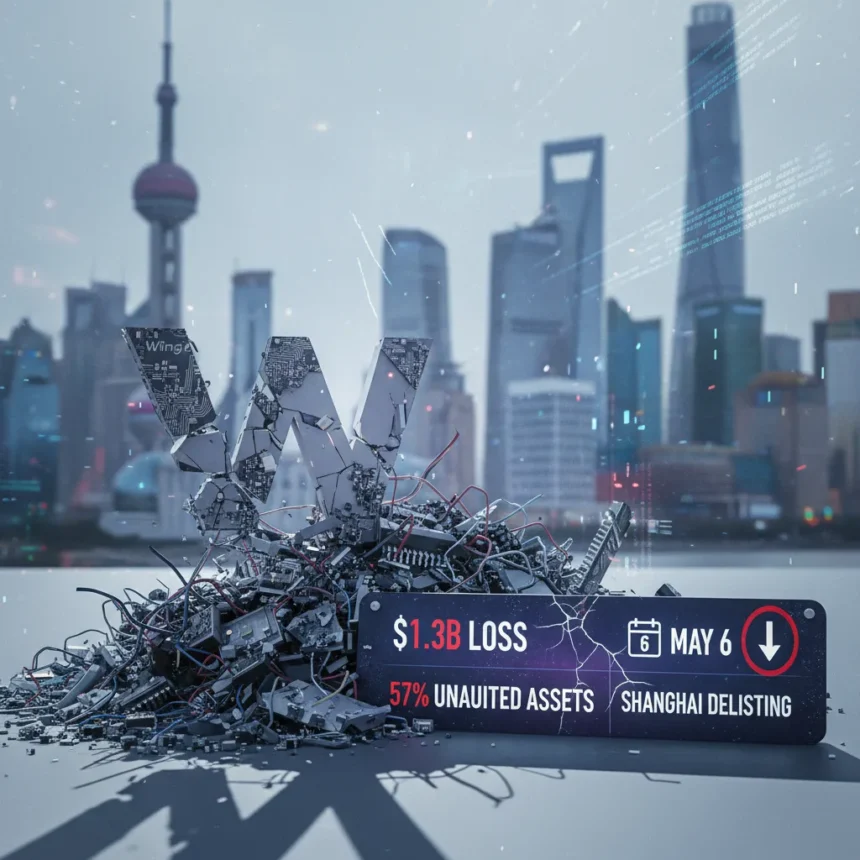
Wingtech delisting risk became an immediate crisis on April 30, 2026, when the Shanghai Stock Exchange suspended trading in the company’s stock and convertible bonds following a catastrophic audit failure that left 57% of its total assets unverified. The Chinese semiconductor conglomerate reported a net loss of 8.7 billion yuan ($1.3 billion) for 2025, driven largely by an 8.95 billion yuan accounting loss on its Dutch subsidiary Nexperia after a downward revaluation to 24.38 billion yuan ($3.43 billion). What makes this collapse uniquely dangerous is not just the size of the loss—it is the auditor’s explicit inability to verify the financial data underlying it.
Key Takeaways
- Wingtech reported an 8.7 billion yuan net loss in 2025, with Nexperia revalued down to $3.43 billion
- Auditor RSM issued a disclaimer of opinion, unable to verify Nexperia’s financial records
- Nexperia represents 57% of Wingtech’s total assets but remains unaudited
- Shanghai Stock Exchange delisting risk warning takes effect May 6, 2026
- Stock dropped 4% to CNY34.03 after earlier 10% decline on audit concerns
How Wingtech’s audit failure triggered delisting risk
Auditor RSM issued a disclaimer of opinion on Wingtech’s 2025 financial statements, a declaration that stops just short of outright rejection. The firm stated it lacked sufficient access to Nexperia’s financial data to express confidence in Wingtech’s consolidated accounts. This is not a qualified opinion—a qualified opinion means the auditor found issues but can still sign off. A disclaimer of opinion means the auditor cannot sign off at all. For a Shanghai-listed company, this triggers automatic delisting procedures.
The timing is brutal. The delisting risk warning begins May 6, 2026, just days after the announcement. Under Shanghai Stock Exchange rules, if Wingtech’s stock price fluctuates more than 5% during trading, the exchange will halt trading immediately. The company has until the end of 2026 to resolve the audit issues or face forced delisting. With stock already down 4% to CNY34.03 following an earlier 10% decline, volatility thresholds could trigger trading suspensions repeatedly, accelerating the path toward permanent removal.
Why Nexperia’s financials remain a black box
Nexperia is Wingtech’s crown jewel and its albatross. The Dutch semiconductor manufacturer represents approximately 57% of Wingtech’s total assets. Yet RSM cannot verify those assets exist or are valued correctly. The auditor’s inability to access Nexperia’s financial records suggests either a breakdown in data transmission between the Dutch subsidiary and its Chinese parent, or a deliberate withholding of information—neither scenario inspires confidence in investors or regulators.

Wingtech’s revaluation of Nexperia downward by 8.95 billion yuan in a single year raises questions about what changed. Did Nexperia’s operational performance collapse? Did export restrictions on advanced semiconductor equipment make the business worth less? Did management simply overvalue the acquisition in prior years? The auditor’s disclaimer prevents any of these explanations from being independently verified, leaving shareholders and creditors in the dark about the company’s true financial position.
What Shanghai delisting means for Wingtech shareholders
Delisting from the Shanghai Stock Exchange does not immediately erase shareholder value, but it does accelerate its destruction. Trading halts triggered by 5% price swings will create artificial scarcity and panic selling. Institutional investors with mandates to hold only listed securities will be forced to exit. The company’s ability to raise capital through equity offerings or convertible bonds evaporates. Debt becomes harder and more expensive to refinance.



Wingtech could theoretically move to a different exchange or restructure, but the reputational damage of a Shanghai delisting is severe in Chinese corporate governance. It signals to lenders, partners, and customers that the company cannot maintain basic financial transparency. For a semiconductor firm dependent on supply chain relationships and government support, that signal is potentially fatal.
Is Wingtech’s delisting inevitable?
The company has six months to resolve the audit failure before forced delisting becomes likely. That timeline is theoretically achievable if Wingtech can restore auditor access to Nexperia’s records and demonstrate that the subsidiary’s financials are sound. But the scale of the revaluation and the auditor’s complete disclaimer suggest the problems run deeper than a data access issue. If Nexperia’s assets truly are worth 24.38 billion yuan rather than the prior valuation, Wingtech’s balance sheet remains devastated regardless of whether the audit passes.
The most likely outcome is that Wingtech will attempt some form of restructuring or asset sale to shore up its financials and satisfy auditors. Without such action, the May 6 delisting risk warning will become a self-fulfilling prophecy.
Why does this matter beyond Wingtech?
Wingtech’s collapse raises systemic questions about how Chinese companies value foreign subsidiaries and whether auditors have sufficient independence to challenge management valuations. If a company can hold assets representing 57% of its balance sheet without meaningful audit verification, the integrity of financial statements across the entire Shanghai exchange comes into question. This is not a Wingtech-specific problem—it is a governance problem that regulators will now scrutinize across the sector.



Can Wingtech avoid delisting by resolving the Nexperia situation?
Technically yes, but practically unlikely within the six-month window. Wingtech would need to either restore full auditor access to Nexperia’s records and demonstrate the revaluation was justified, or sell the subsidiary outright to a buyer willing to pay near the revalued price. Neither outcome appears imminent given the severity of the audit failure.
What happens to Nexperia if Wingtech is delisted?
Nexperia’s operational status and ownership are separate from Wingtech’s listing status. Delisting Wingtech does not automatically transfer or liquidate Nexperia. However, a delisted parent company with no access to public capital markets will struggle to invest in Nexperia, support its operations, or defend it against regulatory challenges. The subsidiary’s future becomes increasingly uncertain.
Wingtech’s crisis is a cautionary tale about the risks of holding unverified foreign assets on a public balance sheet. The company now faces a race against the clock to restore auditor confidence or accept delisting as the consequence of financial opacity. Either way, shareholders have lost the ability to trust what management reports about the company’s true worth.
Edited by the All Things Geek team.
Source: Tom's Hardware