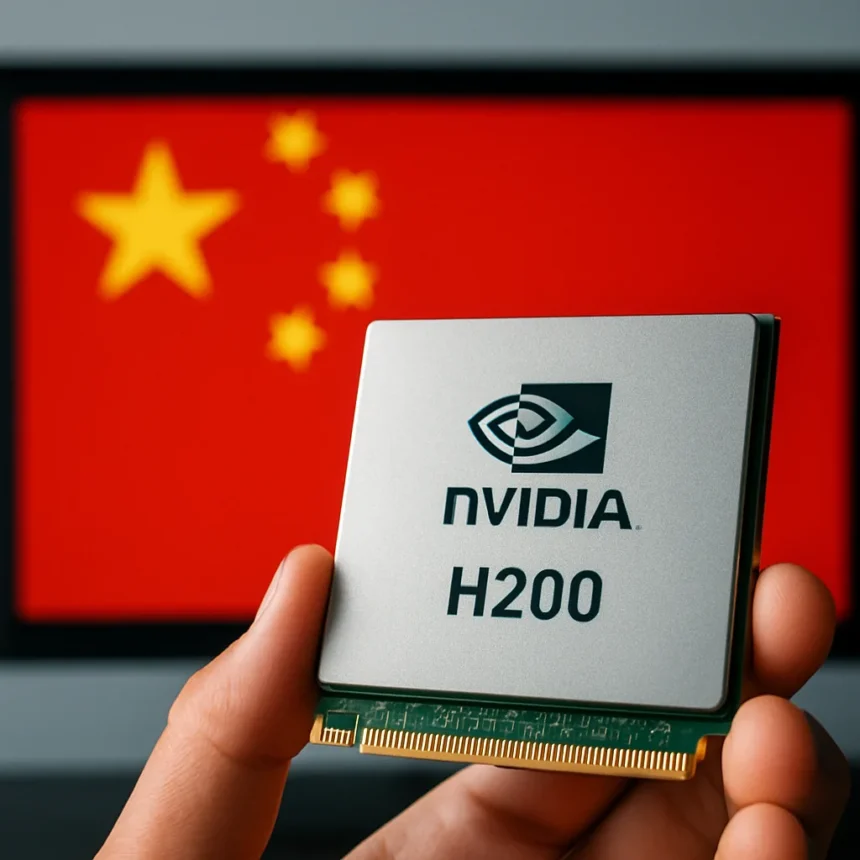
Nvidia H200 China sales remain frozen despite the company receiving US government export licenses to ship the advanced AI accelerators to Chinese customers, according to statements from Nvidia leadership and US commerce officials. The disconnect between regulatory approval and actual commercial activity reveals the complex reality of semiconductor geopolitics in 2025.
Key Takeaways
- Nvidia has received US licenses to export H200 GPUs to China but completed zero sales to date
- Chinese tech companies paused H200 purchases while Beijing evaluates import policy
- China restricts H200 purchases to special circumstances like university research laboratories
- H200 manufacturing is restarting following the licensing approval from Washington
- The gap between regulatory permission and actual commerce highlights ongoing supply chain tensions
The H200 Licensing Paradox
Nvidia received US government approval to export H200 GPUs to China, marking a potential thaw in restrictions that had blocked the sale of latest AI chips to Beijing. However, the approval has not translated into actual orders. Despite the regulatory green light, Nvidia has not shipped a single H200 unit to any Chinese customer, according to US Commerce Department officials testifying before Congress. This gap between permission and practice exposes the layered nature of modern semiconductor controls—government approval is necessary but not sufficient to unlock sales.
The disconnect stems from Beijing’s own deliberative process. Chinese technology companies received informal guidance to pause H200 purchases while the central government evaluated whether to permit imports of the advanced accelerator. This Chinese-side hesitation creates a peculiar situation where both regulatory regimes have signaled openness, yet commercial activity remains frozen. The delay reflects deeper strategic uncertainty about whether advanced AI infrastructure should be sourced from US suppliers, even when legally permitted.
China’s Selective H200 Approach
Beijing has not issued a blanket ban on H200 imports but instead adopted a restrictive framework that permits purchases only in specific circumstances. University research and development laboratories qualify as approved use cases, but commercial deployment and enterprise AI infrastructure projects face implicit barriers. This selective approach allows China to maintain diplomatic flexibility—Beijing can claim it has not prohibited the technology while effectively limiting its practical deployment in the Chinese economy.



The distinction between permitted and practical access matters enormously for Nvidia‘s business. A policy that allows H200 sales only to academic institutions dramatically shrinks the addressable market compared to unrestricted commercial access. Universities purchase far fewer units than enterprises, and their buying power is constrained by research budgets rather than commercial revenue. For Nvidia, regulatory approval that permits only academic sales generates minimal revenue compared to the company’s expectations when it sought export licenses.
Manufacturing Restart and Market Implications
Despite the stalled Chinese sales, Nvidia is restarting H200 manufacturing, suggesting the company expects demand to materialize elsewhere or believes the current freeze is temporary. The restart indicates confidence that the regulatory environment will eventually shift or that other international markets will absorb H200 capacity. Nvidia’s decision to resume production despite zero Chinese sales reflects the company’s broader AI chip strategy: maintain manufacturing readiness across geographies while regulatory and diplomatic conditions evolve.



The H200 situation illustrates a fundamental challenge for semiconductor companies operating under US export controls. Obtaining government approval to sell advanced chips is expensive, time-consuming, and politically contentious. Yet approval alone does not guarantee commercial success if the destination country imposes its own restrictions or if geopolitical tensions discourage customers from purchasing US technology. Nvidia secured the regulatory victory but faces a market that remains effectively closed, at least for now.
What does Nvidia H200 China sales approval actually mean?
US export licenses permit Nvidia to ship H200 GPUs to China, but they do not compel Chinese companies to buy them. Beijing’s informal guidance to pause purchases means the regulatory path is open while the commercial path remains blocked. Approval is a necessary condition for sales, not a sufficient one.
Why did Chinese companies pause H200 purchases?
Chinese technology firms received guidance from Beijing to halt H200 buying while the central government deliberated on import policy. This pause reflects strategic uncertainty about whether to embrace US-supplied advanced AI infrastructure, even when legally permitted.
Can universities in China buy the H200?
Yes. Beijing permits H200 purchases for university research and development laboratories, classifying academic use as a special circumstance. Commercial and enterprise deployment face greater restrictions.


The Nvidia H200 situation in China demonstrates that regulatory approval and market access are distinct challenges. A company can win the government’s permission to sell without winning customers’ willingness to buy. For Nvidia, the practical value of H200 export licenses depends entirely on whether Beijing eventually relaxes its informal purchasing restrictions or whether the company can redirect manufacturing capacity to markets with fewer barriers. Until Chinese demand materializes, the regulatory victory remains more symbolic than commercial.
Edited by the All Things Geek team.
Source: Tom's Hardware