





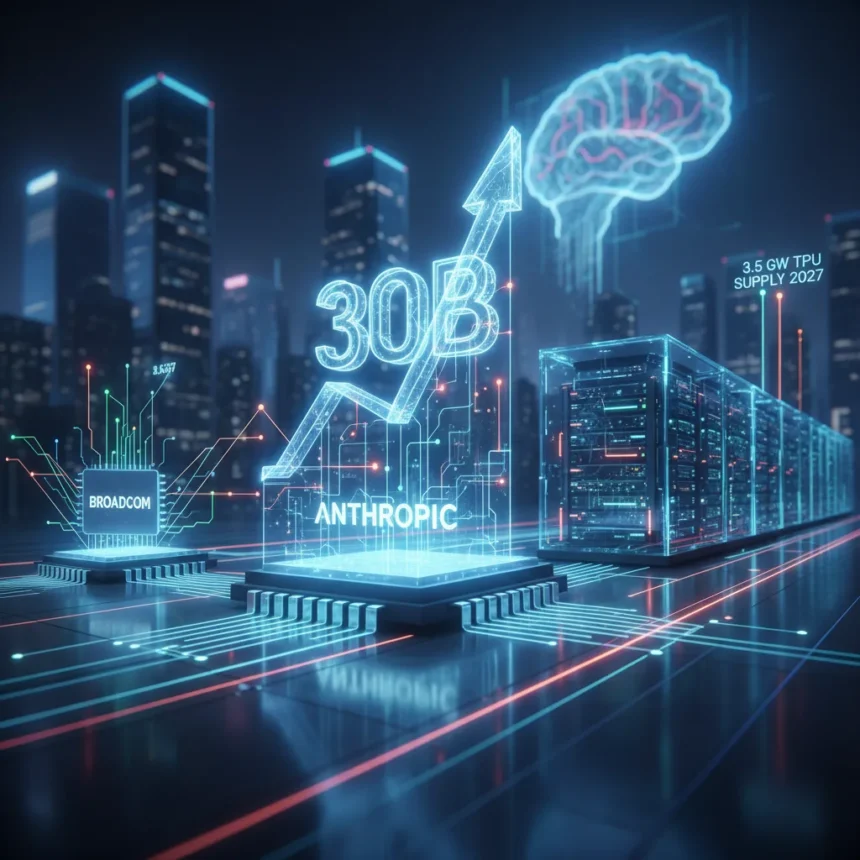
Anthropic’s annual revenue run rate has passed $30 billion, a milestone revealed through Broadcom’s April 6, 2026 securities filing announcing a massive expanded compute capacity agreement. The deal locks in 3.5 gigawatts of Google Tensor Processing Unit capacity starting in 2027, signaling both Anthropic’s explosive growth and the intensifying competition for AI compute resources that will define the next phase of artificial intelligence development.
Key Takeaways
- Anthropic’s revenue run rate has surpassed $30 billion, disclosed via Broadcom’s regulatory filing on April 6, 2026.
- Broadcom will supply 3.5 gigawatts of Google TPU capacity to Anthropic beginning in 2027, contingent on commercial success.
- The deal builds on an October 2025 agreement worth tens of billions of dollars for 1 million TPUs, with over 1GW already online in 2026.
- Broadcom’s long-term partnership with Google extends through 2031 for custom AI and datacenter chip development.
- A vast majority of the new compute infrastructure will be situated in the US, supporting Anthropic’s $50 billion commitment to domestic computing capacity.
Anthropic Revenue Run Rate Milestone Reflects Explosive AI Adoption
Anthropic’s revenue run rate passing $30 billion marks a watershed moment for the AI industry. The company has achieved this scale in just a few years, competing directly against OpenAI and other generative AI providers in a market where compute capacity is the primary bottleneck. This financial milestone was not announced via a press release or earnings call—it emerged as a footnote in Broadcom’s regulatory disclosure, a telling detail about how Anthropic operates. The company prioritizes infrastructure deals and partnerships over public relations, letting financial agreements speak louder than marketing campaigns.
The $30 billion run rate is particularly significant because it reflects Claude’s market penetration and enterprise adoption. Unlike consumer-facing AI services that rely on subscription revenue, Anthropic generates substantial income from enterprise licensing, API usage, and institutional partnerships. This revenue structure demands reliable, massive-scale compute infrastructure—which explains why the company is committing to multi-year TPU arrangements worth tens of billions of dollars.
The 3.5-Gigawatt TPU Expansion: What It Means for AI Compute
Broadcom’s filing reveals that Anthropic’s TPU demand is expected to surge dramatically. The company consumed over 1 gigawatt of capacity in 2026 from its prior deal with Google, but demand is projected to triple to 3.5 gigawatts by 2027, according to Broadcom CEO Hock Tan’s earnings call commentary. This trajectory underscores a brutal reality: AI model training and inference at scale requires exponential increases in compute power year over year.


Three and a half gigawatts of TPU capacity translates to roughly several million AI accelerators running simultaneously, though actual utilization depends on Anthropic’s sales velocity and customer demand. The deployment is contingent on Anthropic’s continued commercial success, and the parties are in active discussions with operational and financial partners to make the deal work. This contingency clause is crucial—it means the 3.5GW commitment is not guaranteed if Anthropic’s growth stalls or if competitive pressures shift the market landscape.
What makes this deal extraordinary is its duration and scope. Broadcom has extended its long-term supply agreement with Google through 2031 to develop and deliver custom TPUs and datacenter networking components. This gives Google, Broadcom, and Anthropic a decade-long lock on latest AI accelerator production, effectively sidelining competitors like Nvidia in a critical segment of the AI infrastructure market.



Google’s Growing Control Over AI Chip Supply
The Anthropic-Broadcom-Google triangle reveals a strategic shift in how AI giants are competing. Rather than buying off-the-shelf GPUs from Nvidia, both Google and Anthropic are investing in custom silicon designed specifically for their workloads. Google’s TPUs are purpose-built for tensor operations, making them more efficient than general-purpose GPUs for many AI tasks. By securing Broadcom as its exclusive manufacturing partner through 2031 and locking in Anthropic as a major customer, Google is consolidating control over a critical supply chain.
This arrangement strengthens Google’s bargaining power with Nvidia and signals that the era of vendor-agnostic AI infrastructure is ending. Companies with the capital to fund custom chip development and secure long-term manufacturing agreements are gaining structural advantages. Anthropic’s $30 billion revenue run rate gives it the financial firepower to participate in this arms race, but smaller AI companies without similar resources will struggle to compete on infrastructure parity.
US Compute Infrastructure and Geopolitical Implications
A vast majority of the new 3.5-gigawatt capacity will be located in the United States, supporting Anthropic’s stated $50 billion commitment to domestic computing infrastructure. This geographic concentration reflects both regulatory pressures and strategic positioning. US policymakers are increasingly concerned about AI capability concentration abroad, and companies like Anthropic are responding by building domestic capacity.
The US-focused deployment also insulates Anthropic from export controls and supply chain disruptions that could affect overseas data centers. As geopolitical tensions around AI technology intensify, companies with primarily US-based infrastructure gain operational resilience and regulatory favor.



The Contingency Risk: What Could Derail This Deal
The Broadcom filing includes a crucial caveat: Anthropic’s consumption of the 3.5-gigawatt capacity is dependent on the company’s continued commercial success. This is not a guarantee. If Claude’s market share stalls, if enterprise adoption slows, or if a competitor emerges with superior capabilities, Anthropic might not be able to utilize the full capacity commitment. The regulatory disclosure notes that this dependency was significant enough to warrant specific mention, suggesting Broadcom and Google view the financial risk as material.
The contingency also reflects the extraordinary uncertainty in AI markets. No one knows which AI model will dominate enterprise deployments five years from now, or whether current revenue trajectories will hold. By building this flexibility into the agreement, Broadcom and Google are hedging against the possibility that Anthropic’s growth could flatten or reverse.
What This Means for the Broader AI Industry
Anthropic’s $30 billion revenue run rate and the 3.5-gigawatt TPU deal signal that the AI market is consolidating around a handful of well-capitalized players. Companies that can secure long-term compute agreements, develop custom silicon, and maintain rapid growth will dominate. Everyone else will compete for scraps or find niche applications where they can compete without needing massive-scale infrastructure.
The deal also suggests that compute capacity, not model innovation, is becoming the primary constraint on AI development. If you can afford the chips and the electricity, you can train competitive models. This commoditization of AI capability favors large incumbents like Google and well-funded startups like Anthropic, while making it harder for smaller research teams to compete.
FAQ
What is Anthropic’s revenue run rate and why does it matter?
Anthropic’s annual revenue run rate has surpassed $30 billion, meaning the company is generating that much revenue on an annualized basis. This milestone matters because it demonstrates that Claude has achieved significant enterprise adoption and market penetration, justifying the company’s massive infrastructure investments and positioning it as a serious competitor to OpenAI.
When will the 3.5-gigawatt TPU capacity come online?
The 3.5-gigawatt capacity is scheduled to begin coming online in 2027, building on the over 1 gigawatt already available to Anthropic in 2026 from the prior October 2025 deal. The exact timeline depends on Anthropic’s commercial success and ongoing discussions with operational and financial partners.
Why is Broadcom partnering with Google instead of Nvidia for this deal?
Broadcom is manufacturing Google’s custom TPUs, which are purpose-built for AI workloads and often more efficient than general-purpose GPUs for tensor operations. This partnership locks in Broadcom’s manufacturing revenue through 2031 and gives Google direct control over its chip supply chain, reducing dependence on external vendors like Nvidia.
Anthropic’s $30 billion revenue run rate and the multi-year TPU commitment represent a turning point in AI infrastructure. The company has moved beyond startup status into the realm of major cloud and AI service providers, with the capital and staying power to compete against entrenched players. The real question is not whether Anthropic can afford this compute capacity, but whether it can grow fast enough to actually use it—and whether Claude can maintain its competitive edge as AI capabilities commoditize.
Edited by the All Things Geek team.
Source: Tom's Hardware




