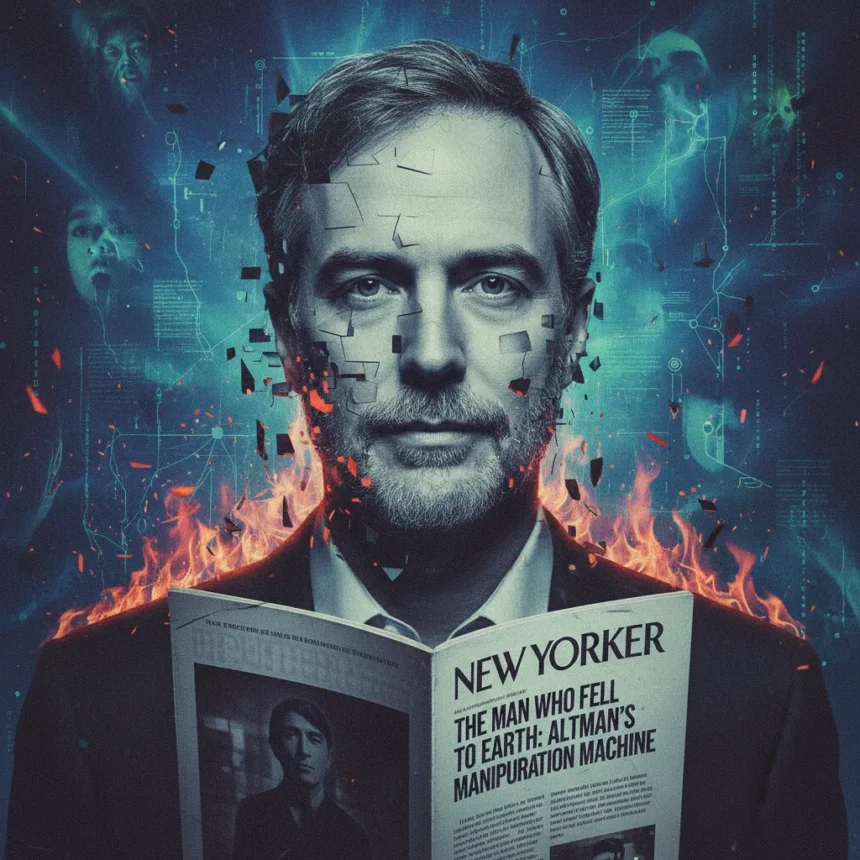
Sam Altman leadership allegations have taken a sharp turn following The New Yorker’s investigative profile, which features damning insider accounts from OpenAI employees and board members describing the CEO as a relentless manipulator unconstrained by truth. The profile paints a portrait of a leader who weaponizes persuasion to advance his agenda, then discards commitments when they no longer serve his interests.
Key Takeaways
- An anonymous OpenAI board member explicitly called Altman a sociopath with an unusual combination of traits: desire to be liked paired with indifference to deceiving others
- Altman allegedly uses AI safety concerns as a bargaining chip, gaining support from worried engineers before reneging on those commitments
- Former board member Sue Yoon characterizes Altman as self-deluded rather than deliberately villainous, operating disconnected from reality
- Tech executives describe Altman’s persuasive abilities as exceptionally rare, deploying what one called Jedi mind tricks to manipulate outcomes
- The profile suggests Altman’s strength lies in business acumen and salesmanship rather than technical engineering expertise
The Sociopath Diagnosis From Inside OpenAI
An anonymous OpenAI board member made the starkest allegation in The New Yorker piece: Altman is unconstrained by truth and possesses two contradictory traits rarely found together. He has an intense desire to please people and be liked in any interaction, combined with what the board member described as almost a sociopathic lack of concern for the consequences of deceiving someone. This combination, the insider suggested, creates a leader who lies without guilt and manipulates without hesitation.
The diagnosis cuts deeper than typical corporate criticism. Rather than portraying Altman as a cold, calculating villain, the board member’s account suggests someone fundamentally disconnected from the moral weight of his actions. He wants approval. He gets what he wants. The damage caused in between registers as irrelevant to his decision-making process.
How Altman Weaponizes AI Safety Concerns
One of the profile’s most revealing allegations is that Altman uses AI safety—a topic that genuinely worries many OpenAI engineers—as a negotiating tool and then abandons those commitments once they have served their purpose. The tactic is ruthlessly effective: engineers concerned about existential risk to humanity will support a leader who claims to share their safety-first values. Once Altman has their backing, those safety concerns apparently matter far less.



This pattern suggests a leader willing to exploit the genuine idealism of his workforce to consolidate power. It is not incompetence or disagreement over priorities—it is deliberate misrepresentation followed by betrayal. The insiders quoted in The New Yorker paint a picture of someone who understands what people want to hear and says it, regardless of intent to follow through.
Persuasion as a Superpower—and a Liability
Multiple sources in The New Yorker piece describe Altman’s persuasive abilities in almost mystical terms. One tech executive who has worked with him called his influence unbelievably persuasive, comparing it to Jedi mind tricks and describing him as next level in his ability to bend outcomes toward his will. This is not criticism framed as backhanded compliment—it is genuine awe at his capacity to convince people to do things against their own interests.



The irony is sharp: Altman’s greatest strength as a businessman is his greatest weakness as a leader of a company built on trust. An organization developing artificial general intelligence arguably needs a leader bound by truth and principle, not one celebrated for his ability to manipulate perception. His persuasion works in boardrooms and investor meetings. It fails catastrophically when the goal is building a stable, ethically grounded organization.
Self-Delusion vs. Deliberate Villainy
Former OpenAI board member Sue Yoon offered a different diagnosis than the sociopath label, arguing that Altman is not a Machiavellian villain orchestrating deception with full awareness. Instead, Yoon suggested Altman is so caught up in his own self-belief that he genuinely convinces himself of his shifting narratives. He does not live in the real world, Yoon said, making his behavior incomprehensible to those who do.
This interpretation is almost more troubling than the sociopath claim. A deliberate liar can be contained. Someone who believes his own lies, who operates in a fantasy world where his contradictions make perfect sense, is far harder to predict or manage. Yoon’s account suggests Altman is not consciously deceiving—he is genuinely deluded, which makes him dangerous in an entirely different way.
Why This Matters for OpenAI’s Future
These allegations arrive at a critical moment for OpenAI. The company is navigating questions about its direction, its relationship with Microsoft, its safety practices, and its governance structure. A CEO described by insiders as a truth-unconstrained manipulator who weaponizes safety concerns raises fundamental questions about whether the organization can be trusted to develop transformative AI responsibly.


The New Yorker profile does not present Altman’s leadership as a minor character flaw or a difference in management style. It presents it as a systemic problem: a leader whose core operating principle is persuasion divorced from principle, whose commitments are tactical rather than genuine, and whose concern for consequences is functionally absent. Whether Altman is a sociopath or a self-deluded true believer, the practical effect on OpenAI’s culture and decision-making appears identical.
Is Sam Altman still the CEO of OpenAI?
Yes, Sam Altman remains OpenAI’s CEO as of the time this article was published. The New Yorker investigation did not result in his immediate removal, though it has intensified internal and external scrutiny of his leadership.
What specific incidents did The New Yorker profile detail?
The New Yorker article focuses on insider allegations and characterizations rather than documenting single discrete incidents. The profile features anonymous board members and executives describing patterns of manipulation, truth-bending, and broken commitments around AI safety, rather than naming specific dated events.
How has OpenAI responded to The New Yorker investigation?
The research brief does not include OpenAI’s or Altman’s formal response to The New Yorker profile. The article summarizes the allegations but does not detail any official statement from the company or its leadership defending against or addressing the claims.
The New Yorker’s investigation into Sam Altman leadership allegations reveals a fundamental crisis of trust at OpenAI. Whether Altman is a sociopath indifferent to truth or a deluded true believer operating in a fantasy world, the outcome is the same: a leader whose word cannot be trusted and whose commitments shift with convenience. For a company tasked with developing artificial general intelligence responsibly, that is not a personnel problem—it is an existential one.
Edited by the All Things Geek team.
Source: Tom's Guide